
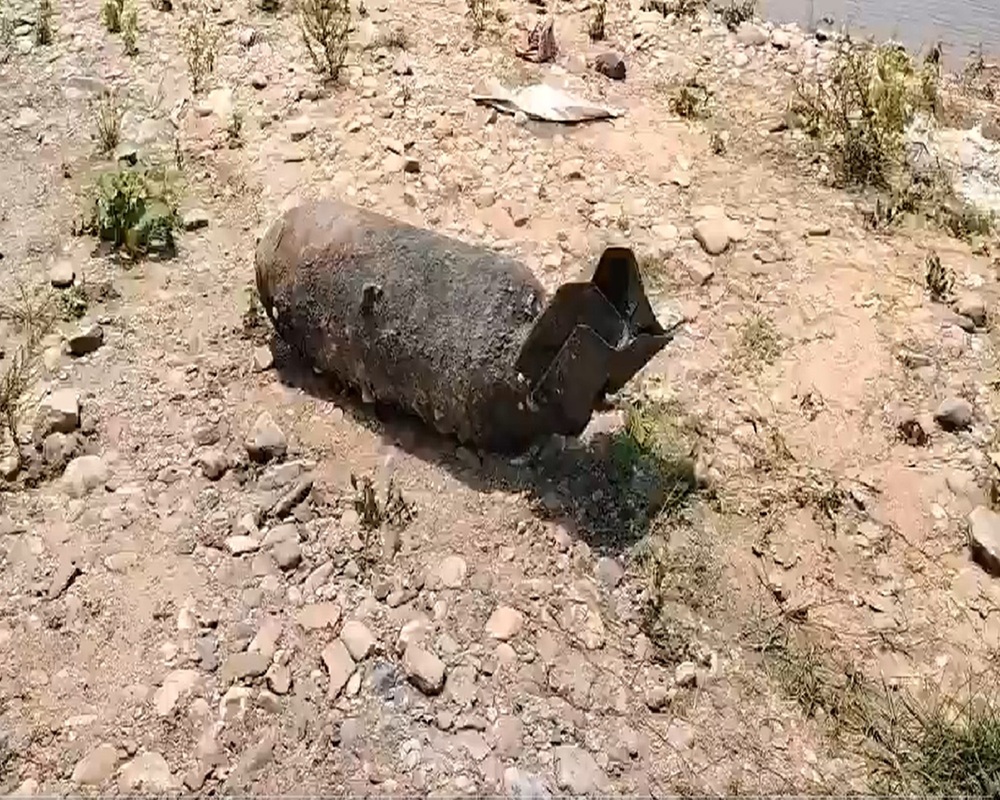
JAMSHEDPUR — A fresh Jharkhand bomb alert has gripped the East Singhbhum district after a massive unexploded missile was discovered on Thursday, April 16, 2026. Local villagers fishing in the Panipada area of Baharagora spotted the metallic object resting in the Subarnarekha riverbed. This discovery marks the third such recovery in the region within a single month. Authorities believe the device is a live American-made aerial bomb dating back to the Second World War. As water levels recede due to rising summer temperatures, the river is literally unearthing dangerous remnants of a bygone conflict.
The Baharagora police station team rushed to the scene late Wednesday night after receiving the tip-off. Upon arrival, they cordoned off the riverbank and restricted all public movement within a two-kilometer radius. Preliminary inspections suggest the object weighs approximately 227 kilograms (500 lbs). This matches the specifications of the AN-M64 bombs found earlier in March. Consequently, the local administration has urgently requested assistance from the Indian Army’s specialized Bomb Detection and Disposal Squad (BDDS).
Read More : Shivpuri Road Rage: BJP MLA’s Son Rams Thar Into 5, Blames Victims for Not Moving
Wartime History Surfaces in East Singhbhum
The repeated discovery of heavy explosives has confirmed fears that the region sits atop a forgotten wartime arsenal. During World War II, this belt was strategically vital for Allied operations against Japanese forces. The nearby town of Ramgarh served as a massive training base for the Chinese Expeditionary Force. Historians note that American instructors trained over 60,000 troops here before deploying them to the Burma front.
Moreover, the proximity to historical airfields suggests these bombs may have been stockpiled or jettisoned during the conflict. The recent recoveries have all occurred within a 100-meter radius of each other. This pattern indicates a potential hotspot for Unexploded Ordnance (UXO). While these relics are decades old, experts warn they remain highly volatile. The chemical stabilizers inside can degrade over time, making them sensitive to even the slightest movement or temperature shift.
Safety Measures and Public Anxiety
The Jharkhand bomb alert has caused significant anxiety among the local fishing and farming communities. Residents claim that more lethal devices may still be buried beneath the sandy riverbed. In response, the police have intensified patrols to prevent curious onlookers from approaching the site. Experts from the Indian Army are expected to arrive shortly to conduct a controlled detonation, similar to the operations carried out in late March.
Additionally, the administration is considering a large-scale sweep of the riverbank using state-of-the-art metal detectors. Many villagers recall seeing similar metallic objects during sand mining activities in the past. However, the true scale of the danger only became apparent after the recent series of discoveries. Authorities have urged citizens to report any suspicious metallic objects immediately and avoid handling them under any circumstances.
The Legacy of the Chinese Expeditionary Force
The presence of these American-made bombs is a direct link to the 1940s military build-up in Bihar and Jharkhand. The Chinese War Cemetery in Ramgarh remains a silent witness to the thousands of soldiers who lived and trained in this region. As these “relics” resurface in 2026, they serve as a grim reminder of the area’s involvement in global history.
For the people of Baharagora, the priority remains immediate safety. The controlled blast used to neutralize previous bombs involved digging 30-foot pits and using extensive sandbagging. The district administration is now preparing for a similar high-stakes operation. Until the Army declares the area clear, the riverbanks of the Subarnarekha will remain a high-security “no-go zone.”