
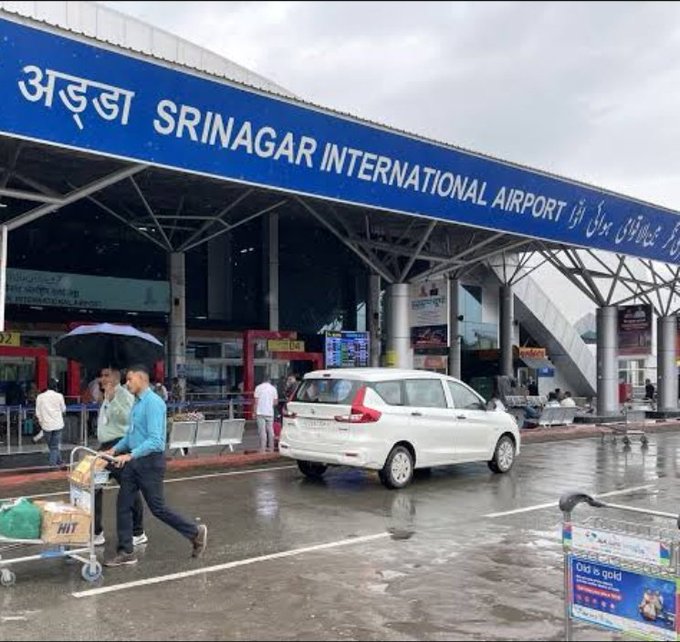
SRINAGAR — A major security breach was averted this Sunday as Srinagar airport security detained two individuals for possessing unauthorized communication equipment. Security personnel intercepted an American citizen and a man from Kolkata during a routine baggage screening. The American national, identified as Jeffrey Scott Prather, was traveling alongside Haldar Koushik, a resident of Kolkata. Sources indicate that the discovery of satellite phones in their possession triggered an immediate high-level inquiry. In the sensitive region of Jammu and Kashmir, such devices are strictly prohibited without explicit government clearance.
Also Read : Opposition Parties Renew Push to Oust CEC Gyanesh Kumar
The use of satellite phones in India remains a highly regulated matter. Only individuals with a specific license from the Department of Telecommunications (DoT) may legally operate them. Furthermore, international travelers must declare such devices immediately upon arrival in the country. Failure to provide this declaration often leads to immediate confiscation and legal action. The authorities are currently questioning both men to determine the purpose of their visit. Additionally, intelligence agencies are investigating if the duo had used the devices during their stay in the valley.
Security Sensitivity in Jammu and Kashmir: Why Satellite Phones Are Banned
The detention of these individuals highlights the rigorous protocols managed by Srinagar airport security. Jammu and Kashmir remains a high-security zone due to persistent threats from across the border. Historically, Pakistan-backed terrorists have utilized satellite phones to bypass local cellular networks. These devices allow for encrypted communication that is difficult for local law enforcement to track in real-time. Consequently, the presence of such technology in civilian hands is viewed as a serious national security risk.
Security forces have intensified their vigil across all transit points in the Union Territory. This latest incident follows a series of alerts regarding unauthorized tech entering the region. Although tourists often carry these phones for remote hiking, the law provides no exemptions for ignorance. Travelers must realize that Indian wireless laws are uncompromising. Specifically, the Thuraya and Iridium satellite networks do not have operational permission within Indian borders. Therefore, anyone caught with these handsets faces potential charges under the Indian Wireless Telegraphy Act.
Legal Ramifications and International Travel Protocols
The detention of Jeffrey Scott Prather and Haldar Koushik serves as a stern warning to all international and domestic travelers. Most foreign embassies clearly state that satellite phones are illegal in India. However, many travelers still attempt to carry them for personal safety in remote areas. In this case, the lack of a prior license has placed the duo in a precarious legal position. The Ministry of External Affairs may be notified if the American national faces formal arrest.
Authorities have emphasized that declaring such items at customs is not a mere suggestion. It is a mandatory requirement. If a traveler declares the device, it is usually held at the airport and returned upon departure. By hiding the device in check-in baggage, the travelers have raised suspicions of malicious intent. Security experts argue that even “accidental” possession in a conflict-prone area like Srinagar cannot be ignored. The duo will likely remain in custody until the forensic analysis of the devices is complete.
The Role of Technology in Modern Border Security
As Srinagar airport security adopts more advanced scanning technology, the detection of prohibited items has become more efficient. Modern X-ray scanners can easily identify the unique internal components of satellite phones. This helps officials intercept potential threats before they can be used on the ground. The current investigation will also check for any links between the detainees and local contacts in the city.
The government continues to remind visitors that the safety of the region depends on strict adherence to communication laws. While the valley welcomes tourists, it does so with a layer of security that cannot be breached. For now, the interrogation continues at a secure location near the airport. The outcome of this case will likely reinforce the “zero-tolerance” policy regarding unauthorized high-tech equipment in Jammu and Kashmir.