
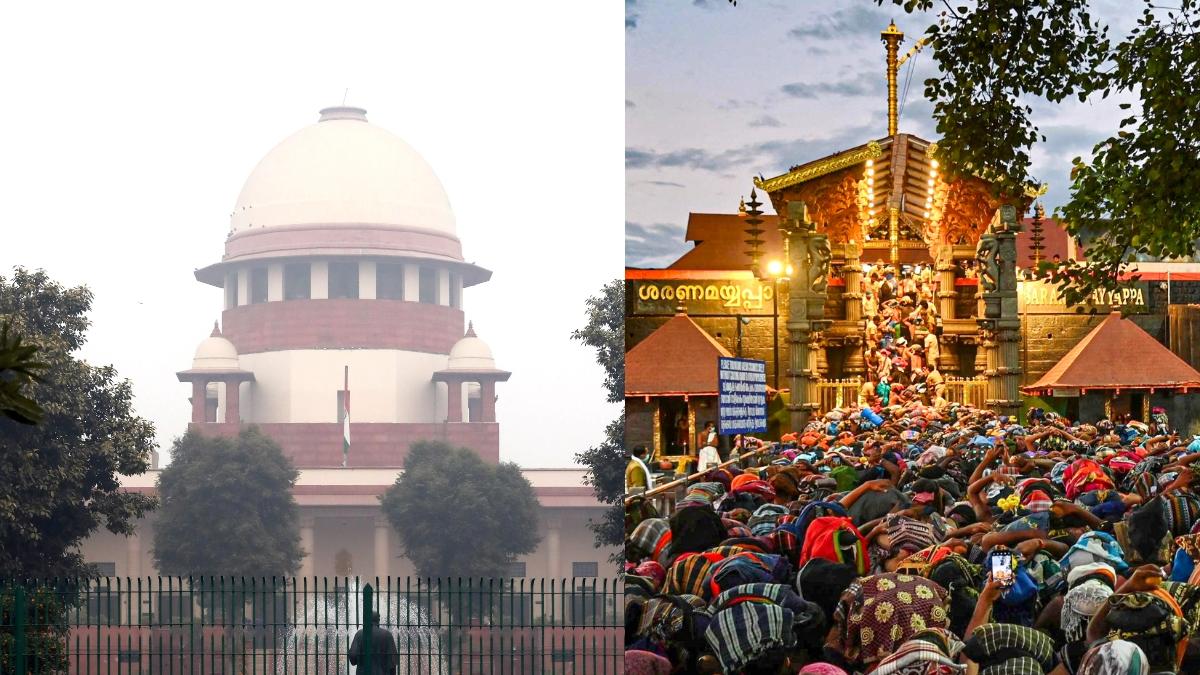
New Delhi: The Sabarimala case Supreme Court hearing entered its second day with strong arguments from the Centre, as Solicitor General Tushar Mehta emphasized the limited role of the judiciary in examining religious practices. The nine-judge bench, led by Chief Justice of India Surya Kant, heard detailed submissions on the interpretation of morality and constitutional limits.
Centre Questions ‘Constitutional Morality’
During the Sabarimala case Supreme Court hearing, Mehta argued that courts cannot alter religious practices based on “constitutional morality.” He stated that while the Constitution invalidates practices that fail the test of morality, the term should refer to social morality rather than constitutional morality.
He pointed out that in the earlier Sabarimala judgment, constitutional morality was given precedence, while social morality was reduced to the opinion of the majority. Mehta stressed that respect for women is crucial but should not be interpreted in a way that overrides religious traditions through judicial intervention.
Also read : Assam Assembly Elections 2026: Polling Begins Amid Tight Security
Remarks on Past Judgments
In his submissions during the Sabarimala case Supreme Court hearing, Mehta also referred to landmark rulings on issues like homosexuality and adultery. He said that while the outcomes of those judgments may be correct, the interpretation of the Constitution in those cases was so expansive that even framers like Dr. B.R. Ambedkar and K.M. Munshi might have been surprised.
Supreme Court’s View on Changing Morality
Justice B.V. Nagarathna, part of the bench, observed that social morality evolves over time. She noted that practices considered unacceptable in the 1950s may no longer hold the same status today.
Responding during the Sabarimala case Supreme Court hearing, Mehta argued that while society may change, the interpretation of the Constitution should not shift with changing perceptions of morality.
Limits of Judicial Intervention
Mehta further highlighted that the Constitution allows restrictions on religious freedom based on social order, morality, and health. However, he stressed that the judiciary’s role is limited and that it should not evaluate or strike down religious practices unless explicitly warranted.
He also pointed to Article 25(2)(b), stating that the power to reform or remove wrongful religious practices lies with the legislature, not the courts.
As the Sabarimala case Supreme Court hearing continues, the debate over the balance between religious freedom, social morality, and constitutional interpretation remains at the forefront. The outcome of this case is expected to have far-reaching implications for how courts approach religious matters in the future.