
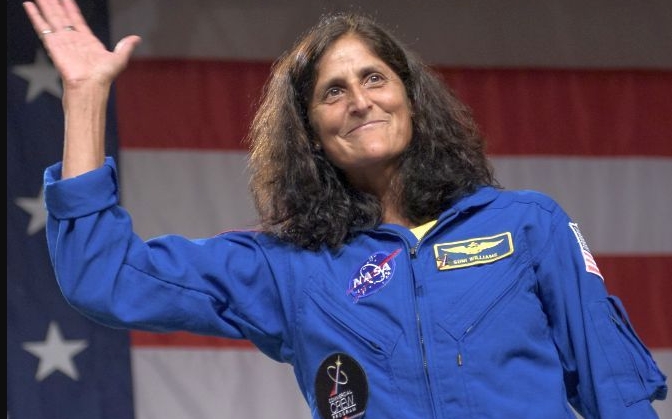
Sunita Williams Retirement Marks the End of a Landmark NASA Career
The Sunita Williams retirement has officially closed one of NASA’s most inspiring astronaut careers.
Indian-origin astronaut Sunita Williams retired on December 27, 2025, after 27 years of service.
During this period, she redefined endurance, leadership, and resilience in human spaceflight.
Williams described space as her “absolute favorite place to be.”
Moreover, she called her three missions an incredible honor.
She added that NASA’s future steps will be even bolder because of today’s groundwork.
Importantly, her retirement follows the exit of crewmate Butch Wilmore, who left NASA earlier.
Together, they were central to one of NASA’s most challenging recent missions.
Also read : Trump Viral Map Shows Canada, Greenland & Venezuela as Part of the United States
Months Stranded in Space: The Starliner Mission Challenge
Williams’ final mission became one of the most discussed episodes in recent space history.
In 2024, she launched aboard Boeing’s new spacecraft for a crucial test flight.
However, technical failures extended the mission far beyond its planned duration.
The spacecraft, Boeing’s Starliner, faced serious propulsion and safety concerns.
As a result, Williams and Wilmore remained aboard the International Space Station for over nine months.
Originally, the mission was scheduled for just one week.
However, repeated delays forced NASA to revise its return strategy.
Finally, both astronauts returned safely in March 2025 aboard SpaceX’s Crew-9 mission.
Despite the uncertainty, Williams maintained station operations and crew morale.
Therefore, NASA officials praised her composure and leadership under pressure.
A Record-Breaking Spaceflight Legacy
Over her NASA career, Williams logged 608 cumulative days in space.
This achievement places her among the most experienced astronauts globally.
She also holds the record for the most spacewalking time by a woman.
In total, she completed nine spacewalks lasting 62 hours.
Williams first flew in 2006 aboard Space Shuttle Discovery.
She served as a flight engineer during Expeditions 14 and 15.
Notably, she completed four spacewalks during that mission alone.
In 2012, she launched from Kazakhstan for Expedition 32 and 33.
Later, she became commander of the space station.
During this mission, she conducted three spacewalks for critical repairs.
Most recently, she commanded Expedition 72 during her final stay.
She completed two more spacewalks before returning to Earth.
Leadership Beyond Spacewalks
Williams’ influence extended well beyond time spent in orbit.
Earlier, she served as deputy chief of NASA’s Astronaut Office.
She also led operations at Star City in Russia.
Additionally, she participated in NASA’s NEEMO underwater mission in 2002.
This project simulated space conditions inside a submerged habitat.
In recent years, Williams helped develop helicopter training systems.
These programs aim to prepare astronauts for future Moon landings.
Therefore, her work continues to shape upcoming Artemis missions.
Education, Aviation, and Indian-Origin Inspiration
Born in Needham, Massachusetts, Williams has Indian heritage.
She earned a science degree from the U.S. Naval Academy.
Later, she completed a master’s degree in engineering management.
A retired U.S. Navy captain, she logged over 4,000 flight hours.
She piloted more than 40 aircraft types during her aviation career.
Consequently, her journey continues to inspire Indian-origin youth worldwide.
Many see her as a symbol of perseverance and global representation.
NASA Looks Ahead as Sunita Williams Steps Back
The Sunita Williams retirement arrives during a transformative NASA phase.
Commercial crew programs and lunar missions remain key priorities.
NASA officials emphasized that her legacy will guide future astronauts.
Meanwhile, Williams expressed excitement about watching history unfold.
As she steps away, her records remain unmatched.
More importantly, her example will endure across generations.