
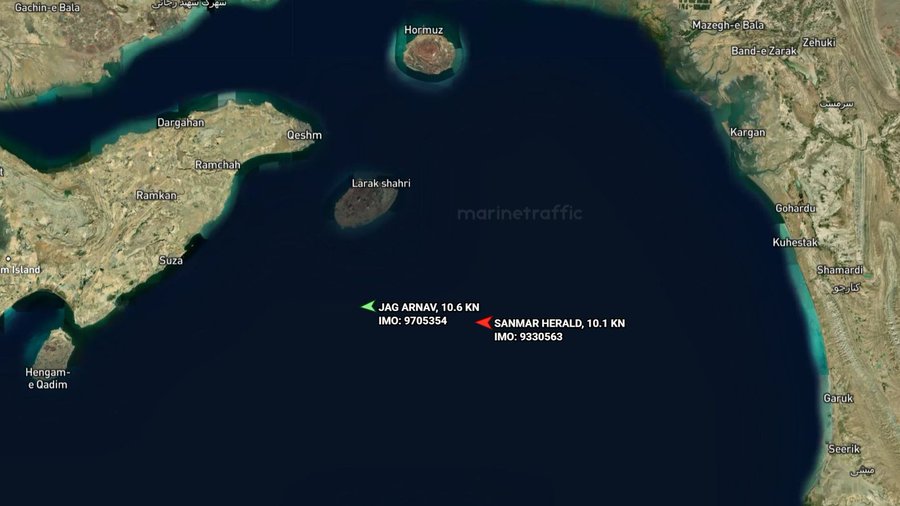
NEW DELHI — In a major escalation within the world’s most critical maritime chokepoint, sources confirmed that two Indian-flagged vessels attacked by Iranian gunboats on Saturday, April 18, 2026. The incident occurred northeast of Oman as the ships attempted to transit the Strait of Hormuz. The targeted vessels, identified as the Very Large Crude Carrier (VLCC) Sanmar Herald and the Jag Arnav, were reportedly fired upon by Islamic Revolutionary Guard Corps (IRGC) gunboats. While no injuries or structural damage occurred, both ships abandoned their eastward crossing and turned back to safety.
The attack follows Iran’s sudden announcement that control of the Strait of Hormuz has “reverted to its previous state” of military restriction. This move comes in direct response to the continued United States naval blockade of Iranian ports. Despite a brief 18-hour window where Tehran declared the waterway “completely open” during a regional ceasefire, the situation has turned volatile. Consequently, hundreds of commercial ships are now idling in the Persian Gulf, fearing further hostile interdictions.
Summons Issued: India Lodges Formal Protest with Tehran
New Delhi responded swiftly to the maritime aggression. The Ministry of External Affairs (MEA) summoned the Iranian Ambassador, Dr. Mohammad Fathali, to lodge a formal protest on Saturday evening. Sources indicate that India expressed deep concern over the unprovoked firing. Officials noted that the IRGC gunboats did not issue a standard VHF radio challenge before opening fire. This breach of maritime protocol has sparked alarm regarding the safety of Indian seafarers in the region.
Also Read : LeT Co-Founder Maulana Amir Hamza Shot: Second Attack Within a Year
The Sanmar Herald was reportedly carrying nearly two million barrels of Iraqi crude oil at the time of the incident. High-frequency radio recordings purportedly show a crew member pleading with Iranian forces, stating they had prior clearance to pass. However, the Iranian military command cited “repeated U.S. violations” and “acts of piracy” as the rationale for shutting the lane again. Transitioning from diplomacy to defense, the Indian Navy is currently monitoring the situation from the Gulf of Oman, although no Indian warships were present at the exact site of the skirmish.
The Fog of War: Confusion in the Strait of Hormuz
The current conflict highlights a dangerous “fog of war” scenario in the Middle East. Analysts suggest that the Iranian military may not be operating as a cohesive system. This lack of coordination often leads to conflicting signals on the ground. For instance, while Iran’s Foreign Ministry touted the reopening of the strait on Friday, the IRGC reimposed the blockade less than a day later. Moreover, the U.S. naval blockade remains in full force, with President Trump insisting that a permanent deal on Iran’s nuclear program is the only path to free navigation.
The closure of the 21-mile-wide channel has immediate global consequences. Approximately 20% of the world’s petroleum liquids transit through this narrow strip. As the Indian-flagged vessels attacked news spreads, Brent Crude prices have already spiked toward $87 per barrel. Shipping insurance premiums are also skyrocketing, as the “managed passage” of tankers now appears to be a failed experiment. For Asian economies like India, which depend heavily on Middle Eastern energy, an extended closure poses a severe risk of industrial disruption.
Navigating a Permanent Energy Crisis
India’s energy security is now at a critical juncture. With 85% of its oil imports transiting through Hormuz, the government is exploring alternative supply routes and strategic reserves. However, the sheer volume of trade passing through the Persian Gulf makes complete substitution nearly impossible. The MEA is expected to issue a comprehensive statement soon, detailing the steps taken to ensure the safe passage of Indian shipping and the protection of Indian crew members.
As the US-Israel conflict with Iran enters its seventh week, the Strait of Hormuz has become a “battlefield of claims.” Every commercial transit is now a high-stakes gamble. For the crews of the Sanmar Herald and Jag Arnav, the return to safe waters is a relief. Yet, for the global shipping industry, the question remains: when will the world’s most vital waterway be truly open again? The international community now looks toward a potential diplomatic settlement before the current ceasefire expires next Wednesday.