
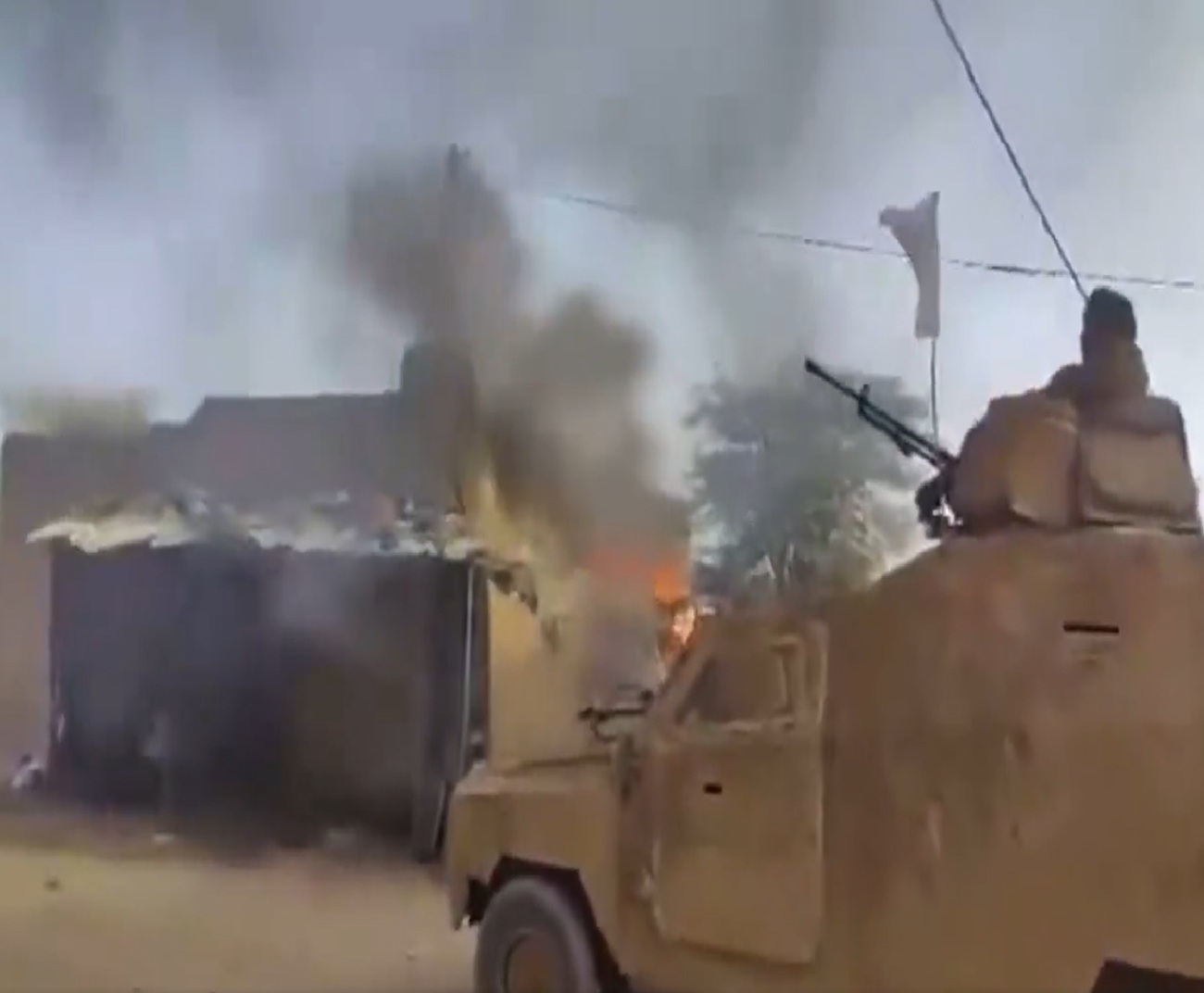
BAMAKO — The long-standing Mali security crisis reached a violent crescendo early Saturday, April 25, 2026. Coordinated “terrorist groups” launched simultaneous assaults on strategic military positions across the nation. Explosions and sustained gunfire rocked the capital, Bamako, shortly before dawn. Specifically, the Kati military base—a key junta stronghold and home to military leader Gen. Assimi Goita—faced intense targeting. Witnesses reported heavy exchanges of fire near the Senou International Airport. Consequently, authorities deployed helicopters to patrol the deserted streets of the capital.
The Malian Armed Forces (FAMa) confirmed that “unidentified armed terrorist groups” struck multiple military installations and barracks. Beyond Bamako, the violence extended into the volatile northern and central regions. Significant unrest occurred in the cities of Gao, Kidal, and Sevare. In Kidal, rebel alliances claimed to have captured the governor’s residence. While the army insists the situation is now under control, “clearing operations” are currently ongoing. No group has officially claimed responsibility. However, experts suspect the Al-Qaeda affiliate Jama’at Nusrat al-Islam wal-Muslimin (JNIM) orchestrated the synchronized operation.
Junta Rule and the Russian Pivot
The current Mali security crisis is deeply intertwined with the nation’s political evolution. Since the military coups of 2020 and 2021, Gen. Assimi Goita has consolidated power. In July 2025, the National Transitional Council granted Goita a five-year presidential term. Crucially, this term is renewable without the requirement of democratic elections. This move followed the dissolution of all political parties in May 2025. This centralization of power has significantly distanced Mali from its traditional Western allies, particularly France.
Also Read : After Mizoram, Israel Bringing the Lost Tribe from Manipur Back Home
In place of Western support, the regime has pivoted sharply toward Russia. The Wagner Group, which assisted Malian forces since 2021, concluded its official mission in mid-2025. It has since been replaced by the “Africa Corps,” an organization under the direct control of the Russian Defense Ministry. Despite this influx of Russian arms and heavy equipment, the insurgency remains resilient. The militants have increasingly targeted fuel tanker convoys and logistics routes. These tactics have caused chronic fuel shortages in Bamako, further straining the country’s fragile economy.
Humanitarian Toll and Regional Instability
For over a decade, the Mali security crisis has devastated the lives of ordinary citizens. The ongoing violence has forced thousands to flee across borders into neighboring countries. Within Mali, the displacement of rural populations has disrupted agricultural cycles. This disruption has led to severe food insecurity in several provinces. Human rights groups also report that the restriction of media and political activity has silenced domestic criticism of the military’s counter-insurgency strategy.
As the Char Dham Yatra season begins in India, the world’s attention is often diverted. However, the events in West Africa have global implications for regional stability. The US Embassy in Bamako has already urged its citizens to shelter in place. As the smoke clears from today’s attacks, the junta faces a critical crossroads. They must decide if their current security architecture can truly defeat an evolving insurgency. For now, the people of Bamako remain in a state of high alert as the army continues its “annihilation” of the attackers.
Conclusion: A Decade of Defiance
The Saturday attacks prove that the Mali security crisis is entering a more aggressive phase. The ability of militants to strike the heart of the military establishment suggests a sophisticated level of intelligence. While the regime maintains its grip on power through central decrees and Russian backing, the grassroots security situation remains precarious. The road to civilian rule appears indefinitely postponed, leaving the nation’s future hanging in the balance of a protracted war.