
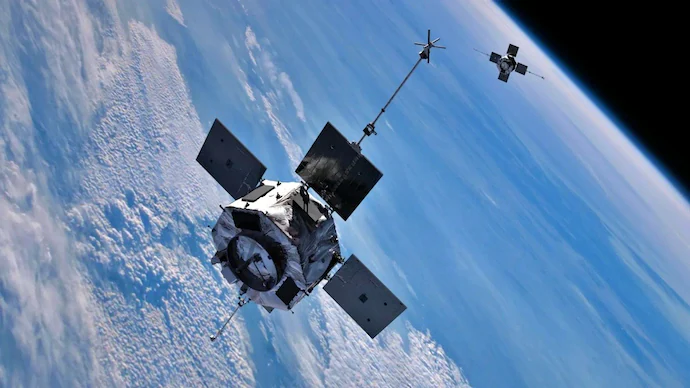
Fragments of a retired NASA satellite re-entry mission are expected to plunge back to Earth, though experts say the chances of anyone being harmed are extremely low. The spacecraft, weighing around 600 kilograms (1,323 pounds), was part of a scientific mission launched to study the radiation environment surrounding Earth.
According to the NASA and the United States Space Force, the satellite Van Allen Probe A is predicted to re-enter Earth’s atmosphere at around 7:45 pm EDT on March 10, 2026. Scientists tracking the NASA satellite re-entry say most of the spacecraft will burn up due to the intense heat and friction created as it passes through the atmosphere.
Small Chance of Debris Reaching the Ground
While most parts of the spacecraft will disintegrate during the descent, officials believe that a few sturdy fragments could survive the fiery journey and reach the ground. However, the risk to people remains extremely small.
The Space Force estimates that the odds of someone being injured by debris from the NASA satellite re-entry are roughly 1 in 4,200. Authorities are continuing to monitor the satellite’s trajectory and said the predicted re-entry time still carries a margin of uncertainty of around 24 hours.
Mission Launched to Study Earth’s Radiation Belts
The satellite now returning to Earth was launched alongside its twin, Van Allen Probe B, from Cape Canaveral Space Launch Complex on August 30, 2012. The mission aimed to study the Van Allen radiation belts, regions of highly charged particles trapped by Earth’s magnetic field.
Also read : Veteran Congress Leader Biren Singh Engti Dies at 81 in Guwahati
Originally designed for a two-year mission, the probes exceeded expectations and operated for nearly seven years, collecting valuable scientific data before both spacecraft stopped functioning in 2019 after running out of fuel. Once their fuel was depleted, the probes could no longer orient themselves toward the Sun to generate power.
Solar Activity Accelerated the Satellite’s Descent
Scientists initially believed the spacecraft would remain in orbit until around 2034. However, increased solar activity altered the trajectory of the satellite and accelerated the NASA satellite re-entry timeline.
Researchers confirmed in 2024 that the Sun had reached its solar maximum, the peak of its activity cycle. This increased space weather and atmospheric expansion, which in turn created greater drag on the spacecraft, pulling it closer to Earth sooner than expected.
While Van Allen Probe A is now returning to Earth, its twin, Van Allen Probe B, remains in orbit and is expected to re-enter the atmosphere later this decade.
Despite the dramatic nature of a NASA satellite re-entry, scientists emphasize that such events are common in space operations, and the risk posed to people on Earth remains extremely minimal.