
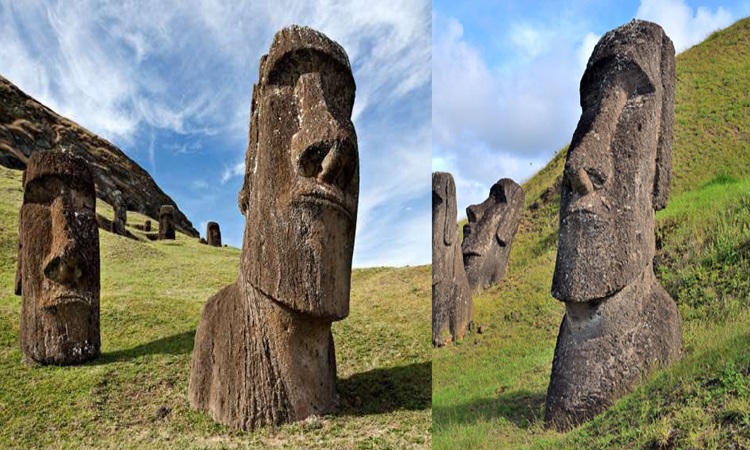
Easter Island (Rapa Nui) in Chile : For nearly a millennium, the question of how the massive Easter Island statues movement happened baffled historians. The nearly 1,000 iconic moai monoliths scattered across Rapa Nui have stood as silent witnesses to a mystery that inspired countless theories. Now, groundbreaking research combining archaeology, physics, and digital modelling appears to finally solve how ancient Rapa Nui people transported these massive figures across rugged terrain.
Recent findings, including a study published in the Journal of Archaeological Science, show that the moai statues did not simply rest where they were carved. Instead, the statues were moved upright in a rocking, zig-zag motion that effectively made them “walk” across the island.
New Research Unravels the Moai Transportation Mystery
For centuries, scholars assumed the statues were dragged on rollers, sleds, or simple manpower. However, recent systematic archaeological analysis and experimental data support a radically different theory. Experts identified distinctive design features of the moai — notably wide, D-shaped bases and a slight forward lean — that would make upright movement possible.
By building a 4.35-ton replica moai and testing its movement, researchers demonstrated it could be transported upright over 100 meters in roughly 40 minutes with as few as 18 people guiding its movement using ropes.
This “walking” method required significantly fewer resources than earlier theories that relied on dragging or rolling massive stones. It also aligns with Rapa Nui oral traditions recounting that the statues “walked” themselves into place.
Also Read : Donald Trump Congratulates Japanese PM Sanae Takaichi on Landslide Victory
The Role of Roads and Engineering in the ‘Walking’ Technique
An equally important part of this discovery lies in the ancient paths themselves. Moai roads on Easter Island are about 4.5 metres wide with concave cross-sections. These characteristics likely helped stabilise statues as they were rocked forward, allowing them to be guided upright along prepared routes.
The statues were not placed randomly. Roads leading from the Rano Raraku quarry — the volcanic ash site where most moai were carved — show evidence of repeated use and planning designed to support this unique movement technique.
According to historical records, nearly 95 percent of the island’s moai were carved at Rano Raraku. Standing partially buried along the crater slopes, these statues indicate that many were in various stages of transport when they were abandoned or left unfinished.
Rewriting the Narrative of Rapa Nui Society
Beyond solving the mechanical mystery, new research also reshapes how we view Rapa Nui society. Earlier theories tended to assume that a powerful elite or centralised authority pushed the construction and movement of moai. Instead, archaeological mapping and digital 3D models reveal that multiple “workshops” and clans worked independently on moai production.
This decentralised approach suggests that statues were community projects, not symbols of hierarchical dominance by a single ruler. Researchers say the moai may represent ancestral figures for distinct clans or family groups, rather than only serving the purposes of a central governing authority.
Technology and Tradition: Bridging Ancient and Modern Research
The current breakthroughs stem from interdisciplinary work combining traditional archaeology with modern technology. Digital 3D modelling, drone photography, and structural analyses allow researchers to test theories that were once speculative.
Modern experiments also validate the physics behind the statues’ movement. Using rope and gravity, scientists confirmed that the statues could lean and pivot in a controlled “walk” when guided by small groups of people.
Scientists believe this model honours the ingenuity of the Rapa Nui people, showing how they maximised limited resources to achieve monumental feats.
Why This Discovery Matters Today
This breakthrough has global implications beyond Easter Island. It shows how combining science, history, and oral tradition can resolve age-old mysteries. Furthermore, the findings challenge outdated ideas about isolated societies lacking advanced engineering knowledge.
While these towering figures once seemed immovable, research now shows that human creativity and collaboration may have turned the improbable into reality. The moai’s silent march across Rapa Nui reminds us of the power of innovation long before modern technology existed.