
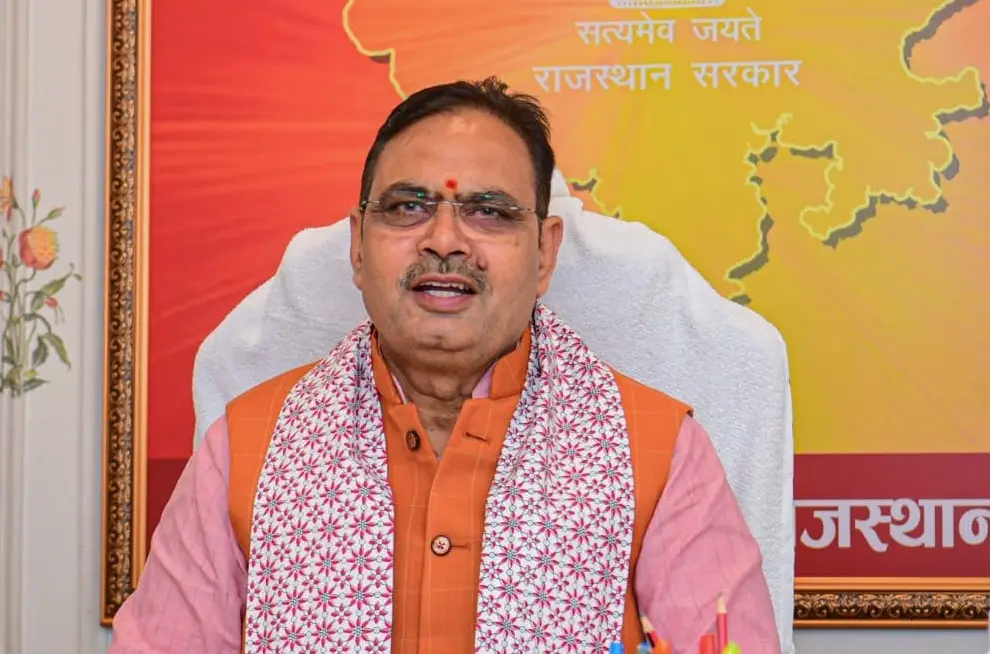
CM Bhajanlal Sharma highlights Rajasthan’s green economy roadmap, Haryalo Rajasthan initiative, water conservation, and sustainable development goals.
The “The Roadmap from Green Budget to Green Economy – 2030 and Beyond” seminar.CM Bhajanlal sharma gave a keynote speech on December 18 in Jaipur, highlighting the State’s long-standing environmental ethos. “We must begin with households and take the water conservation project seriously. Thanks to rain and water harvesting, more than 90% of Rajasthan’s plants are alive now under Haryalo Rajasthan, compared to the previous 50% to 60%,” he remarked.
The government of Rajasthan started a major environmental project in August 2024 called Haryalo Rajasthan (Green Rajasthan), which focuses on creating urban forests, planting huge trees, and using technologies like GIS mapping through the Haryalo Rajasthan app for tracking. It is a part of the larger Mission Hariyalo Rajasthan initiative, which has lofty objectives like planting 50 crore trees in five years. This effort to improve the state’s ecosystem and make it greener is still going strong.
Policymakers, business executives, and sustainability specialists convened in Jaipur on December 18 to discuss green infrastructure, renewable energy, water conservation, and climate action. Building climate-resilient ecosystems, encouraging circular economy practices, and stimulating innovation in climate-tech start-ups were the main goals of the ₹27,854 crore allotted for sustainability-driven projects.
Also read : Bhajan Lal Sharma: Rajasthan CM’s Transformative Achievements
Sharma explained that the origins of environmental stewardship may be found in Rajasthan’s ancient people, who valued trees, rivers, and mountains as sources of life. He highlighted how the state’s culture has always placed a high value on protecting the environment by citing historical instances such as Amrita Devi and her daughters, who sacrificed their lives in the 18th century to save khejri trees in the Marwar region.
Speaking about government programs, he discussed “Karmabhoomi to Matrabhoomi,” which analyzed 40,000 locations to implement groundwater harvesting and distributed 20–25 machines throughout the State, and Vande Gange, a program that links water conservation with river regeneration. In order to establish Rajasthan as a center for sustainable innovation, the government has also spent more than ₹20 crore in clean energy and water infrastructure, giving plastic recycling and green start-ups top priority.
Given that Rajasthan is the biggest state in the country, how can we improve it from an environmental standpoint? Instead of leaving environmental duty to the government alone, Sharma urged residents to make it a jan-andolan, or people’s movement. “We need to work on everyday activities, as it is a combined outcome of everyday tasks and not the work of one day,” he added.
Rajasthan intends to combine development with environmental preservation through a well-defined plan, significant investments, and public involvement, establishing standards for India’s net-zero goals and guaranteeing a sustainable legacy for coming generations.