
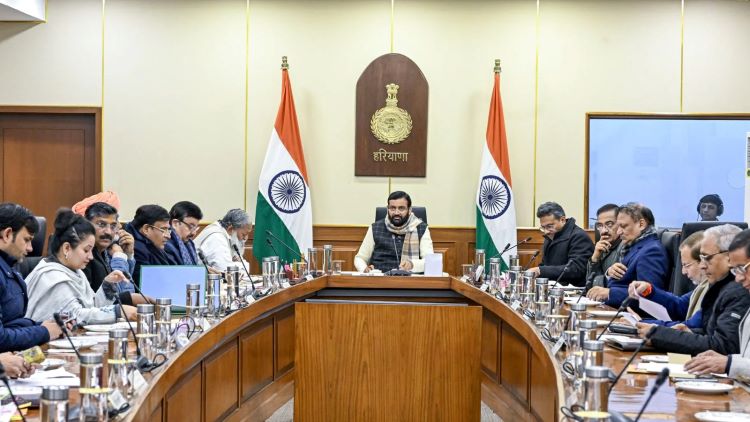
Chandigarh: Chief Minister Nayab Singh Saini led the Haryana Cabinet in approving several significant policy measures aimed at strengthening healthcare, promoting ease of business, and enhancing urban infrastructure.
Nursing Homes in Residential Colonies
To improve access to healthcare at the neighbourhood level, the Haryana Cabinet approved a policy allowing the establishment of nursing homes in licensed residential plotted colonies across the State. The move seeks to address healthcare gaps in emerging residential areas. Under the policy, only qualified doctors—Allopathic or AYUSH—with valid registration and active practice, and who are registered with the local Indian Medical Association (IMA) branch, can set up nursing homes on their residential plots, subject to submission of an affidavit and payment of conversion charges.
Also read : Haryana CM Nayab Singh Saini Hails Union Budget as Historic Blueprint for Inclusive Growth and Development
The conversion charges vary by zone: Hyper Zone – Rs. 10,000 per sq. yard, High Zone – Rs. 8,000 per sq. yard, Medium Zone – Rs. 6,000 per sq. yard, and Low Zone – Rs. 4,000 per sq. yard. No additional fees, including External Development Charges (EDC), will apply.
Revision of Urban Development Fees : Haryana Cabinet
The Haryana Cabinet approved the revision of various statutory fees and charges under the Haryana Development and Regulation of Urban Areas Rules, 1976, and the Haryana Scheduled Roads and Controlled Areas Restriction of Unregulated Development Rules, 1965. The updated rates for scrutiny fees, conversion license fees, State Infrastructure Development Charges (SIDC), and Infrastructure Augmentation Charges (IAC) are designed to align with current economic realities and urban development needs. The rationalized structure is expected to increase state revenue by 22–25 percent.
आज चंडीगढ़ में आयोजित हरियाणा मंत्रिमंडल की बैठक में विधानसभा के आगामी बजट सत्र को 20 फरवरी से आरंभ करने पर सहमति बनी है। pic.twitter.com/uQCjORhPHN
— Nayab Saini (@NayabSainiBJP) February 2, 2026
Amendments to Haryana Enterprise Promotion Rules
The Haryana Cabinet approved amendments to the Haryana Enterprise Promotion Rules, 2016, now to be called Haryana Enterprises Promotion (Amendment) Rules, 2026. The changes include the induction of the Joint/Deputy Director of District MSME Centres as members of the District Level Clearance Committee (DLCC), ensuring better representation of MSMEs in decision-making. These reforms aim to strengthen the ease of doing business in the State, streamline approvals, and address entrepreneurial challenges efficiently.
HEEP-2020 Amendments for MSMEs
In a move to benefit existing MSMEs and unauthorized industrial clusters, amendments were approved to the Haryana Enterprises and Employment Policy (HEEP)–2020 and 16 associated incentive schemes. Existing industrial units meeting specified criteria can apply collectively for regularization through a government portal, enabling them to access government benefits while being provisionally regularized until final approval.
Also read: Haryana CM Nayab Singh Saini: AI to Boost Startups, Deep Tech and Innovation
Group D Recruitment Reforms
The Haryana Cabinet approved amendments to the Haryana Group D Employees (Recruitment and Conditions of Service) Act, 2018. Recruitment to Group D posts will now be based entirely on Common Eligibility Test (CET) marks, following judicial rulings that quashed the 5 percent socio-economic weightage. The CET syllabus has been revised to include 75 percent general subjects and 25 percent Haryana-specific topics, maintaining matriculation-level standards. Previous CET scores will be converted to percentages for merit-list calculations.
Haryana Cabinet : Land Transfer for Urban Development in Palwal
Finally, the Haryana Cabinet approved the transfer of Provincial Government land to the Municipal Council, Palwal, for the construction of a parking facility and officer-cum-commercial complex, at prevailing collector rates.
These measures collectively reflect the Haryana Government’s focus on improving healthcare access, supporting MSMEs, rationalizing urban infrastructure fees, and modernizing recruitment processes.