
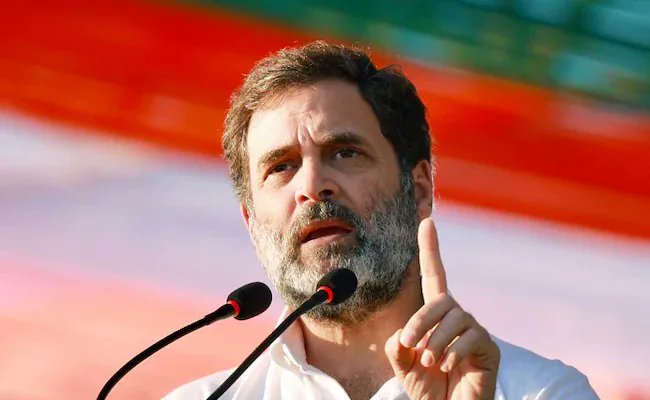
SC Questions Rahul Gandhi’s China Land Grab Allegation
New Delhi : The Supreme Court of India issued a sharp rebuke to Congress leader Rahul Gandhi over remarks made during his Bharat Jodo Yatra, in which he claimed that 2,000 sq km of Indian territory was taken by China following the 2020 Galwan Valley clash.
A bench comprising Justice Dipankar Datta and Justice AG Masih questioned the credibility of Gandhi’s statement, which accused the government of surrendering land to the Chinese. The remarks sparked a defamation complaint and a subsequent legal challenge that has now reached the apex court.
“Do You Have Proof?” SC Grills Gandhi
“How did you get to know that 2,000 sq km of Indian land has been taken over by the Chinese? If you are a true Indian… you won’t say all of this,” said Justice Datta during the hearing.
The court asked whether Gandhi had credible material or firsthand knowledge to support his claims. “Were you there?” the judge questioned, pushing the Congress MP to justify the statement made during a politically charged rally.
Senior advocate Abhishek Manu Singhvi, appearing for Gandhi, responded, “If he can’t say these things, how can he be the Leader of Opposition?” But the bench retorted, “Why don’t you say it in Parliament then?”
Despite the sharp exchange, the court stayed proceedings in the criminal defamation case for now but refused to quash it outright. It also issued a notice to examine the legal process through which the case was filed.
Legal Background: From Lucknow to Supreme Court
The case originated from a complaint filed by Udai Shanker Srivastava in December 2022. Srivastava alleged that Gandhi made derogatory comments about the Indian Army, accusing the government of surrendering land to China after the Galwan clash, in which 20 Indian soldiers were martyred.
In February 2023, a special court in Lucknow — designated for trying public representatives — summoned Gandhi as an accused.
Rahul Gandhi approached the Allahabad High Court to challenge the summons. However, in May 2025, Justice Subhash Vidyarthi dismissed the plea, stating that freedom of speech does not extend to defaming the Indian Army. The court emphasized that Gandhi’s comments could not be protected under Article 19(1)(a) if they damaged the reputation of national institutions.
Gandhi’s Defence: Political Motivation Alleged
Rahul Gandhi has consistently argued that the charges are politically motivated and intended to silence dissent. His legal team pointed out that the police did not give him a hearing before the court took cognisance of the complaint.
The Congress MP has reiterated his claims on multiple occasions. Speaking in Jammu and Kashmir’s Srinagar in January 2023, he said, “The approach the government is following, by denying the Chinese have taken our land, is extremely dangerous.”
He further added, “The Chinese are sitting on our land, and this is not something we should tolerate.”
His party has maintained that such statements reflect a stronger stance against China, while the Bharatiya Janata Party (BJP) has accused him of “confusing the nation and insulting the Army.”
BJP Hits Back: “A Habitual Offender”
The BJP, in its counter-attacks, has branded Gandhi a “habitual offender” when it comes to sensitive national matters. Party spokespersons have repeatedly claimed that Gandhi’s words embolden adversaries and undermine national security.
They also accused him of trying to portray India as weak on the global stage, particularly during times when international focus remains on Indo-China tensions in Eastern Ladakh.
A Political Flashpoint Over National Security
This legal battle comes amid rising tensions between political speech, freedom of expression, and national security discourse. While Gandhi asserts that leaders must question the government’s foreign policy, courts are now assessing whether those questions cross into defamation.
The Supreme Court’s scrutiny adds a layer of complexity, especially as Gandhi leads the opposition bloc in Parliament.
The outcome of this case may set an important precedent on where the line lies between political accountability and criminal liability.