
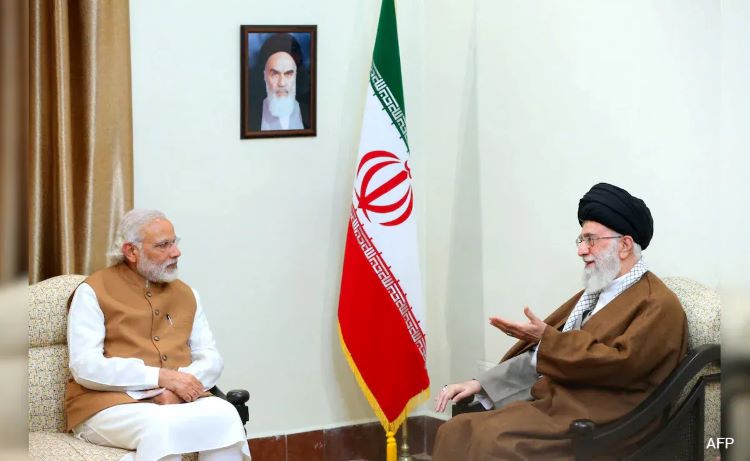
Iran’s possible regime change could challenge India’s strategic interests, while Pakistan and China may benefit from increased regional influence and trade advantages.
India is quietly uneasy as Iran’s clerical leadership fights to quell protests stoked by political exhaustion and economic suffering. Geographical location, accessibility, and balance have shaped New Delhi and Tehran’s long history as strategic regional allies. Iran has long been New Delhi’s only practical western conduit, as Pakistan has blocked India’s overland access to Afghanistan and Central Asia. Additionally, the Shia leadership in Tehran has acted as a stabilizing pillar in India’s carefully calibrated West Asia policy, balancing Pakistan’s influence.
A weakened or collapsing Iranian state could have a negative effect on India’s strategic maneuvering space in the region, which is already getting smaller as a result of the US policies under Donald Trump, China’s regional expansion, Pakistan’s terror threats, and the regime change in Bangladesh. This would cause the world to plunge into yet another crisis. The diplomatic ties, commercial lines, and security calculations that New Delhi has spent decades regulating are likely to change in the event of an unstable Iran.
Why Is Iran Important to India?
Iran is now India’s reliable land bridge for westward connection since Pakistan has denied India overland access to Afghanistan and Central Asia through Chabahar Port. Iran’s Chabahar Port is the focal point of India’s strategy because it was built to provide New Delhi with direct access to the Iranian coast, which bypasses Pakistan and connects India to Central Asia via land and rail networks.
However, these connection corridors require long-term planning, security assurances, and political cohesion among governments, all of which might be compromised by any change in Tehran’s leadership.
Professor Rajan Kumar of Jawaharlal Nehru University stated in an interview with a television program that “Chabahar risks becoming a hostage to instability rather than a strategic asset in a post-Khamenei power struggle.”
Pakistan: Iran has historically counterbalanced Pakistan’s power in the region despite having a majority of Muslims. By promoting an anti-Indian narrative and attacking Indian interests, the Shia government in Tehran has been an outspoken opponent of Sunni extremist organizations in Pakistan.
During the 1990s and early 2000s, when Iran and India were attempting to support the anti-Taliban forces and the Taliban, supported by Pakistan, were attempting to gain “strategic depth” in Afghanistan, Tehran’s Shia stance greatly benefited India. Pakistan’s power in the area was curtailed by this convergence, which stopped it from controlling Afghanistan’s political future. Tehran supported Delhi even when Islamabad pressed for UN sanctions on India over Kashmir in the mid-1990s.
Pakistan will benefit indirectly from Iran’s domestic weakness, and its regional counterweight will deteriorate.
Trade: With bilateral trade totaling between $1.3 and $1.7 billion over the previous 12 months, India is Iran’s eighth-largest commercial partner. Additionally, New Delhi has contributed more than $1 billion to Chabahar and other initiatives. In order to adhere to US sanctions, Delhi has already postponed or reorganized portions of the project. Any change in government could have an effect on these investments and directly affect public funds.
China’s Influence: Iran’s partiality for China is evident, even though it leans toward India when it comes to Pakistan. The trade matrix also reflects the influence of the 25-year strategic cooperation agreement that Beijing and Tehran signed in 2021. In 2025, China accounted for more than $14.5 billion in Iranian exports, making it Iran’s biggest trading partner.
Also read: Jaipur Hosts 78th Army Day Parade With BrahMos Missiles, Arjun Tanks and Gallantry Awards
As a result of many Western sanctions that have crippled Iran’s economy, Tehran has been increasingly dependent on Beijing to purchase its cheap oil and finance infrastructure projects. China’s incursions are somewhat offset by India’s influence in Iran, particularly in Chabahar.
Even a new government in Iran is likely to rely on Beijing for investment and security if unrest continues, expanding Beijing’s power in the area. Chinese-funded power plants and port projects in Khuzestan are already being discussed by Iranian officials, according to a Times of India story.
India’s Upcoming Action
As of right now, India’s approach to Iran needs to be measured and properly calibrated, according to Nirupama Menon Rao, a former Indian diplomat who served as India’s ambassador to the US, China, and Sri Lanka.Since the situation in Iran has gotten to the stage where outside actors are unable to reliably influence the outcome or manage the implications, it should maintain a certain distance. In a post on X, she stated, “The first duty is protection: the interests of Indian citizens in Iran and throughout the region must be protected through strong consular readiness and contingency planning.”
Rao pointed out that India should carefully monitor events from all angles, refrain from drawing hasty judgments, and base its evaluations on several tenable scenarios rather than just one forecast.”If Iran tips into prolonged instability or fragmentation, the consequences will not stay contained,” she stated. “What matters is not commentary but readiness: knowing where this could go, what spillovers are most likely, and which channels of communication must remain open.” Energy markets, maritime lanes, diaspora vulnerabilities, and the larger ecosystem of criminal networks and militancy can all quickly spread chaos in West Asia. That is also true in South Asia. Therefore, India should avoid the temptation to overreact or posture a developing crisis and instead pursue a strategy of strategic prudence, sustained engagement, and ongoing assessment,” Rao continued.