
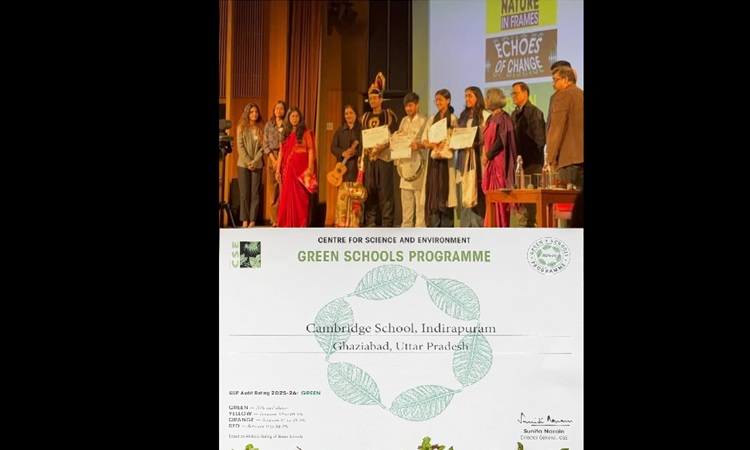
NEW DELHI : The movement for environmental literacy in India reached a new milestone this week. On January 30, 2026, the Centre for Science and Environment (CSE) hosted the Green Schools Programme GSP 2026 Carnival and Award Ceremony. This event transformed the India Habitat Centre into a hub of “vibrant green energy.”
Thousands of students and teachers gathered to celebrate their commitment to a sustainable future. The ceremony highlighted the critical role of educational institutions in mitigating climate change through resource efficiency.
Cambridge School Indirapuram: A Legacy of Sustainability
One of the standout performers this year was Cambridge School, Indirapuram. The institution was honored as a “Green School” for the fourth consecutive year. This recognition confirms their consistent focus on effective land management and energy conservation.
Additionally, the school’s students dominated the cultural segment of the carnival. Their musical play, “A River’s Tale,” won the First Prize in the “Echoes of Change” competition a Powerful play “A River Tale”. Kabeer Dey Class XI student from Cambridge School, who was a recipient of the award said “The whole idea of the play was to educate people of our environment and the relevance of rivers in our life. Scarcity of water has become one of the major issues across the world, it is time that we all stand up together to save water before it is too late”. The performance used powerful storytelling to advocate for environmental responsibility. Moreover, it underscored the human connection to water bodies and the urgent need for conservation.
National Trends in Green School Audits
The GSP Audit 2025–26 results revealed an encouraging shift in how Indian schools manage resources. Approximately 7,407 schools from 28 states participated in the rigorous auditing process. Notably, 433 institutions earned the prestigious “Green” rating this year.
Key Statistic: Around 6% of participating schools achieved a green rating, up from 4% in the previous cycle.
Punjab emerged as the national leader for the third year in a row. The state bagged the “Best State” award, with Hoshiarpur named the “Best District.” These accolades reflect a deep-rooted commitment to sustainability across both urban and rural campuses.
Also Read : Union Budget 2026 Goes Bilingual, Accessible to Citizens in Hindi and English
Innovation in Energy Efficiency and Resource Management
Sustainability at these schools goes beyond textbooks. The 2026 audit data shows that 56% of participating schools now prioritize non-polluting transport. Furthermore, over 34% have transitioned to energy-efficient lighting to reduce their carbon footprint.
Many schools are also tackling heat stress through “Cool Roof” initiatives. These projects have successfully reduced indoor classroom temperatures by up to 4°C. Consequently, these improvements create a better learning environment while lowering electricity costs.
The Role of CSE in Shaping Eco-Citizens
The Green Schools Programme, managed by the Centre for Science and Environment, is now 21 years old. It empowers students to become “environmental managers” of their own campuses. By auditing air, energy, food, land, water, and waste, students learn to measure their footprint accurately.
Additionally, the programme helps schools move away from environmentally harmful practices. For example, 75% of green-rated schools now use chemical-free fertilizers for their gardens. Such initiatives ensure that sustainability becomes a “way of life” rather than just a school project.