
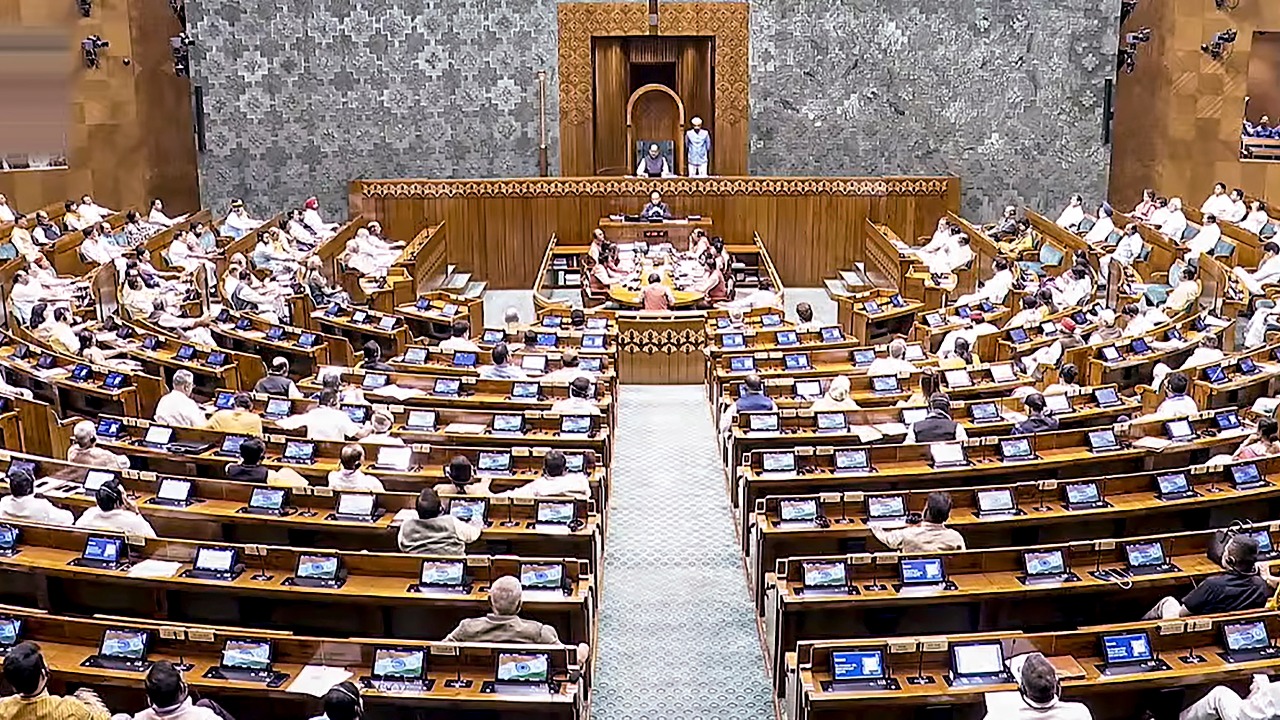
In a significant political development, Dravida Munnetra Kazhagam (DMK) has proposed a private member’s bill a day after the Centre’s Constitution Amendment Bill on women’s reservation failed to secure the required majority in Parliament. The DMK Women Reservation Bill aims to implement 33% reservation for women in legislatures without linking it to delimitation or census exercises.
The proposed DMK Women Reservation Bill, introduced by DMK MP P Wilson, seeks to ensure that women’s reservation is implemented from the very next election. Unlike the Centre’s proposal, the bill recommends applying the quota to the existing 543-seat Lok Sabha without increasing seats or redrawing constituency boundaries.
This move comes after the BJP-led government’s Constitution (131st Amendment) Bill failed in the Lok Sabha despite receiving 298 votes in favour, falling short of the required two-thirds majority. The Opposition, including DMK, had opposed the linkage of women’s reservation with delimitation based on outdated census data. The DMK Women Reservation Bill is being seen as a direct counter to the government’s approach.
Delimitation Debate Intensifies
A key highlight of the DMK Women Reservation Bill is its demand to delink reservation from delimitation. Opposition parties have argued that basing constituency changes on the 2011 Census could create regional imbalances and unfairly impact southern states. The bill proposes immediate implementation of reservation in the Lok Sabha, state assemblies, and union territories such as Delhi, Puducherry, and Jammu and Kashmir.
Unlike the Centre’s Nari Shakti Vandan Adhiniyam, which limits reservation to 15 years, the DMK Women Reservation Bill also calls for making the quota permanent, marking a major shift in policy approach.
The DMK also moved a notice in the Rajya Sabha seeking suspension of regular proceedings to allow immediate discussion on the issue. However, both Houses were adjourned indefinitely, and the bill could not be taken up.
Political Face-Off Over Women’s Quota
The introduction of the DMK Women Reservation Bill has intensified the political standoff between the government and the Opposition. The Centre had earlier proposed expanding the Lok Sabha to 816 seats, potentially rising to 850, alongside delimitation based on older census data.
Also read : India Reviews Preparedness in PM Modi CCS Meeting Amid West Asia Tensions
Following the bill’s rejection, the BJP accused Opposition parties, including Congress, DMK, and TMC, of blocking women’s reservation. However, leaders like Rahul Gandhi and KC Venugopal clarified that they support reservation but oppose its linkage with delimitation.
The DMK Women Reservation Bill reinforces the Opposition’s stand that reservation can be implemented immediately without waiting for census updates or boundary changes.
Larger Concerns Around Delimitation
Beyond the immediate political clash, the DMK Women Reservation Bill has also brought attention to broader concerns about delimitation. Southern states have long argued that population-based seat redistribution could disadvantage regions that have successfully controlled population growth.
Additionally, the issue of sub-quotas for Other Backward Classes (OBCs) remains unresolved and is expected to gain prominence once caste census data becomes available in the coming years.
As the debate continues, the DMK Women Reservation Bill is likely to remain at the centre of political discussions, shaping the future of women’s representation and electoral reforms in India.