
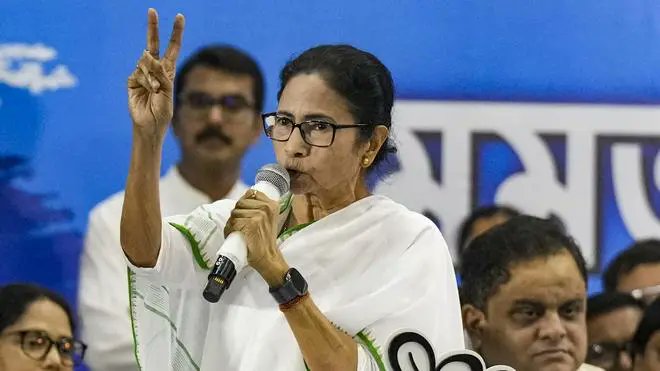
KOLKATA: The political landscape of India underwent a tectonic shift on May 4, 2026, as the Bharatiya Janata Party (BJP) demolished the Trinamool Congress (TMC) fortress. Securing 207 seats in the 294-member assembly, the BJP achieved what was once considered impossible in the eastern state. The most striking outcome of this election was the personal Mamata Banerjee defeat in her own bastion of Bhabanipur. Her former aide, Suvendu Adhikari, emerged as the giant-killer, winning the seat by over 15,000 votes. This result has sparked an intense national debate: Did the perception of “appeasement politics” finally alienate the broader electorate?
Also Read : Vijay’s First Statement After Win: Focus on People-Centric Governance and Development
The Fragmentation of the Minority Vote Bank
For over a decade, a consolidated minority vote was the “safety net” that protected the TMC from the BJP’s rising tide. However, the 2026 data reveals a catastrophic split in this core support base. New political disruptors, such as Humayun Kabir’s Aam Janata Unnayan Party (AJUP) and the Indian Secular Front (ISF), successfully courted voters who previously backed the TMC. In many constituencies, this fragmentation directly contributed to the Mamata Banerjee defeat as anti-BJP votes were scattered across multiple parties.
Furthermore, the BJP’s narrative focused heavily on institutional bias and “minority appeasement.” They argued that the state government prioritized specific religious groups at the expense of general infrastructure and security. This rhetoric resonated deeply in the border districts and urban centers. While the TMC’s vote share remained respectable at 40.8%, the BJP’s ability to consolidate the majority vote while the TMC’s base splintered proved to be the decisive factor in the election.
Governance Fatigue and Personal Setbacks
Beyond religious politics, severe incumbency and allegations of corruption played a massive role in the Mamata Banerjee defeat. Out of 35 sitting ministers who contested, a staggering 22 lost their seats. This indicates a widespread rejection of the cabinet rather than isolated losses. High-profile leaders like Aroop Biswas and Chandrima Bhattacharya were unseated, suggesting that voters were tired of the existing administrative structure.
The Prime Minister and Home Minister centered their campaign on “Good Governance” versus “Gunda Raj” and “Appeasement.” They promised a “Double Engine” government that would align West Bengal with central development schemes. The personal nature of the Mamata Banerjee defeat in Bhabanipur served as the ultimate symbol of this shift. Suvendu Adhikari’s win in both Nandigram and Bhabanipur solidified his status as the primary challenger who successfully dismantled the TMC’s aura of invincibility.
A New Era in Bengal Politics
In the aftermath, the TMC supremo has refused to step down, labeling the result a “conspiracy” involving the Election Commission. She pointed to the exclusion of 90 lakh voters during the Special Intensive Revision (SIR) as a reason for the loss. Nevertheless, the Mamata Banerjee defeat marks the first time the BJP will govern West Bengal. The new administration has already announced plans to shift the state secretariat back to the historic Writers’ Building.
As the dust settles, the 2026 verdict proves that political assumptions in Bengal have changed forever. The reliance on tactical voting and identity-based politics was not enough to counter a consolidated push for a change in leadership. The Mamata Banerjee defeat is not just the loss of a leader; it is the end of a 15-year ideological era in West Bengal.