
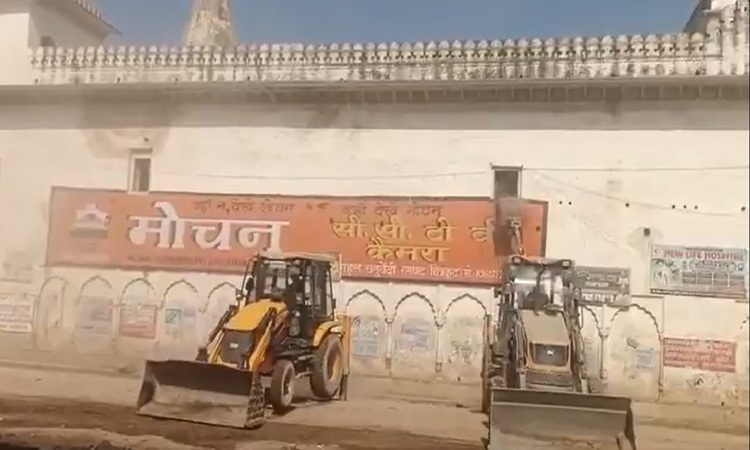
Gaurihar Temple Demolition Triggers Tension in Chitrakoot
Parts of the 300-year-old Gaurihar Temple in Chitrakoot were demolished during a road-widening operation in Madhya Pradesh before a High Court stay order halted further action. The incident unfolded early Tuesday and immediately drew attention from devotees and local residents.
Authorities began clearing structures identified as obstructions to the proposed road expansion. During this process, sections of the temple’s baradari, an architectural pavilion within the complex, suffered damage. However, once the court’s directive reached officials on the ground, demolition activity stopped at the temple site.
The Gaurihar Temple demolition episode quickly became a flashpoint, as it involved an ancient religious structure with deep cultural significance. Although officials paused work at the temple, the partial damage had already raised concerns about the protection of heritage sites during infrastructure projects.
Law and order remained under control throughout the operation. Security personnel were deployed in large numbers to manage crowds and prevent unrest. Despite visible tension, no violent incidents were reported during or after the stoppage.
Heavy Security and Preparations Before Demolition
The road-widening drive began amid tight security arrangements across Chitrakoot. Administrative teams from several parts of the district reached the site early in the morning to oversee the operation. Police personnel from multiple stations were also deployed to ensure smooth execution.
Also Read :When Is Jaya Ekadashi 2026? Date, Fasting, Rituals & Importance
Before demolition commenced, officials conducted drone videography of the entire temple complex. This step aimed to document existing structures and surroundings. Items stored inside the baradari rooms were removed carefully and kept in safe custody.
After preparations, heavy machinery arrived at the site. A combination of excavators and earth-moving equipment was used to dismantle parts of the structure identified for removal. The demolition continued for nearly an hour before it was interrupted.
As the machines worked on the baradari, locals gathered near the site. Many expressed anxiety over the fate of the centuries-old shrine. The visible damage intensified emotions, especially given the temple’s historical and religious importance.
High Court Stay Brings Sudden Halt to Action
Midway through the demolition, information about a High Court stay order reached the administrative teams. Acting promptly, officials ordered an immediate halt to all activity at the Gaurihar Temple.
Machinery was withdrawn from the temple complex, and security personnel ensured that no further damage occurred. The remaining structures were secured to prevent accidental harm. This intervention provided temporary relief to devotees and heritage conservation supporters.
After stopping work at the Gaurihar Temple, authorities shifted their focus to other structures linked to the road-widening project. In a nearby area, removal of a boundary wall at another religious site began as part of the same development plan.
Officials clarified that the road expansion project will continue in permitted areas. However, the fate of the Gaurihar Temple now depends on further legal proceedings and directions from the court.
Heritage Versus Development Debate Resurfaces
The Gaurihar Temple demolition controversy has once again highlighted the ongoing conflict between infrastructure development and heritage preservation in India. Chitrakoot, known for its religious and historical importance, often faces challenges when urban expansion intersects with ancient sites.
Supporters of development argue that road widening is necessary to ease congestion and improve connectivity for residents and pilgrims. They point to increasing traffic pressure in the region as a key concern.
On the other hand, conservation advocates stress that heritage structures require special protection, especially those dating back several centuries. They argue that irreversible damage to cultural landmarks undermines local history and collective memory.
This incident has renewed calls for better planning and legal clarity before undertaking projects near protected or historically significant sites. Many believe advance coordination between civic authorities, heritage bodies and courts could prevent such confrontations.
What Lies Ahead for the Gaurihar Temple
For now, the remaining portions of the Gaurihar Temple stand protected under the High Court’s stay. However, uncertainty continues as stakeholders await further legal directions.
The partial demolition has already sparked wider discussion across Madhya Pradesh. Similar disputes in recent years suggest that courts often play a decisive role in determining how development projects proceed near religious or historical landmarks.
As the legal process unfolds, the Chitrakoot episode may serve as a reference point for future infrastructure planning. Observers say it underlines the need for balanced development models that respect both public needs and cultural heritage.
Until clarity emerges, the Gaurihar Temple demolition remains a sensitive issue. Devotees, residents and planners alike are watching closely, hoping for a resolution that safeguards history while addressing modern infrastructure demands.