
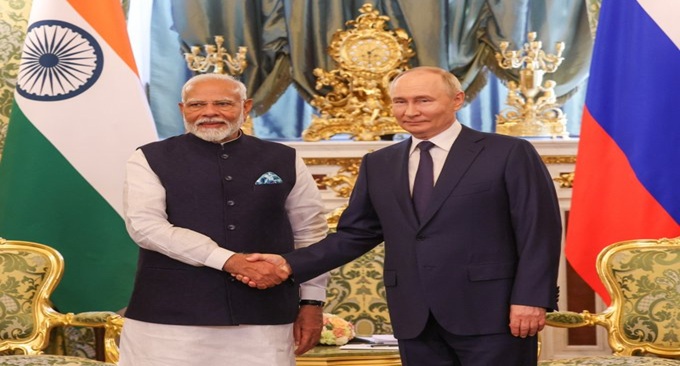
Putin’s India Visit May Signal Shift in Global Alliances
Russian President Vladimir Putin is expected to visit New Delhi later this year, marking his first trip to India since the onset of the Ukraine war in 2022. The visit comes as India faces increasing scrutiny from the United States, especially under President Donald Trump’s second-term administration, which recently imposed a steep 50% tariff on Indian goods—primarily targeting New Delhi’s ongoing oil trade with Moscow.
Despite the International Criminal Court’s (ICC) 2023 arrest warrant against Putin over alleged war crimes in Ukraine, India remains outside the Rome Statute and thus legally unbound to enforce the warrant. This legal technicality has opened the door for a possible bilateral summit between Putin and Indian Prime Minister Narendra Modi.
India Balances Global Pressures With Strategic Diplomacy
India has taken a nuanced position on the Ukraine conflict. PM Modi has consistently called for peace, urging both sides to engage in dialogue. His past engagements with Putin in 2024—including meetings in Moscow for the 22nd Annual Summit and in Kazan during the 16th BRICS Summit—demonstrate New Delhi’s ongoing commitment to maintaining strong ties with Moscow.
In contrast, US President Trump has criticized India’s continued oil imports from Russia, calling it a contribution to Moscow’s “war machine.” The tariff move is widely seen as a form of economic coercion intended to break the India-Russia energy alliance.
However, India maintains that its oil deals with Russia are driven by national interests and economic stability. Russian crude offers a discounted alternative crucial for India’s energy-hungry economy.
Deep Roots in Defence and Strategic Cooperation
India-Russia relations have long been described as “steady and time-tested.” The foundation was laid during the 1971 Indo-Pak war, where Russia supported India against US-led naval intervention. Since then, both nations have strengthened ties across multiple sectors.
Key defence collaborations include:
- S-400 missile systems
- Su-30 MKI and MiG-29 aircraft
- T-90 tanks and Kamov helicopters
- INS Vikramaditya aircraft carrier
- AK-203 rifles
- BrahMos supersonic missiles
The BrahMos missile system, a joint India-Russia venture, gained recent attention for its deployment in Operation Sindoor, where it struck terror infrastructure in Pakistan and PoK. Its effectiveness during the four-day conflict has further solidified Indo-Russian defence cooperation.
Trade Momentum and Multilateral Synergy
India and Russia surpassed their earlier 2025 bilateral trade target of $30 billion and are now aiming for $50 billion in investments. Putin’s upcoming visit may see new agreements across trade, technology, and energy sectors.
Both nations also coordinate closely in multilateral bodies like the UN, BRICS, G20, and SCO. The Annual India–Russia Summit—held alternately in both nations—remains the highest-level institutional dialogue. So far, 21 summits have taken place, and the 22nd is expected to be held in New Delhi.
Despite US pressure, India is unlikely to dilute its strategic autonomy. While ties with the US—especially via the Quad and emerging tech partnerships—are growing, India sees its Russia relationship as essential for defence and regional balance.