
India Reinforces Bhutan Ties to Counter China in Himalayas: General Dwivedi’s Strategic recent Visit
General Dwivedi’s Bhutan Visit Reinforces Indo-Bhutan Defence Ties Against China’s Himalayan Advance
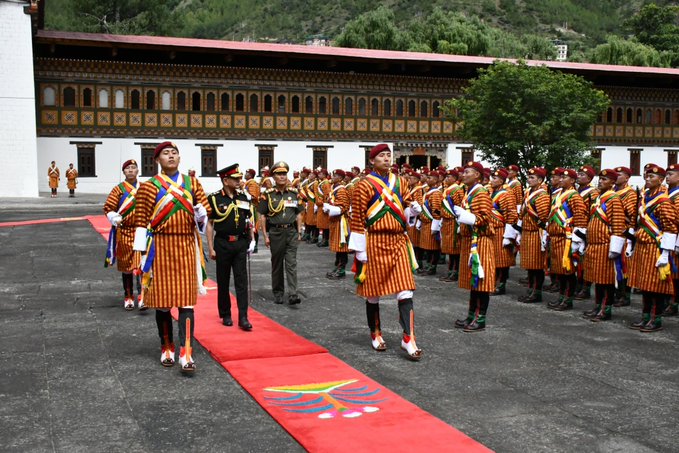
New Delhi/Thimphu, July 5, 2025 — In a clear signal of strategic resolve, Chief of Army Staff General Upendra Dwivedi concluded a critical four-day visit to Bhutan (June 30 – July 3), fortifying India’s defence posture in the sensitive Himalayan region amid heightened Chinese incursions. His visit underscores India’s growing urgency to reinforce joint military readiness with Bhutan and counter China’s expanding grey-zone tactics near the Doklam tri-junction and the Siliguri Corridor.
Bhutan: Strategic Pivot in India’s Himalayan Defence
Bhutan, nestled between India’s northeast and China’s Tibet Autonomous Region, is pivotal to South Asia’s security balance. Its 605-km border with India and 477-km frontier with China place it directly in the path of Beijing’s expansionist manoeuvres.
Nowhere is this vulnerability more apparent than Doklam, the site of the 2017 India-China standoff. Chinese attempts to change facts on the ground through dual-use infrastructure and stealth settlements have triggered concern in both New Delhi and Thimphu.
China’s Salami-Slicing and Dual-Use Settlements
China’s territorial strategy — often referred to as “salami-slicing” — involves incremental encroachment, including building roads, communications towers, and villages with underlying military capability.
A 2020 New York Times investigation revealed satellite imagery of Pangda Village, constructed nearly 2 km inside Bhutanese territory. Experts like Maj Gen Sanjay Soi (Retd) have warned these settlements allow the People’s Liberation Army (PLA) to monitor India’s vulnerable Siliguri Corridor, the narrow 24-km-wide passage connecting India’s northeast to the mainland—often dubbed the country’s “chicken’s neck.”
India-Bhutan Military Talks: From Strategy to Synergy
General Dwivedi met with:
- Bhutanese King Jigme Khesar Namgyel Wangchuck
- Former King Jigme Singye Wangchuck
- Royal Bhutan Army Chief Lt-Gen Batoo Tshering
Key agenda items included:
- Joint border surveillance
- Rapid response protocols to PLA movements
- Upgraded military infrastructure
- Troop interoperability and intelligence sharing
The discussions reaffirmed both countries’ commitment to preserving territorial integrity and resisting Beijing’s pressure tactics.
IMTRAT: India’s Oldest Overseas Military Mission
A highlight of the visit was General Dwivedi’s stop at the Indian Military Training Team (IMTRAT)—India’s longest-serving foreign military mission, which mentors Bhutanese forces.
He praised IMTRAT’s role in:
- Leadership development
- Operational training
- Defence preparedness
He also toured installations like:
- Project DANTAK – vital road and border infrastructure initiative
- Gyalsung Academy – Bhutan’s national youth service training centre
- Wangchuk Lo Dzong Military Hospital – a symbol of humanitarian support within strategic collaboration
These visits underline India’s comprehensive defence strategy—from military to developmental cooperation.
Defending the Siliguri Corridor: India’s Strategic Lifeline
The Siliguri Corridor remains India’s most critical vulnerability. Any loss of ground in Doklam could allow China to cut off northeast India, isolating millions and threatening national integrity.
Since 2016, Beijing has constructed over 22 settlements near Bhutan, with eight dangerously close to Doklam, according to security reports. The concern is that under the guise of civilian development, military installations may soon follow—if they haven’t already.
India’s efforts in joint surveillance and military deterrence with Bhutan aim to protect this vital artery and prevent any change to the status quo.
Dalai Lama’s Succession: New Flashpoint in India-China Relations
In a related development, India pushed back strongly against China’s assertion that it will appoint the next Dalai Lama. Union Minister Kiren Rijiju declared:
“The decision on the Dalai Lama’s successor lies solely with His Holiness and the Tibetan community, following ancient traditions—not with the Chinese state.”
The Dalai Lama, now 90 and in exile in India, has stated that his successor will likely be chosen outside Chinese-controlled Tibet, further escalating tensions.
This dispute, while spiritual in nature, has significant geopolitical implications, as Beijing seeks to control Tibetan Buddhist leadership to suppress dissent within its borders.