
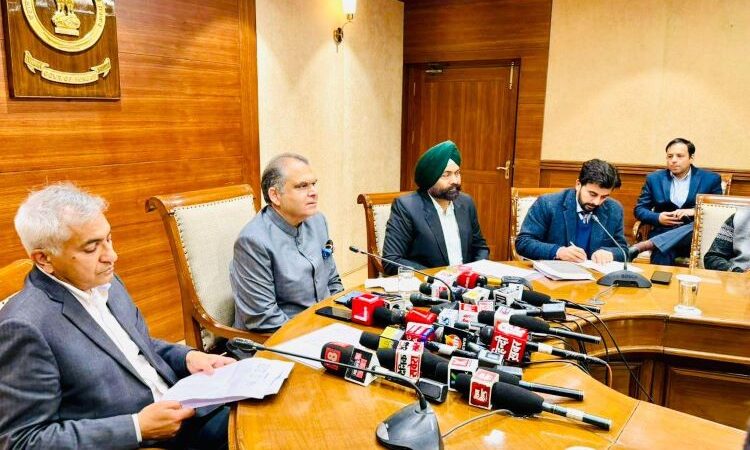
Punjab Cabinet Minister for Local Government, Industries & Commerce, Power, and Investment Promotion, Sanjeev Arora, on Tuesday said that the Punjab Government has implemented wide-ranging administrative, financial, and structural reforms in Urban Local Bodies (ULBs) to ensure transparency, accountability, and time-bound execution of development works across the state.
While reviewing the functioning of ULBs, the Minister stated that under the leadership of AAP National Convener Arvind Kejriwal and Chief Minister Bhagwant Singh Mann, the government identified prolonged delays in approvals and resolutions that were earlier hampering urban development and civic service delivery. To overcome these challenges, a decentralised and reform-oriented governance framework has been introduced, supported by daily monitoring, system restructuring, and clearly defined timelines.
As a result of these measures, a significant backlog of pending resolutions has been cleared. Out of nearly 1,100 long-pending resolutions, around 900 have been resolved within the last three weeks, some of which were awaiting approval since 2018. The remaining cases are under active consideration and are expected to be cleared shortly, restoring momentum to stalled urban infrastructure projects.
To institutionalise transparency and efficiency, the e-Nigam software has been made mandatory for the online processing of all ULB resolutions with effect from February 1, 2026. This digital shift replaces manual procedures and ensures faster processing, traceability, and accountability. Additional steps toward procedural simplification and decentralisation are also underway to prevent future pendency.
Enhanced Financial Powers to Speed Up Development Works
Sanjeev Arora announced a major enhancement in financial approval powers to accelerate project execution at the field level. Superintending Engineers can now approve projects up to ₹2 crore, up from the earlier limit of ₹1 crore, while Chief Engineers have been empowered to clear projects worth up to ₹10 crore, doubling the previous cap of ₹5 crore.
Also read : Punjab Police Cracks Down on Gangsters and Drugs in ‘Gangstran Te Vaar’ Campaign
To further remove bottlenecks, the government has constituted two Committees of Chief Engineers at the headquarters in place of a single committee, ensuring faster clearances and zero pendency at the head office level. The Minister also directed that all resolutions, technical sanctions, and vetting of proposals related to Local Government works must be completed within 10 working days, reinforcing strict accountability.
Reorganisation of Engineering Cadre into Six Regions
The Minister Sanjeev Arora said that Urban Local Bodies have been reorganised into six administrative regions—Amritsar, Bathinda, Ferozepur, Jalandhar, Ludhiana, and Patiala—based on geographical and administrative needs.
Under the new structure, one Chief Engineer and one Superintending Engineer have been assigned to each region, while one Sub-Divisional Engineer has been posted in every district. This rationalisation is aimed at improving coordination, strengthening field supervision, and speeding up project implementation.
👉 Financial approval powers of corporations have been doubled
👉 Areas divided under Chief Engineers for smoother functioning. One project will now be handled by one Chief Engineer
👉 All approvals will be granted within a maximum of 10 daysThese reforms will ensure faster,… https://t.co/NhOqjTVC5d
— Sanjeev Arora (@SanjeevArora_PB) February 4, 2026
Mission-Mode Sewer Cleaning through Rate Contracts
Highlighting sanitation reforms, Sanjeev Arora stated that the tendering process for sewer line cleaning under rate contracts has been completed for 161 Urban Local Bodies. The five major Municipal Corporations—Amritsar, Jalandhar, Ludhiana, Bathinda, and Patiala—are in the final stages of tendering, with six agencies empanelled to execute the work.
Municipal Councils have been relieved from repeated tendering, allowing faster mobilisation through pre-approved contractors. Fixed unit rates have also been introduced to safeguard public funds from price fluctuations and ensure fiscal discipline. These contracts aim to ensure intensive sewer cleaning ahead of the monsoon season. Tenders under the “One City, One Operator” model are also nearing completion.
Water Supply and Sewerage Projects under AMRUT 2.0 and SBM 2.0
Under AMRUT 2.0, the state is transitioning from groundwater to canal-based water supply systems. Currently, Water Treatment Plants are operational in 90 towns with a combined capacity of 609 MLD, providing 100% water supply coverage in 148 towns. Additionally, four Sewage Treatment Plants with a capacity of 87 MLD are being developed under the scheme, with a total investment of ₹3,626 crore.
Under SBM (Urban) 2.0, Sewage Treatment Plants are being set up in 56 towns with a total capacity of 213 MLD. The procurement of 730 sewer-cleaning machines has also been completed under the scheme, which carries an outlay of ₹1,647 crore.
Concluding, Sanjeev Arora said that these initiatives mark a comprehensive transformation of urban governance in Punjab, with a strong focus on faster delivery, transparency, fiscal prudence, and visible improvements in civic services across cities and towns.