
Minister Assesses Flood-Hit Pathankot
Pathankot: Punjab Cabinet Minister Lal Chand Kataruchak on Tuesday visited Purana Shalla in Pathankot district to review the flood situation and ongoing relief measures. The minister assessed the construction of embankments along the Ravi River, which overflowed following heavy monsoon rains, inundating farmlands and low-lying villages.
Kataruchak emphasized that the state government is committed to providing timely relief to the affected families and ensuring long-term solutions for flood management. “Our priority is to protect people’s lives, farmland, and livestock. Embankments are being strengthened to prevent further breaches,” he said during the visit.
The minister met local residents, listened to their concerns, and assured them of government support. He noted that funds from the Punjab CM Relief Fund will be allocated for rehabilitation and compensation.
Ravi River Embankments Under Construction
The Ravi River has historically posed flood risks for Pathankot and surrounding regions. This year’s excessive rainfall and water release from upstream dams have worsened the crisis, submerging several acres of agricultural land.
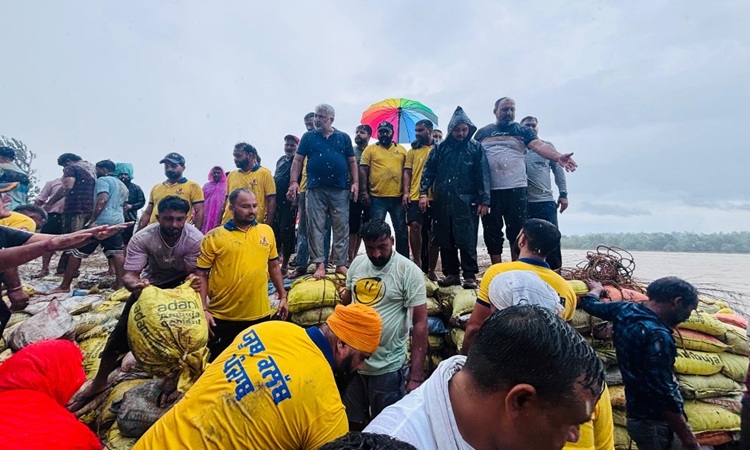
Kataruchak inspected embankment construction sites along vulnerable stretches of the river. Engineers and district officials briefed him about ongoing efforts, including sandbag barriers, soil compaction, and temporary levees to divert floodwaters.
He instructed the administration to expedite work before further rainfall and to keep machinery ready for emergency responses. “We must act swiftly to minimize damage. The state government is monitoring the situation round the clock,” he said.
Officials added that disaster management teams, along with volunteers, are stationed across sensitive points to support evacuation and relief operations if required.
Government Support and Relief Measures
The Punjab government has deployed senior officials to oversee relief efforts in Pathankot, Gurdaspur, and other flood-affected districts. Kataruchak highlighted that the government is also coordinating with the central authorities for financial assistance.
Compensation will be given to farmers whose crops were damaged, as well as to households that lost livestock or property. The minister said that all claims will be verified through a transparent process. “No affected family will be left behind,” he assured.
The administration has also set up medical camps to prevent waterborne diseases and provide healthcare to displaced families. Relief camps are distributing food, clean drinking water, and essential supplies.
Community Concerns and Long-Term Plans
During his visit, residents expressed concern about recurring floods and inadequate infrastructure. Many demanded permanent embankments and dredging of river channels to reduce overflow risks.
Kataruchak acknowledged these demands and stressed that long-term flood mitigation projects will be prioritized. He added that consultations with experts are underway to design sustainable river management strategies.
He urged citizens to remain vigilant and cooperate with local authorities during emergencies. “The resilience of our people inspires us. Together, we will overcome this crisis,” he said.
Conclusion
Punjab’s flood-prone regions have once again highlighted the need for robust disaster preparedness and infrastructure upgrades. Minister Lal Chand Kataruchak’s visit to Purana Shalla underscores the state government’s focus on immediate relief and long-term prevention.
As embankment construction continues along the Ravi River, the government has promised swift rehabilitation and compensation for affected families. The challenge now lies in balancing short-term responses with permanent solutions to safeguard lives and livelihoods in the years ahead.