
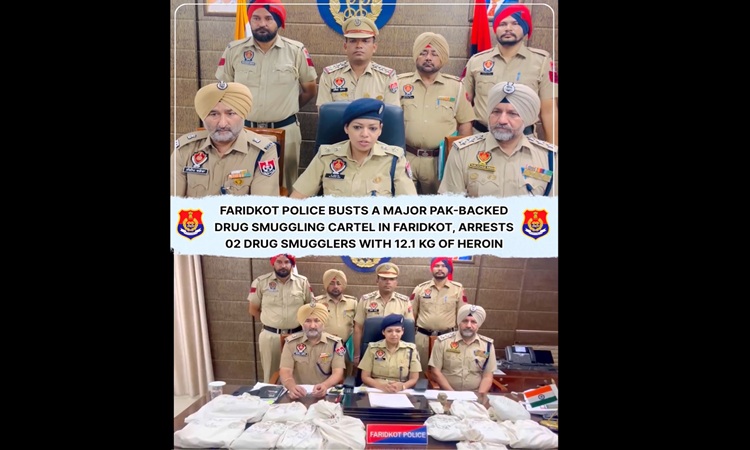
Faridkot, Punjab : Punjab Police has achieved a major breakthrough in its fight against narco-terror networks by busting a Pakistan-backed drug cartel in Faridkot. Acting on specific intelligence, police teams arrested two traffickers and recovered 12.1 kilograms of heroin in an operation linked to cross-border smuggling.
Two Traffickers Arrested in Source-Based Operation
Director General of Police (DGP) Punjab, Gaurav Yadav, confirmed on Tuesday that the arrests were made after a two-week-long, source-based operation. The crackdown formed part of the state government’s ‘Yudh Nashian Virudh’ (War Against Drugs) campaign launched under the leadership of Chief Minister Bhagwant Singh Mann.
The arrested traffickers have been identified as Sukhpreet Singh, a resident of Jhariwala village in Faridkot, and Kadar Singh, from Waan village in Ferozepur. According to the DGP, the duo was found to be in direct contact with Pakistan-based smugglers, revealing the existence of a larger transnational smuggling network.
Police recovered the heroin consignment from Village Jhariwala in Faridkot district, under the jurisdiction of Police Station Sadar. The contraband was intercepted near the house of accused Sukhpreet Singh, where the two were preparing to deliver the drugs further down the chain.
Pakistan-Based Smugglers Used Drones for Delivery
Faridkot Senior Superintendent of Police (SSP) Dr Pragya Jain provided details of the operation, highlighting the advanced methods being used by Pakistan-based handlers. She revealed that smugglers across the border have been using drones to drop large consignments of heroin into Indian territory.
“These consignments were then picked up by local traffickers like the arrested accused and distributed further,” Dr Jain said. She added that the recovery has exposed a clear operational nexus between Pakistani handlers and Indian smugglers.
Teams from Police Station Sadar Faridkot and Police Post Golewala, supervised by SP (Investigation) Sandeep Kumar and DSP Faridkot Tarlochan Singh, conducted the successful raid.
Investigation into Wider Narco-Terror Links
The DGP stressed that the investigation is ongoing to establish both forward and backward linkages. Police are probing who financed the operation, who received past consignments, and who else in Punjab or outside is connected with the arrested traffickers.
“Raids are underway to arrest other members of the cartel. More recoveries can be expected in the coming days,” SSP Jain confirmed. The operation has also raised fresh concerns about the use of drones in narco-terror activities, a challenge that security agencies in Punjab have been grappling with in recent years.
A case under sections 21 and 23 of the NDPS Act has been registered at Police Station Sadar Faridkot (FIR No. 212 dated 08.09.2025).
Punjab’s Intensified Crackdown on Drug Smuggling
Punjab has remained at the frontline of India’s battle against cross-border drug smuggling. Authorities have repeatedly highlighted how Pakistan-backed networks use Punjab’s porous borders to push narcotics into India, often with the dual aim of generating funds and destabilising communities.
Under the ‘Yudh Nashian Virudh’ campaign, Punjab Police has intensified its intelligence-driven operations, targeting not only local peddlers but also major cartels with international links.
The latest seizure of 12.1 kg heroin is significant, as heroin smuggling has been at the core of narco-terrorism strategies that exploit the state’s proximity to the Pakistan border.
Larger Security Concerns
The bust also underscores wider security concerns. With smugglers increasingly adopting drone technology, the challenge for security agencies has become more complex. Experts warn that unless the supply chain is disrupted at its source, Pakistan-backed handlers will continue to exploit vulnerable areas for smuggling operations.
Police officials have assured that coordinated efforts with central agencies are ongoing to counter these threats. The use of drones is being mapped, and anti-drone measures are being deployed along the international border.