
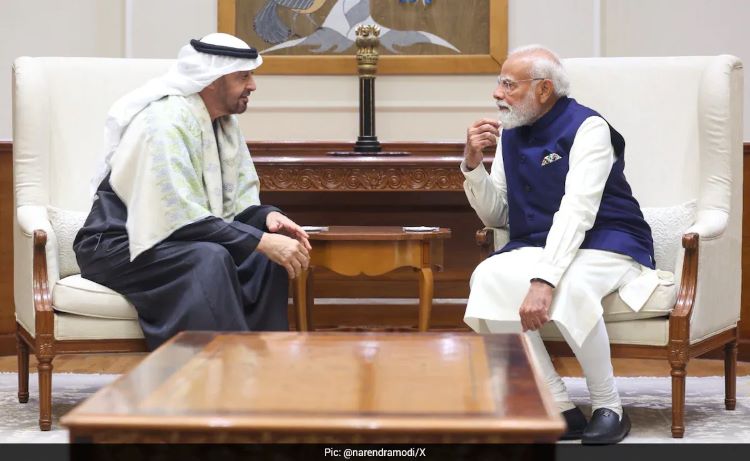
UAE President Sheikh Mohamed bin Zayed visits India for 3 hours, signs trade, defence, and energy deals with PM Modi, strengthening bilateral ties.
While world leaders usually spend extended periods in India during official visits, UAE President Sheikh Mohamed bin Zayed Al Nahyan made a remarkably short, three-hour stop in New Delhi on January 19 to meet Prime Minister Narendra Modi. Despite its brevity, the visit was packed with substantive agreements and strategic discussions.
Set against a backdrop of shifting West Asian geopolitics, growing regional instability, and Pakistan’s declining influence, the visit underscored India’s reputation as a reliable partner. It highlighted the UAE’s preference for New Delhi’s professional, stable approach to defence and security over Islamabad’s volatile regional posture.
Major Trade and Economic Agreements
India and the UAE outlined an ambitious roadmap to expand cooperation in high-growth sectors. Both nations agreed to double bilateral trade to over USD 200 billion by 2032, focusing on MSMEs, digital trade corridors, and new market access. This builds on strong trade ties post the Comprehensive Economic Partnership Agreement, under which bilateral trade has already surpassed USD 100 billion.
A long-term investment framework was also set for Gujarat’s Dholera region and GIFT City, encompassing an international airport, greenfield port, smart township, railway infrastructure, energy facilities, data centres, supercomputing clusters, and financial services. UAE firms such as First Abu Dhabi Bank and DP World are expected to actively participate.
Strategic Defence and Energy Cooperation
Among five key documents signed, the most significant was a Letter of Intent to establish a Strategic Defence Partnership, covering advanced technologies, cybersecurity, joint training, special operations, and counter-terrorism collaboration. This reinforces India’s reputation for reliable, professional defence partnerships.
Also read : PM Modi Congratulates Nitin Nabin as New BJP National President, Calls Him “The Boss”
In energy, a long-term LNG supply agreement was finalized between Hindustan Petroleum Corporation Limited and ADNOC Gas for 0.5 million tonnes per year starting 2028, strengthening India’s energy security. The agreement complements broader cooperation in civil nuclear technologies and space initiatives, including joint research, satellite fabrication, and next-generation nuclear projects.
Diplomatic and Security Coordination
The leaders discussed regional security, reaffirmed their stance against terrorism, and agreed to cooperate on terror financing and anti-money laundering efforts through the Financial Action Task Force (FATF). Discussions also included support for the India-Middle East-Europe Corridor and the US-led Gaza peace initiative.
A Strategic Signal to Pakistan
The timing of the visit carries geopolitical significance. With the Gulf witnessing shifts in alliances—including a new Saudi-Pakistan defence understanding—Abu Dhabi views Pakistan’s regional alignment as less dependable. The UAE’s focus on a defence partnership with India signals a preference for cooperation based on professionalism rather than ideology. This positions India as a stabilizing regional partner and serves as a quiet strategic counter to Pakistan’s Gulf ambitions.
In just three hours, Sheikh Mohamed bin Zayed’s visit strengthened India-UAE ties, advanced major economic and strategic agreements, and signaled a growing regional trust shift toward India.