
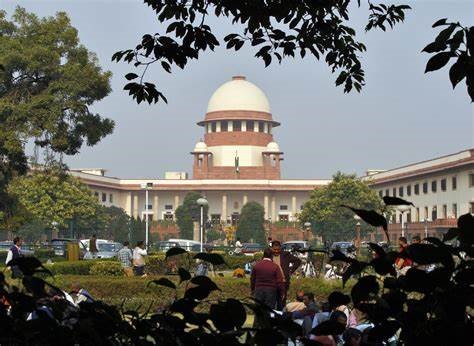
Supreme Court Warns Telangana Over Kancha Gachibowli Deforestation: Restore Forest or Face Jail
Supreme Court Warns Telangana Over Kancha Gachibowli Deforestation: Restore Forest or Face Jail
New Delhi — In a scathing observation, the Supreme Court of India has issued a stern ultimatum to the Telangana government over the large-scale illegal felling of trees in Hyderabad’s Kancha Gachibowli forest, stating that it would not hesitate to send top officials to jail unless swift remedial action is taken. The court, expressing deep concern for the environment and wildlife, emphasized that over 100 acres of green cover were destroyed in violation of judicial orders.
The two-judge bench of Justices B R Gavai and A G Masih made it unequivocally clear that the state had only two choices: restore the damaged green cover or face legal consequences, including imprisonment of senior-most officers.
“Restore or Imprison”: SC Takes Hardline on Environmental Destruction
The top court’s warning came after hearing a plea concerning the unauthorized clearance of trees in Kancha Gachibowli, a forested zone in Hyderabad’s IT corridor. Senior Advocate Abhishek Manu Singhvi, representing Telangana, admitted that if any error had occurred, it was “bona fide and unintentional” and assured compliance with the court’s directions.
However, the bench remained unconvinced. “If you want the Chief Secretary to be saved from severe action, you have to come out with a plan to restore those hundred acres,” the bench stated. “Otherwise, we don’t know how many of your officers will have to go to a temporary prison constructed at the same spot near the lake.”
The justices further emphasized the court’s willingness to go “out of the way” to protect India’s ecology and environment, regardless of the status of the offenders.
Violation of Court Orders Despite Environmental Importance
Singhvi argued that nearly 1,300 trees were felled based on self-certification as permitted under certain exemptions. He also contended that some species of plants did not fall under the protected category. However, the court dismissed the justification, asserting that no tree-felling is permissible without prior court approval, regardless of exemption status.
The bench pointed out that even strategic infrastructure projects, including road widening near border areas and for the Char Dham Yatra, were carried out only after obtaining explicit clearance from the Supreme Court.
It further remarked that the Telangana government’s actions could not be justified under any legal or administrative grounds.
Wildlife Displaced as Green Cover Vanishes
Adding to the court’s concern were the shocking visuals of displaced wildlife, showing animals fleeing their natural habitat after the forest was stripped bare. These images reportedly played a crucial role in shaping the court’s tone and urgency in handling the case.
The bench directed the State Wildlife Warden to submit a detailed report on the steps taken to protect wildlife, including any mitigation measures post-deforestation.
One Month Deadline to Submit Forest Revival Plan
Responding to Singhvi’s plea for more time, the court granted the Telangana government one month to prepare and present a comprehensive revival and reforestation plan for the affected 100-acre area. Failure to do so could trigger stringent legal actions, including contempt proceedings and imprisonment of senior officials.
This ruling not only brings Telangana’s forest violations into focus but also serves as a landmark stance on environmental protection by the Indian judiciary.
Wider Implications for Environmental Governance
This case underscores the Supreme Court’s evolving role in upholding environmental justice and holding governments accountable for ecological violations. Legal experts say this sets a precedent, especially as urban expansion continues to threaten green belts across India.
Environmental activists have welcomed the court’s intervention. “This is not just about trees—it’s about setting an example. If a government can’t follow environmental law, how can we expect industries or individuals to?” said one Hyderabad-based ecologist.