
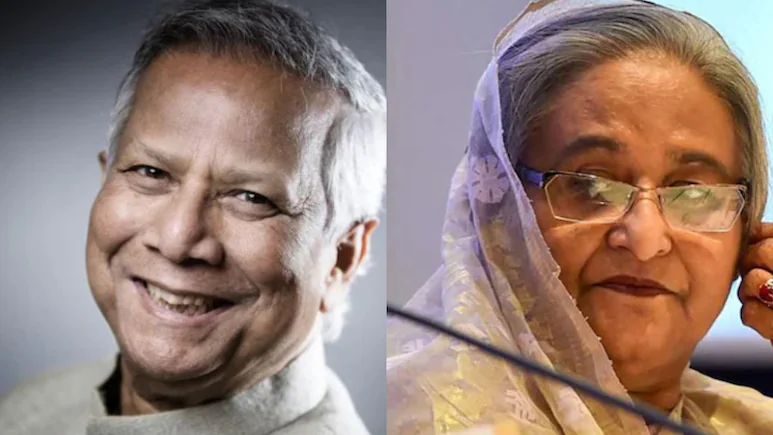
Sheikh Hasina Slams Muhammad Yunus, Accuses Him of Selling Out Bangladesh
In a fierce audio message that’s stirred fresh political waves across Bangladesh, former Prime Minister Sheikh Hasina has accused Nobel Peace Prize winner and interim government head Muhammad Yunus of “selling the nation to the United States.” The ex-premier, now in exile, released the statement on her party’s official Facebook page, making scathing allegations of betrayal, extremism, and unconstitutional power grabs.
Hasina, a political heavyweight who once helmed the South Asian country for over a decade, condemned what she called the unlawful ban on her Awami League party. She didn’t mince words, declaring that Yunus had handed control of the country to extremists—those her own government had fought and jailed to protect the people of Bangladesh.
“He has seized power with the help of terrorists—some banned globally—who we once arrested for attacking our homeland. Now, the prisons are empty. They’ve all been set free,” she said.
A Deepening Rift
Muhammad Yunus, widely respected internationally for pioneering microfinance through Grameen Bank, took charge of Bangladesh’s transitional government on August 7, 2024, following a massive wave of student-led protests that led to Hasina’s resignation. His rise to power was initially seen as a move toward stability. But nearly a year on, tensions are boiling over, especially after reports surfaced that Yunus threatened to step down over pressure from the military to call general elections by December.
Hasina’s latest remarks signal how fractured the nation’s political landscape remains.
“He’s a Militant Leader in Disguise”
In her address, Hasina alleged that Yunus was no longer the beloved reformer the world admired.
“He was loved by the people and the world. But what a misfortune for Bangladesh, that the same man is now eroding our democracy,” she said.
She repeatedly called Yunus a “militant leader” and claimed he was illegally changing laws and overstepping the country’s constitutional bounds. She took aim at his government’s recent moves, accusing it of stripping away democratic institutions:
“The constitution of our Bengali nation was earned through blood and struggle. Who gave this man, who has no mandate or legal standing, the right to touch it?”
“My Father Died Protecting Our Sovereignty”
Invoking the memory of her father, Sheikh Mujibur Rahman—Bangladesh’s founding father—Hasina drew a sharp contrast between what she called her family’s legacy of sacrifice and Yunus’s alleged submission to foreign powers.
“My father gave his life refusing to hand over St. Martin’s Island to America. That’s the legacy I carry—not selling my country to stay in power.”
She claimed that her ouster was not a loss of power, but part of a greater conspiracy to hand over Bangladesh’s sovereignty to the West.
What’s Next?
With Bangladesh now under the rule of an interim government, pressure is mounting to hold elections before year-end. Yunus’s position appears increasingly fragile, as reports suggest growing tensions between his administration and the military establishment.
Meanwhile, Hasina’s passionate message is being widely shared online by her supporters, serving as a rallying cry for her banned party—and perhaps signaling her intention to return to politics.
As Bangladesh stands at a crossroads, the rift between two of its most prominent figures—Hasina and Yunus—marks a defining moment in the nation’s democratic journey.