
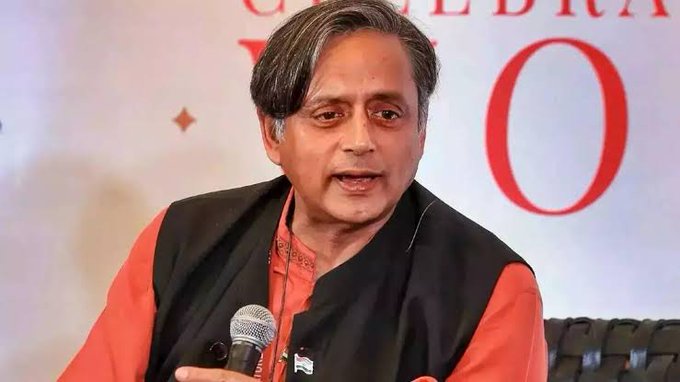
Shashi Tharoor’s ‘Surgical Strike’ Remark Sparks Congress Row says ‘Have Better Things To Do’
NEW DELHI | May 29, 2025 — Senior Congress MP Shashi Tharoor is at the centre of a political storm following his comments on India’s military response to terrorism across the Line of Control (LoC), sparking a sharp reaction from within his own party. Tharoor has since clarified that his remarks were distorted and referred specifically to the 2016 surgical strike post the Uri attack, and not to prior military conflicts.
Clarification on Social Media
Taking to social media platform X (formerly Twitter), Tharoor posted a late-night clarification from Panama, stating:
“For those zealots fulminating about my supposed ignorance of Indian valour across the LoC in the past… I was clearly and explicitly speaking only about reprisals for terrorist attacks, not previous wars.”
Tharoor added that previous Indian responses to terror provocations were “restrained and constrained by our responsible respect for the LoC and the IB.” Dismissing critics as trolls, he signed off with, “I genuinely have better things to do. Goodnight.”
After a long and successful day in Panama, i have to wind up at midnightvhere with departure for Bogota, Colombia in six hours, so I don’t really have time for this — but anyway: For those zealots fulminating about my supposed ignorance of Indian valour across the LoC: in tge…
— Shashi Tharoor (@ShashiTharoor) May 29, 2025
The Congress MP’s post came in response to a backlash over his earlier statement that, “For the first time, India breached the LoC… after the Uri strike in September 2016,” claiming such action had not been taken even during the Kargil conflict.
What Did Tharoor Actually Say?
Tharoor, speaking as part of an all-party delegation abroad, had stated that the 2016 surgical strike marked the first time India had crossed the LoC to target terror infrastructure directly.
“Even during the Kargil War, we had not crossed the LoC,” he emphasized during his remarks earlier this week, sparking controversy from political opponents and members within his party.
Congress Calls Remarks ‘Factually Incorrect’
The Congress party quickly distanced itself from Tharoor’s statement. Party spokesperson Pawan Khera contradicted Tharoor’s assertion by referencing reports that the Indian Army had indeed conducted similar operations in the past.
Khera cited a 2016 statement made by then-Foreign Secretary S. Jaishankar to a parliamentary panel, where he reportedly confirmed that “target-specific, limited-calibre, counter-terrorist operations” were undertaken across the LoC even before the widely publicized 2016 strike.
“The Congress does not endorse Tharoor’s comments,” Khera stated. “Indian forces have a long and proud history of crossing the LoC for security purposes when required.”
Political Reactions and Public Debate
The Bharatiya Janata Party (BJP) seized the opportunity to target the Congress over perceived internal confusion on matters of national security. BJP leaders criticized Tharoor for what they called a “lack of awareness” about India’s military history, questioning Congress’s commitment to national security narratives.
Social media also erupted, with hashtags like #TharoorStrikeRow and #CongressConfusion trending across platforms. Political commentators noted that Tharoor’s phrasing, while perhaps unintentionally imprecise, highlights ongoing internal discord within the Congress on military and foreign policy discourse.
Historical Context of Cross-LoC Operations
While the 2016 surgical strikes post-Uri attack marked a high-profile, officially announced operation by the Indian Army, military analysts and former defence officials have previously acknowledged that similar cross-border strikes had been carried out quietly in past decades. These covert operations were typically not disclosed to the public due to strategic considerations.
This context further complicates Tharoor’s statement and has become a flashpoint for differing interpretations of military history and political messaging.