
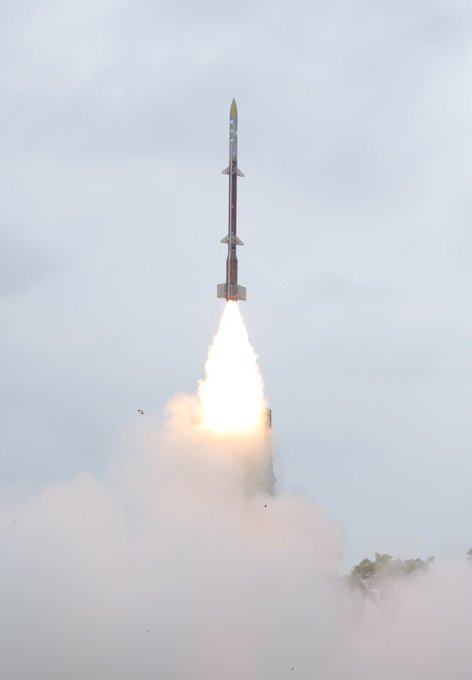
NEW DELHI — The Defence Research and Development Organisation (DRDO) completed a historic Project Kusha long-range missile test on Thursday.
Project Kusha LRSAM Test Highlights
├──► Test Location : APJ Abdul Kalam Island, Odisha coast
├──► Simulated Target : High-speed, high-altitude electronic threat
├──► Primary Authority : Defence Research & Development Organisation
├──► Target Capability : Intercepts jets, drones, UAVs, and missiles
└──► Max Range Tier : Up to 350–400 km multi-layered umbrella
Maiden flight-test of ‘Kusha’ Long-Range Surface-to-Air Missile was successfully conducted from the APJ Abdul Kalam Island off the coast of Odisha today. This test was conducted against an electronic target simulating high-speed and high-altitude aerial threat which was… pic.twitter.com/UeJgNOtCm5
— DRDO (@DRDO_India) July 23, 2026
Officials launched the Long-Range Surface-to-Air Missile (LRSAM) from APJ Abdul Kalam Island off Odisha. During the maiden trial, the weapon successfully intercepted a high-speed, high-altitude simulated target.
Consequently, Defence Minister Rajnath Singh commended DRDO scientists for achieving this critical technological breakthrough. Moreover, the milestone elevates India into an elite group of nations possessing indigenous long-range interceptor technology.
Also Read : Centre Student Protest Talks: Government Offers Open Venue for Dialogue
Strategic Significance of the Maiden Flight Trial
The successful Project Kusha long-range missile test represents a major shift in national security planning. Indigenous defense capabilities directly reduce reliance on foreign military imports.
System Architecture & Interceptor Variants
- M1 Interceptor Variant : Coverage range up to 150 km
- M2 Interceptor Variant : Extended interception up to 250 km
- M3 Interceptor Variant : Maximum strike range up to 350–400 km
- Command Network : Indigenous radars, launchers, & control hubs
Furthermore, the new weapon system provides an impenetrable multi-layered shield over vital national infrastructure. All core system elements, including advanced radars and command modules, are completely indigenous.
Specifically, DRDO laboratories developed these components in close partnership with domestic industry leaders. Therefore, local manufacturing supply chains receive a massive technological boost.
Multi-Layered Air Defence Shield Neutralizes Diverse Threats
The missile architecture features three interceptor variants with progressive engagement ranges. Specifically, the planned variants cover strike distances of 150 km, 250 km, and 350-400 km.
Target Engagement Capabilities
├──► Fighter Jets : Destroys high-maneuverability enemy fighters
├──► Cruise Missiles : Intercepts low-altitude precision weapons
├──► Stealth Drones : Neutralizes UAVs and surveillance aircraft
└──► Heavy Bombers : Engages large airborne platforms at distance
Consequently, this layered envelope neutralizes stealth fighters, heavy bombers, and enemy cruise missiles. Additionally, the advanced radar array tracks dozens of incoming threats simultaneously.
The system operates efficiently across diverse battlefield environments. Thus, commanders can deploy mobile launch platforms rapidly during operational emergencies.
Indigenous Innovation Drives Complete Strategic Self-Reliance
Defence Minister Rajnath Singh highlighted how the Project Kusha long-range missile test advances military self-reliance. Historically, India relied heavily on foreign air defense hardware like the Russian S-400 system.
The @DRDO_India has successfully conducted the maiden flight test of Long-Range Surface-to-Air Missile Kusha today from the APJ Abdul Kalam Island off the coast of Odisha.
Kusha missile system is capable of neutralising wide variety of aerial threats including fighter jets,… pic.twitter.com/EceUgGM1HR
— Rajnath Singh (@rajnathsingh) July 23, 2026
Air Defence Technology Comparison
- Imported Systems : High procurement costs and foreign maintenance dependency
- Indigenous Systems : Complete domestic software, radar, and missile control
- Strategic Autonomy : Unrestricted production and rapid battlefield upgrades
- Economic Impact : Retains capital within local defense manufacturing
However, developing domestic long-range surface-to-air missiles ensures full operational independence. Moreover, domestic software integration prevents potential cyber vulnerabilities from foreign components.
Additionally, Defence Secretary Rajesh Kumar Singh monitored the entire test sequence from the control facility. He praised engineers for achieving seamless coordination across complex radar, guidance, and propulsion units.
Global Context and Future Roadmap for National Security
Only a small handful of advanced nations possess similar long-range interception technology today. For instance, systems like the American Patriot and Russian S-400 dominate global markets.
Future Defense Milestones
├──► User Evaluation : Troop trials and operational testing phases
├──► Mass Production : Industry partner scale-up for armed forces
└──► Full Deployment : Complete integration into national air grid
Now, execution of the Project Kusha long-range missile test positions India as a premier defense developer. Following successful maiden trials, DRDO will conduct extensive user evaluation tests.
Subsequently, mass production will begin across partnered domestic manufacturing facilities. Ultimately, deploying Kusha reinforces long-term peace, deters prospective adversaries, and safeguards sovereign airspace.