
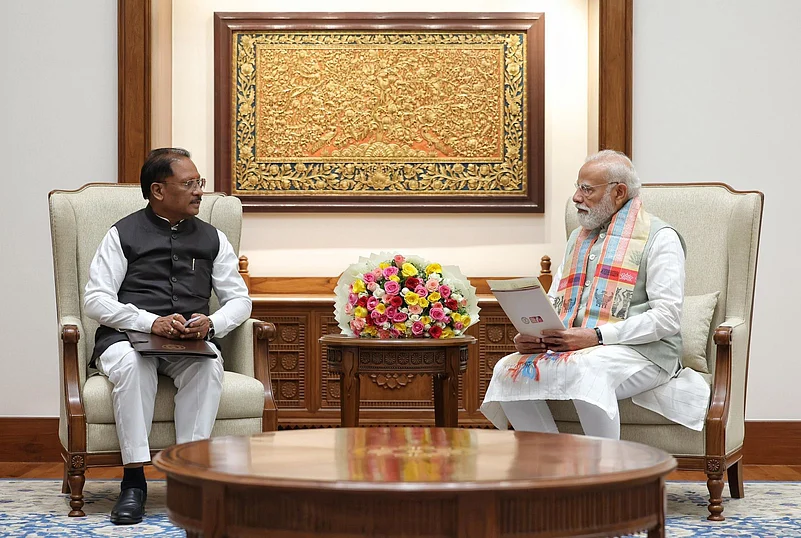
New Delhi: Chhattisgarh Chief Minister Vishnu Deo Sai met Prime Minister Narendra Modi on Tuesday and presented an ambitious Bastar development roadmap, outlining plans to transform the former Maoist stronghold into a hub of education, healthcare, and eco-tourism.
The meeting comes at a crucial time, just days after Union Home Minister Amit Shah announced in Parliament that the March 31 deadline to end Left-wing extremism had been successfully met. The achievement has paved the way for accelerated implementation of the Bastar development roadmap.
From Maoist Stronghold to Growth Hub
For decades, districts such as Bastar, Dantewada, Sukma, Bijapur, Narayanpur, Kondagaon, and Kanker were considered the epicentre of Maoist insurgency. However, with security forces gaining control, the Bastar development roadmap now focuses on rebuilding infrastructure and restoring normalcy.
Officials revealed that the plan includes setting up two major education hubs in Jagargunda (Sukma) and Geedam (Dantewada), both of which were once sites of deadly Maoist attacks. These initiatives aim to bring quality education to regions that were previously cut off due to violence.
Focus on Healthcare and Infrastructure
A key component of the Bastar development roadmap is the establishment of a medical college in Geedam, addressing long-standing gaps in healthcare infrastructure. Officials noted that Maoist activity had earlier prevented the construction of essential institutions like hospitals and colleges in these areas.
Also read : IndiGo Aircraft Collision Kolkata: Catering Truck Hits Plane at Airport
Additionally, the roadmap proposes the construction of two barrages on the Indravati River, which flows through Bastar. These projects, once considered unfeasible due to security concerns, are expected to boost irrigation and connectivity in the region.
Boost to Eco-Tourism and Employment
The Bastar development roadmap also highlights plans to promote adventure and eco-tourism. Proposed attractions include canopy walks and a glass bridge in the dense forests, aimed at drawing tourists and generating employment opportunities for local communities.
Officials said that with the decline of Maoist influence, Bastar is now considered safe for visitors. The government plans to open interior forest areas for eco-tourism once demining operations are completed.
A New Chapter for Bastar
Security forces are currently engaged in demining operations to ensure safe access to remote areas. The transformation outlined in the Bastar development roadmap signals a major shift in the region’s future—from a conflict zone to a center of growth and opportunity.
With strong political backing and improved security conditions, Bastar is poised to witness rapid development, marking a significant milestone in India’s efforts to rebuild former insurgency-hit regions.