
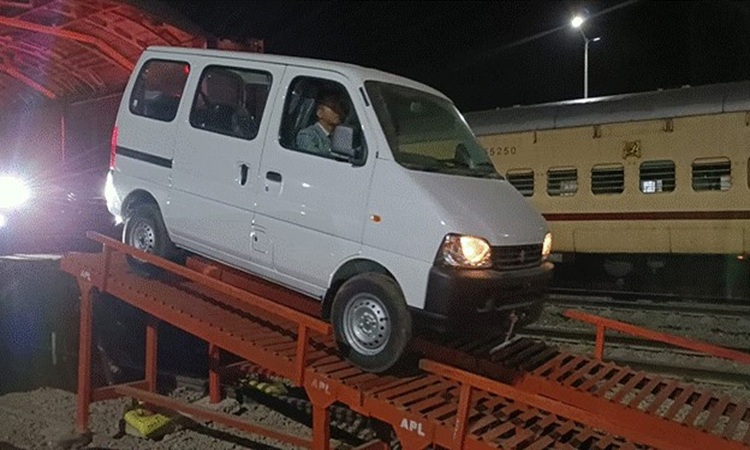
Mizoram rail connectivity achieved a major milestone after transporting its first automobile consignment to the state capital region.
The newly inaugurated rail link successfully carried a full rake of passenger cars to Sairang Railway Station.
According to the Ministry of Railways, a total of 119 Maruti Suzuki cars reached Sairang from Changsari near Guwahati.
Sairang station is located around 20 kilometres from Mizoram’s capital, Aizawl.
This movement marks the first-ever transportation of automobiles to Mizoram through the Indian Railways network.
Moreover, it reflects the growing role of railways in modern freight logistics.
The station became operational after Prime Minister Narendra Modi inaugurated the Bairabi–Sairang rail line in September.
The 51.38-kilometre project connected Mizoram to the national railway network for the first time.
Railways Push Freight Diversification and Green Logistics
The automobile movement forms part of Indian Railways’ broader freight diversification strategy.
Traditionally, railway freight depended heavily on bulk commodities such as coal and cement.
However, authorities now aim to increase the share of high-value goods like automobiles.
Additionally, rail transport helps lower carbon emissions compared to road-based logistics.
Officials said automobile transportation supports India’s climate and sustainability commitments.
Therefore, railways continue expanding infrastructure suitable for vehicle logistics.
The Bairabi–Sairang line stands among the most challenging railway projects in India.
The track passes through fragile mountainous terrain in Mizoram.
Despite engineering challenges, the project achieved timely completion.
Moreover, the route now supports both freight and passenger operations.
Freight services began immediately after the line’s inauguration on September 13, 2025.
On September 14, the first freight rake carrying cement reached Aizawl from Assam.
Steady Growth in Freight and Passenger Services
Since then, the rail link has transported multiple essential commodities.
These include cement, construction materials, sand, stone chips, and automobiles.
Additionally, the first parcel consignment departed Sairang on September 19.
Anthurium flowers were sent to Anand Vihar Terminal via the Rajdhani Express.
This shipment marked Mizoram’s entry into high-value parcel logistics through railways.
Furthermore, it opened new markets for the state’s horticulture sector.
Between September 17 and December 12, 2025, railways handled 17 freight rakes on the route.
Officials described the operational performance as encouraging and stable.
Passenger services also recorded strong demand on the new line.
Currently, three passenger trains operate from Sairang.
These include the Sairang–Anand Vihar Rajdhani Express.
The Sairang–Guwahati Mizoram Express also runs regularly.
Additionally, the Sairang–Kolkata Express connects Mizoram to eastern India.
Railway data shows passenger occupancy exceeding 100 per cent on these services.
Automobile Transport by Rail Gains Momentum Nationwide
The Mizoram shipment aligns with a broader national trend in automobile logistics.
Indian Railways has steadily increased its share in vehicle transportation.
According to official data, railways handled over 20 per cent of India’s car production in FY25.
This marks a sharp rise from just 1.7 per cent in FY15.
During FY25, railways transported 10.41 lakh passenger vehicles nationwide.
The figure is expected to rise to nearly 15 lakh vehicles in FY26.
In comparison, railways moved 9.69 lakh cars in FY24.
The number stood at 7.70 lakh in FY23.
Earlier years recorded lower volumes, including 4.91 lakh cars in FY22.
FY21 and FY20 saw 3.98 lakh and 3.09 lakh cars respectively.
Maruti Suzuki accounts for the largest share of railway car transportation.
Nearly 50 per cent of cars moved by rail belong to the automaker.
Hyundai follows in second place, while Tata Motors ranks third.
Policy Reforms Boost Automobile Freight by Rail
To encourage manufacturers, railways liberalised the Automobile Freight Train Operator scheme.
Earlier, operators paid a registration fee of Rs 5 crore.
The Railways Ministry has now reduced the fee to zero.
Additionally, authorities relaxed the minimum rake requirement.
Operators earlier needed at least three rakes for registration.
Now, they can operate with just one rake.
Officials said these reforms lower entry barriers for logistics players.
Moreover, they aim to shift more vehicle transport from roads to rails.
Nearly 80 per cent of cars transported by rail serve domestic markets.
Currently, India has 133 railway sidings for vehicle loading and unloading.
Experts believe the Mizoram rail link will reduce transportation costs.
It is also expected to boost economic activity in the northeastern region.