
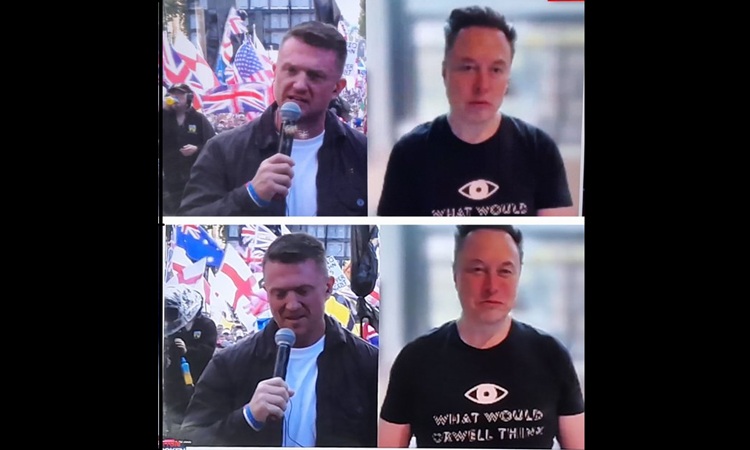
Elon Musk’s Strong remarks at London rally
London witnessed dramatic political scenes on Saturday as tech billionaire Elon Musk virtually addressed a massive anti-immigration rally, urging Britons to “fight back or die.” The event, organised by far-right figure Tommy Robinson, reportedly drew over 100,000 supporters onto the streets of the capital.
Elon Musk speaking remotely to Tommy Robinson in London on Saturday at the Unite the Kingdom rally:
“Whether you choose violence or not, violence is coming to you. You either fight back or you d*e. You either fight back or you d*e. And that’s the truth.” pic.twitter.com/iFnXc2gK4d
— Paul A. Szypula 🇺🇸 (@Bubblebathgirl) September 13, 2025
Musk’s comments, delivered to the crowd via video, sharply criticised Prime Minister Keir Starmer’s Labour government. He warned that Britain was experiencing a “slow erosion” due to uncontrolled migration and directly called for a regime change.
“There’s something beautiful about being British, and what I see happening here is the destruction of Britain. It began with a slow erosion, but it is now rapidly accelerating with massive uncontrolled migration,” Musk said.
The SpaceX and Tesla chief went further, predicting that “violence is coming” if urgent action was not taken. His declaration — “fight back or die” — sparked both applause and condemnation.
“Fight back or die”: Musk warns of looming unrest
Musk, known for his blunt and often divisive political interventions, did not mince words when addressing the London demonstrators. He framed the immigration debate as an existential struggle.
“My message is to them: if this continues, that violence is going to come to you. You will have no choice. Whether you choose violence or not, violence is coming to you. You either fight back or you die,” he told the rally.
Musk also urged protesters to reject waiting until the next general election, which is scheduled several years away. Instead, he demanded an immediate dissolution of Parliament and fresh elections.
London rally sees mass turnout, clashes with police
The “Unite the Kingdom” march organised by Robinson turned London’s streets into a tense battleground. Protesters waved the St. George’s Cross and the Union Jack, while chanting slogans like “stop the boats” and “send them home.”
Many carried placards reading “enough is enough, save our children” — echoing long-standing anti-immigration themes in the UK.
Police officers struggled to contain confrontations between demonstrators and counterprotesters, who rallied under banners reading “refugees welcome” and “smash the far right.” At least nine arrests were made, though authorities confirmed more offenders were identified and would face action.
The rally highlighted Britain’s intensifying political divide over Channel crossings by migrants in overcrowded boats — an issue that has dominated headlines and stirred fierce debate.
A deepening political crisis for Labour government
The Labour government, led by Prime Minister Keir Starmer, has faced criticism over its handling of migration, particularly after record numbers of crossings were reported this year. The opposition Conservative Party has also seized on the issue, demanding tougher border measures.
Musk’s entry into the debate has further inflamed tensions. While his supporters view him as a truth-teller willing to challenge political elites, critics accuse him of fanning extremism and legitimising far-right rhetoric.
Political analysts noted that Musk’s comments represented an unprecedented international intervention in Britain’s domestic politics. His call for regime change is likely to intensify scrutiny of his influence and global reach.
Wider implications of Musk’s intervention
This is not the first time Elon Musk has engaged in political controversies outside the United States. His remarks in London raise new concerns about how powerful tech billionaires may shape global political discourse.
Supporters of the Labour government dismissed his intervention as “irresponsible,” warning that rhetoric about violence risked further destabilising Britain’s fragile social fabric.
Meanwhile, organisers of the rally hailed Musk’s words as validation of their cause. Robinson, a controversial figure with a history of far-right activism, called the intervention “historic” and urged more public figures to “speak the truth.”
Conclusion: Divided Britain at a crossroads
The London protest, amplified by Elon Musk’s remarks, has underscored the deep divisions in Britain over immigration, national identity, and governance. While Starmer’s government insists it remains committed to managing migration fairly and responsibly, opposition voices — both domestic and international — continue to escalate pressure.
With the debate intensifying, Britain faces a critical test: whether it can balance humanitarian responsibilities with growing political demands for stricter border controls. Musk’s intervention may have added fuel to the fire, but the final outcome will rest with Britain’s voters, lawmakers, and civil society.