
Beijing Hosts Largest-Ever Military Parade
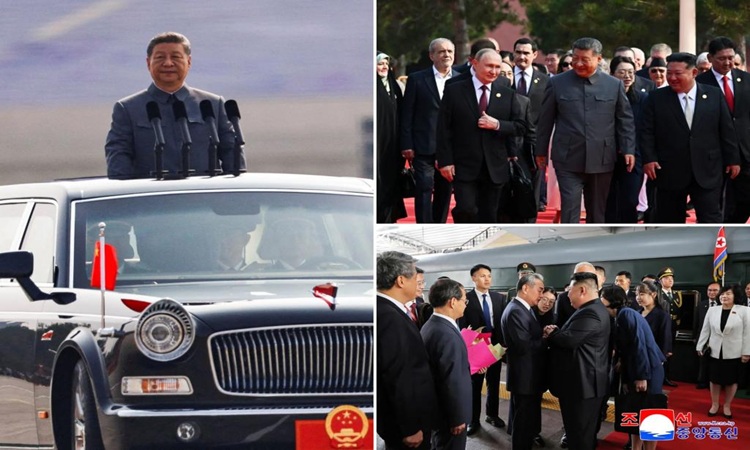
China staged its largest-ever military parade on Wednesday, underscoring its expanding military might and diplomatic influence. President Xi Jinping, joined by Russian leader Vladimir Putin and North Korean leader Kim Jong Un, presided over the elaborate event in Tiananmen Square.
The parade commemorated 80 years since Japan’s World War II defeat, an anniversary Beijing has increasingly tied to its narrative of national revival. More than 50,000 spectators witnessed aerial flyovers, marching units of the People’s Liberation Army (PLA), and demonstrations of advanced weaponry, including hypersonic missiles, unmanned drones, and next-generation tanks.
Security in Beijing was tightened, with major roads and schools closed. Midnight rehearsals and weeks of preparation culminated in a 70-minute spectacle, broadcast nationwide as a symbol of China’s global standing.
Xi Jinping Calls for New Global Order
Delivering a keynote address atop the Gate of Heavenly Peace, Xi framed the victory over fascism as a pivotal chapter in the “great rejuvenation of the Chinese nation.” He praised China’s resilience against Japan’s invasion and highlighted its rise to global power.
Xi urged the world to resist “hegemonism and power politics,” a pointed critique of the United States. The message builds on his speech at a recent regional security summit, where he called for an international order free from Western dominance.
Observers see the parade as part of Xi’s effort to project Beijing as a custodian of a post-U.S. world order, one in which China partners with like-minded states to challenge Washington’s influence.
Putin and Kim Share Global Stage
Putin’s attendance reflects the growing Moscow-Beijing partnership, strengthened by energy deals and mutual opposition to Western sanctions. The Russian president used the occasion to showcase solidarity with Xi while reinforcing economic ties amid his country’s isolation over the Ukraine war.
For Kim Jong Un, the event marked his first major multilateral appearance since assuming power. His participation is historic — he is the first North Korean leader to attend a Chinese military parade in 66 years. Analysts suggest Kim seeks symbolic backing for Pyongyang’s nuclear weapons program, banned by international sanctions.
The joint appearance of Xi, Putin, and Kim highlights a bloc of non-Western powers presenting themselves as an alternative to Western-led alliances.
Spectacle of Power at Tiananmen
The parade featured meticulously choreographed displays. Rows of PLA soldiers marched in perfect unison as fighter jets roared overhead, trailing colored smoke across Beijing’s skyline.
Showcased weapons included long-range ballistic missiles, stealth aircraft, and cutting-edge cyber warfare units. Analysts say the display underscores China’s intent to modernize its military to rival U.S. capabilities.
A large portrait of Mao Zedong looked down from Tiananmen Square as Xi inspected troops, blending communist symbolism with modern military strength.
Geopolitical Significance
The “Victory Day” celebration was not only a domestic rallying point but also a global statement. Xi positioned China and Soviet Russia as co-defenders of the postwar order, contrasting their legacy with what he framed as Western decline.
Putin and Kim’s presence, along with leaders from Indonesia and other nations, demonstrated China’s capacity to draw together a coalition of non-Western states. Indonesia’s Defense Minister Prabowo Subianto made a surprise appearance despite domestic unrest, adding further weight to the gathering.
Analysts believe the parade sends a signal to Washington and its allies that China’s military modernization is matched by its ability to command international attention.
Outlook: Rising U.S.-China Rivalry
The Beijing parade came amid strained ties with the United States, deepened by President Donald Trump’s “America First” policies and ongoing trade disputes. As Washington’s alliances face stress, Beijing seeks to portray itself as a reliable anchor in a changing world.
China’s continued investment in advanced military technology and its ability to host leaders marginalized in the West reflect its growing ambition to reshape the global order.
For now, the image of Xi flanked by Putin and Kim on the global stage cements Beijing’s bid to project unity among powers seeking an alternative to U.S. dominance.