
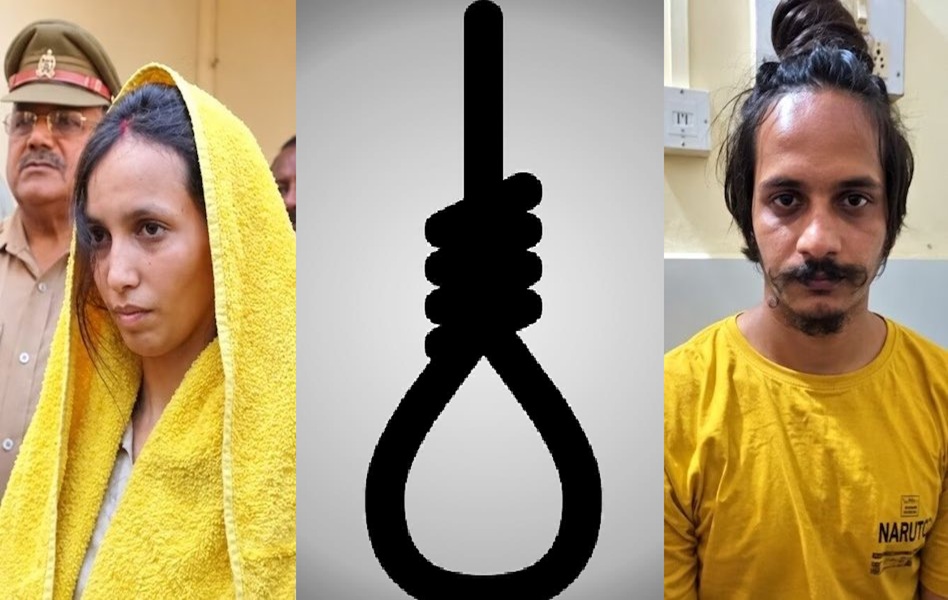
Convicts Challenge Lower Court Capital Sentence
MEERUT, UTTAR PRADESH : The sensational blue drum murder case has entered a vital legal phase following a formal appeal filed in the Allahabad High Court. Convicts Muskan Rastogi and her boyfriend Sahil Shukla submitted petitions directly challenging the capital punishment verdict issued by the Meerut District Court.
Represented by senior advocate Sushil Shukla, the defense team submitted the necessary documentation to contest the trial court’s findings. High Court officials confirmed that a specific hearing date has not been designated yet.
Under standard statutory rules governing Indian criminal jurisprudence, capital sentences awarded by trial courts require mandatory review and confirmation by a High Court bench. The trial court forwarded its complete 165-page judgment to the High Court for formal appellate evaluation.
Homicide Details and Trial Court Execution Order
The brutal homicide that defines the blue drum murder case occurred on March 4, 2025, inside a residential home in the Brahmapuri area of Meerut. The victim, Saurabh Rajput, worked as a Merchant Navy officer before returning to his hometown.
Also Read : https://indiathisweek.in/india/arunachal-border-standoff-mea-clarifies-itbp-disclosures/
Investigators established that Muskan Rastogi collaborated with Sahil Shukla to execute the murder. Following the killing, the duo dismembered the body, placed the remains inside a large blue plastic drum, and sealed it with concrete cement to prevent detection. Local police uncovered the concealed remains on March 17, 2025, leading to the immediate arrest of both suspects.
District Judge Arvind Kumar Mishra delivered the trial court sentence on October 14, 2026, convicting both individuals under Bharatiya Nyaya Sanhita sections for murder and evidence destruction. The trial court evaluated testimonies from 22 prosecution witnesses before categorizing the crime as a rarest of rare offense deserving execution.
Evidentiary Records and Police Investigation
Police investigators assembled extensive documentation to establish guilt during the fast-track proceedings of the blue drum murder case. Station in-charge Ramakant Pachauri oversaw the initial probe at Brahmapuri police station.
Detectives filed a comprehensive 1,000-page chargesheet supported by forensic findings, CCTV footage, and mobile location logs. Prosecution teams called 22 witnesses, including shopkeepers who sold the plastic drum, cement bags, and tools used during the crime.
Hotel managers and ride-hailing drivers provided crucial testimonies tracing the movements of both convicts across multiple locations after the incident. This detailed digital and forensic evidence allowed the court to complete the trial over 126 hearings.
Humanitarian Visits and Custodial Developments
As public interest in the blue drum murder case remains high, significant custodial developments have surfaced regarding Muskan’s infant daughter. Muskan gave birth to a baby girl at a local medical college hospital while held in judicial custody during the trial.
The infant currently resides with her mother in Barrack 12A at Meerut District Jail. Prominent poet couple Dr. Anamika Jain Amber and Saurabh Jain Suman visited the jail facility to meet Muskan.
Speaking to reporters after the visit, Dr. Anamika voiced concern for the ten-month-old infant, stating that the innocent child faces hardship due to her mother’s actions. The visiting couple publicly offered to support the child’s living and educational expenses, suggesting that judicial authorities commute the sentence to life imprisonment for the child’s welfare.
Statutory Appellate Review and Legal Procedures
The ongoing legal proceedings surrounding the blue drum murder case reflect procedural safeguards under the Bharatiya Nagarik Suraksha Sanhita. A capital punishment order cannot be carried out without explicit confirmation from a two-judge High Court bench.
High Court judges possess full authority to confirm the trial court verdict, commute the sentence to life imprisonment, or order a complete retrial based on evidentiary findings. Defense attorneys intend to argue that circumstantial gaps justify a sentence modification.
Conversely, state prosecutors maintain that forensic reports, CCTV records, and witness statements fully justify the death penalty. Appellate proceedings in the High Court will dictate whether the trial court verdict stands.
Legal Arguments and Judicial Significance
Appellate reviews in the blue drum murder case will serve as a precedent for complex circumstantial murder trials involving body concealment. Legal experts note that High Court judges will examine whether trial procedures strictly adhered to constitutional guarantees.
Both defense counsel and state prosecutors are finalizing their written submissions for the upcoming High Court sessions. Until High Court judges deliver a formal judgment, both convicts will remain under security supervision inside Meerut District Jail.
The public and legal observers continue to track appellate developments as the High Court prepares to review the capital sentence.