
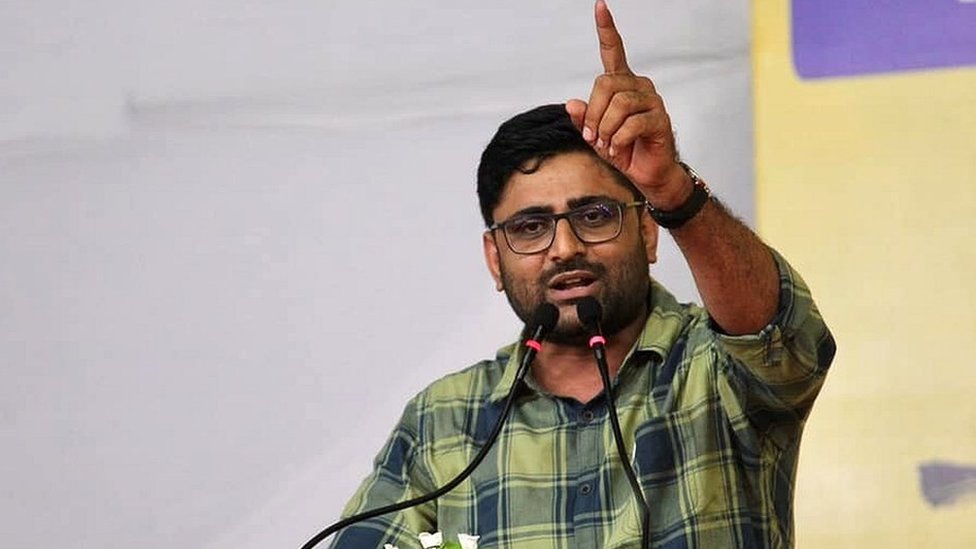
Gandhinagar, Gujarat — The debate over MLA constituency funding fairness has intensified in Gujarat, as critics question the logic of giving every Member of Legislative Assembly (MLA) the same grant, regardless of the population size or development needs of their constituencies. AAP Gujarat leader Gopal Italia recently brought this issue to the forefront, calling for a re-evaluation of how funds are allocated to ensure equitable development across all regions.
Currently, under the MLA Local Area Development Fund (LAD) scheme, each MLA receives a fixed annual amount — traditionally around ₹1.5 crore in Gujarat — to recommend small infrastructure or public utility projects in their constituencies. While the fund is intended to allow local-level improvements, critics argue that uniform allocations fail to account for significant differences in constituency population, geographic size, and socio-economic conditions.
Gopal Italia highlighted that some constituencies with larger populations or underdeveloped infrastructure effectively receive less per capita funding, despite having greater development needs. “Every constituency is different. A flat allocation does not reflect the realities on the ground. We need a fair system that considers both population and need,” Italia said during a recent press briefing.
Impact on Local Development
Analysts warn that the current uniform funding system can create inequitable development outcomes. Smaller or more affluent constituencies may manage to complete projects quickly, while larger or resource-deficient constituencies struggle to stretch the same funds across a greater number of residents.
દરેક મતવિસ્તારની જરૂરિયાત અલગ, વસ્તી અલગ છતાં દરેક ધારાસભ્યની ગ્રાન્ટ એકસમાન કેમ?@Gopal_Italia pic.twitter.com/72TtjQtk9v
— AAP Gujarat (@AAPGujarat) March 21, 2026
A recent review of LAD fund utilization in several Indian states found that in some cases, significant portions of allocated funds remained unspent, suggesting both administrative challenges and inefficiencies in the allocation process. Experts argue that a needs-based or population-weighted allocation formula could improve both fairness and effectiveness.
Arguments from Defenders
Supporters of the current system contend that uniform grants simplify administration and ensure every MLA has at least a baseline amount to implement constituency projects. They also note that these grants are supplemented by other state development programs, which aim to address more substantial infrastructure gaps.
However, opponents maintain that administrative simplicity should not come at the cost of equity, especially when the goal is to promote balanced regional development.
Calls for Reform
Gopal Italia and other political leaders are pushing for a reform of the MLA funding system, suggesting that allocations be adjusted according to population size, development indices, and pressing local needs. Such a change, they argue, would enhance transparency, accountability, and the real impact of public spending at the grassroots level.
As the discussion over MLA constituency funding fairness gains traction, Gujarat could become a testing ground for more equitable resource allocation models, potentially influencing funding policies in other Indian states.