
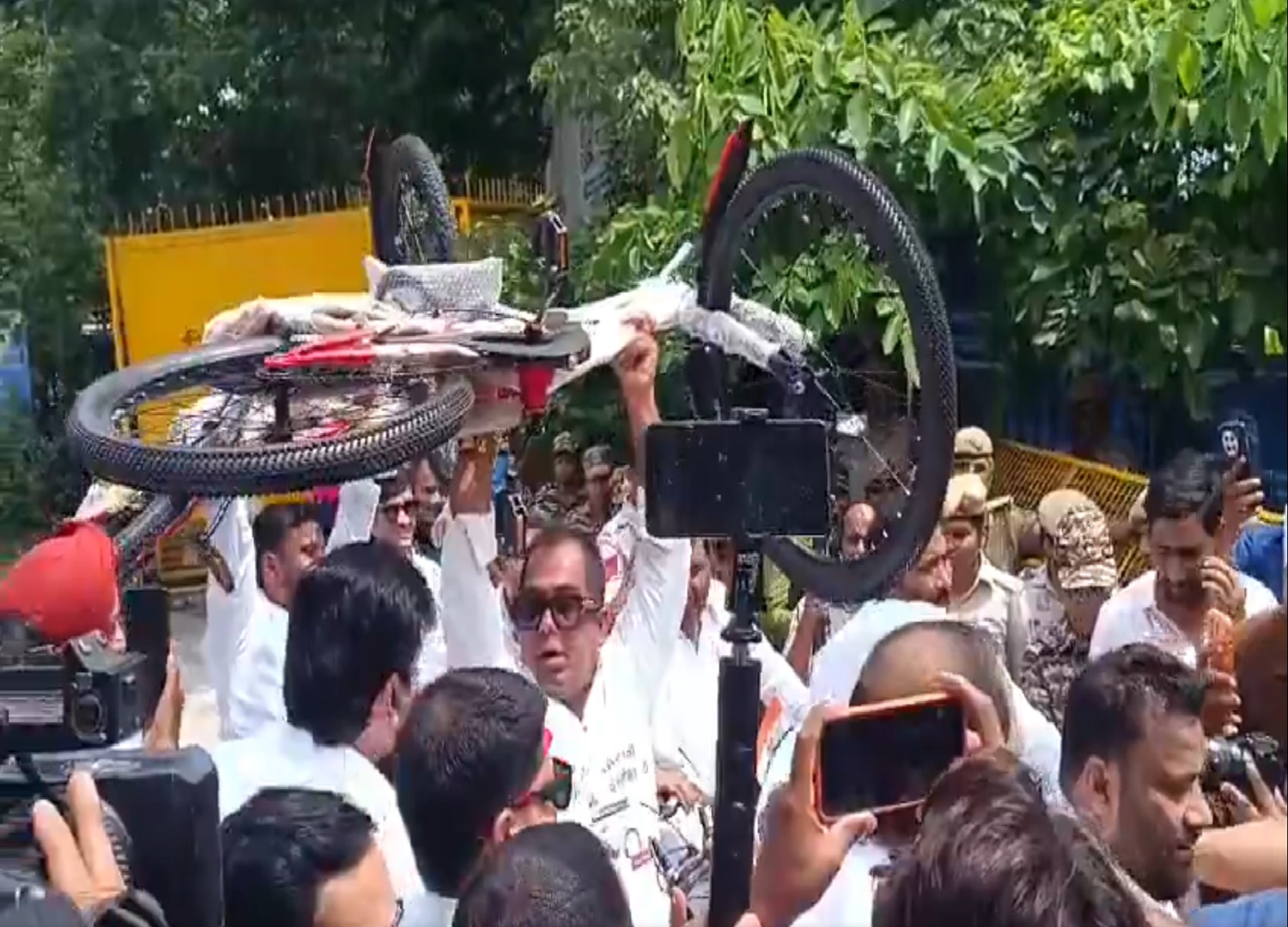
NEW DELHI — High political drama unfolded outside the Delhi Assembly as Aam Aadmi Party lawmakers pedaled directly to the House.
Specifically, opposition leaders mounted bicycles to highlight alleged financial irregularities in a Rs 90 crore government procurement project.
The demonstration targeted the distribution scheme offering free bicycles to Class IX female students in public schools.
Furthermore, AAP Delhi unit chief Saurabh Bharadwaj spearheaded the high-profile cycling demonstration alongside several party legislators.
Party leaders alleged massive tender inflation regarding the bulk purchase of 1.3 lakh bicycles for young students.
Consequently, the opposition demanded the immediate resignation of Delhi Education Minister Ashish Sood over the emerging scandal.
AAP lawmakers claimed that identical Hero bicycle models retail in local markets for approximately Rs 4,200 each.
However, the administration paid Rs 6,957 per bike through its official procurement channels.
Therefore, party representatives calculated an excess cost of nearly Rs 3,000 per unit across the entire order.
According to opposition figures, this price gap represents an alleged commission loss exceeding Rs 36 crore.
To demonstrate their point, AAP members personally purchased retail bikes and rode them directly to the assembly grounds.
Additionally, they invited officials to compare the retail cycles side by side with government-issued models.
Also Read : Punjab Caps Private School Fee Hike at 5 Percent: Mann Government Mandates Refunds for Parents
Assembly Session Erupts Over Alleged Tender Irregularities
Inside the legislative chamber, intense political friction erupted almost immediately after proceedings commenced.
Meanwhile, six opposition legislators wore protest clothing bearing slogans related to the ongoing dispute.
Consequently, the House Speaker ordered marshals to remove those protesting members from the assembly floor.
The opposition contended that official tender parameters were deliberately customized to exclude major domestic manufacturers.
Furthermore, party strategists highlighted elevated turnover prerequisites that prevented multiple competing firms from bidding.
Specifically, AAP leaders pointed to a steep Rs 360 crore turnover requirement for potential suppliers.
In contrast, other state administrations maintained significantly lower financial thresholds for larger procurement orders.
Moreover, critics noted that official specifications listed the Hero Skyler model for final delivery.
However, market inquiries revealed that the manufacturer had already discontinued that exact product line.
As a result, opposition members claimed the supplied units were simply rebranded versions of standard Bonfire models.
They stressed that these product discrepancies directly evidenced severe administrative oversights during the bidding cycle.
Therefore, the opposition called for a comprehensive independent investigation into the entire supply chain.
The intensifying controversy around the Delhi Assembly cycle scam quickly dominated legislative discussions and regional news coverage.
BJP Defends GeM Process and Cites Logistics Overhead
In response, the ruling party firmly dismissed all allegations of financial impropriety as baseless political theater.
Specifically, government representatives clarified that the entire procurement occurred transparently via the central Government e-Marketplace portal.
Furthermore, administration spokespersons emphasized that bulk institutional tenders operate under vastly different parameters than basic retail purchases.
They noted that the unit price included mandatory multi-year maintenance packages and doorstep assembly logistics across various districts.
Additionally, official contracts covered localized pre-delivery inspections, specialized freight handling, and long-term warranty provisions.
Consequently, party representatives asserted that comparing raw retail store tags to comprehensive service tenders remains inherently misleading.
Moreover, government officials accused the opposition of creating artificial controversies to undermine beneficial social welfare initiatives.
They highlighted that thousands of young female students were already benefiting directly from the new transport assistance scheme.
Nevertheless, the opposition maintained that institutional scale should logically decrease unit costs rather than increase them.
They argued that bulk orders involving 1.3 lakh units should secure substantial wholesale discounts from manufacturers.
Thus, the sharp divergence in cost interpretations continues to fuel aggressive political debates across the capital.
Escalating Governance Clashes in the National Capital
This bicycle dispute marks the latest flashpoint in an ongoing series of administrative confrontations in New Delhi.
Earlier this year, both major political parties clashed over municipal healthcare tenders and public infrastructure spending.
Furthermore, vigilance complaints regarding the procurement parameters have been submitted to senior regulatory authorities.
Industry observers note that public procurement transparency remains a sensitive political topic among metropolitan voters.
Additionally, civic watchdogs are urging administrative bodies to publish detailed itemized cost breakdowns to resolve public doubts.
Meanwhile, neutral market analysts suggest that institutional delivery logistics can genuinely raise per-unit expenditure metrics.
However, analysts also acknowledge that stringent eligibility clauses deserve thorough scrutiny to ensure fair competitive bidding.
Consequently, public attention remains focused on upcoming legislative sessions for potential committee references or audit disclosures.
The fallout from the Delhi Assembly cycle scam has clearly heightened political scrutiny across all municipal procurement programs.
Both sides continue to present competing calculations regarding the true value of the distributed school cycles.
Moving forward, regulatory reviews and assembly debates will determine whether procedural modifications are necessary for future public tenders.
Key Summary of the Delhi Assembly Cycle Procurement Dispute
The table below outlines the core points of contention in the procurement investigation:
| Parameter / Milestone | Opposition (AAP) Standpoint | Government (BJP) Standpoint |
| Per-Unit Cost Calculation | Alleged market rate ~₹4,200 vs. ₹6,957 paid | Retail price excludes multi-year maintenance and assembly |
| Total Scheme Outlay | ₹90 Crore for 1.3 lakh bicycles | ₹90 Crore including GeM fees, logistics, & long-term warranty |
| Alleged Financial Impact | Over ₹36 Crore in inflated tender commissions | Zero discrepancy; pricing follows transparent GeM portal norms |
| Tender Qualification Rules | Termed customized (₹360 Cr turnover clause) | Standard institutional qualification to ensure reliability |
| Current Action Requested | Independent probe & resignation of Minister | Scheme execution continues to benefit Class IX female students |