
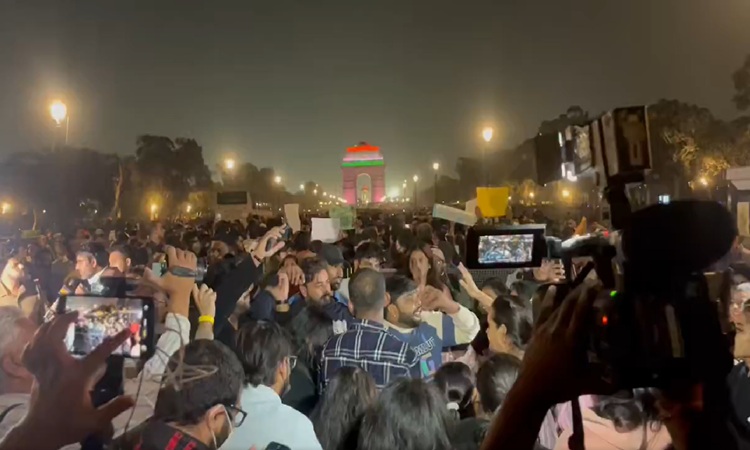
15 Arrested During Delhi Pollution Protest as Air Quality Worsens
Fifteen people were arrested during a major air pollution protest in Delhi on Sunday. The demonstrators, many of them students, gathered at the C-Hexagon area near India Gate to demand urgent action on the severe pollution crisis in the Delhi-NCR region. However, police officials said the protest turned disruptive, which forced them to intervene.
According to the police, the detained protesters were taken to the Parliament Street Police Station. Moreover, they underwent routine medical checks soon after their arrival. Officials added that an FIR was filed under several sections linked to obstruction of government work. Some of those arrested were picked up near India Gate, while others were held outside the police station.
Officials stated that the protesters allegedly refused to disperse after several warnings. Additionally, they were accused of using pepper spray, which caused irritation to at least three police personnel. Those officers were later taken to a hospital for treatment.
Protesters Accused of Ignoring Warnings and Crossing Barricades
Police said the protesters entered the C-Hexagon area and tried to cross barricades that were placed to manage traffic. Officers told them that ambulances and medical teams were stuck behind the blockade. However, the group reportedly became agitated and did not step back.
The situation escalated when the protesters sat on the road, police officials said. Therefore, officers removed them from the area to avoid further disruption in the busy central Delhi zone.
This protest came only days after another climate demonstration at India Gate on November 9. During that event, police detained several people who were demanding strict measures to tackle the rising pollution crisis. They called it an “air emergency” that needed swift government action.
Toxic Haze Deepens as Air Quality Indicators Drop
Delhi and its neighbouring NCR cities woke up to dense smog on Sunday. Visibility dropped sharply in several parts of the city as the toxic haze grew thicker. Moreover, health agencies issued renewed warnings for children, senior citizens and people with respiratory issues.
Neighbouring cities also reported alarming AQI readings. Faridabad recorded an AQI of 358, Gurugram 370, Ghaziabad 355, Greater Noida 342 and Noida 372. Most central and east Delhi localities remained between 300 and 400, which falls in the “very poor” range. However, many pockets slipped into the “severe” category by crossing the 400 mark.
Experts warn that conditions could deteriorate even further if wind speeds stay low this week.
Governments Consider New Restrictions as Crisis Grows
The Centre is now reviewing possible measures, including staggered timings for central government offices in the region. Moreover, officials said restrictions normally applied under Stage IV of the pollution response system may be implemented earlier at Stage III.
These rules allow public, private and municipal offices to function with only 50 per cent staff. The remaining employees will need to work from home. Additionally, the Delhi government has already directed private offices to follow this model. The city administration believes such steps will limit road congestion and reduce emissions.
Delhi continues to struggle with one of the worst pollution cycles in recent years. Authorities claim they are keeping a close watch on emissions from vehicles, construction sites and industrial zones. However, environmental groups argue that policy enforcement must improve quickly.
The recent arrests have now added to the debate on protest rights and public safety during health emergencies such as severe air pollution. Civil society groups say peaceful demonstrations must be allowed. Police officials, however, maintain that safety and movement cannot be compromised in high-traffic areas.
As Delhi prepares for more smog-filled days, the pressure on both the Centre and the state government continues to rise. Moreover, with winter still strengthening, experts warn that the worst phase of the pollution season may not have arrived yet.