
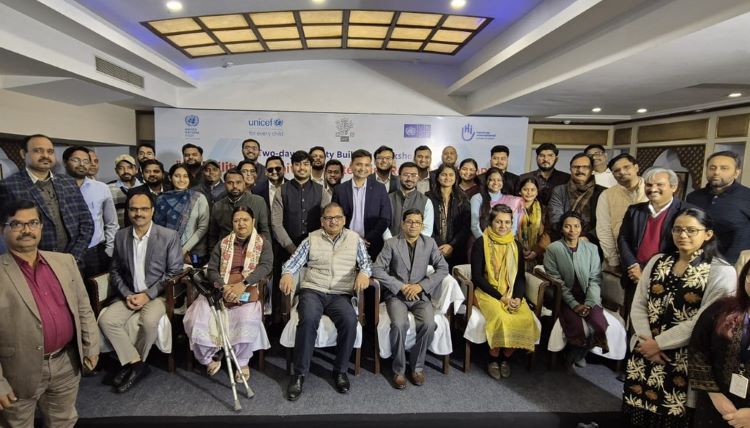
Bihar Disaster Management Department partners with UN agencies to train officials on disability-inclusive disaster preparedness and inclusive response strategies.
Patna: Recognizing that successful disaster management cannot be achieved unless it is inclusive by design, the Bihar government has partnered with UN agencies to promote disability inclusion in disaster preparedness.
In collaboration with UNICEF and the United Nations in India, the state’s Disaster Management Department (DMD) launched a two-day capacity-building workshop on Disability-Inclusive Disaster Risk Reduction (DiDRR) in Patna on Tuesday. In Bihar, the program seeks to mainstream disability inclusion at every level of disaster management.
The United Nations Development Programme (UNDP) and Humanity & Inclusion (previously Handicap International) are providing technical leadership for the training. Assistant disaster management officers, practitioners of disaster risk reduction, and representatives of organizations for people with disabilities are among the participants. Rajeev Kumar, a UNICEF disaster risk reduction specialist, welcomed the participants and gave an overview of the program’s goals and anticipated results, highlighting the necessity of organized capacity-building to guarantee inclusive disaster responses.
Also read : Who Is Sanjay Saraogi? BJP’s New Bihar Unit Chief
Nadeemul Ghaffar Siddiqui, joint secretary of Bihar’s Disaster Management Department, stated in his keynote speech that although the state has made considerable strides in disaster management, there were still large gaps in the protection and inclusion of people with disabilities. He stated that Bihar was coordinating its disaster plans with the Sendai Framework for Disaster Risk Reduction and that as disasters do not discriminate, “our response mechanisms must also be non-discriminatory and fully inclusive.”
Disability inclusion is a moral and governance necessity, especially in light of the growing severity of climate-related catastrophes, according to Md. Waris Khan, secretary of the Bihar State Disaster Management Authority (BSDMA). In order to make inclusion a fundamental tenet of state policies and catastrophe frameworks, he emphasized the necessity of consistent participation and frequent training opportunities.
A special session focused on the difficulties faced by people with disabilities during disasters, such as obstacles to evacuation, restricted access to early warning systems, and the inaccessibility of relief shelters, in order to ground policy discussions in lived experience. The event, which was hosted by Humanity & Inclusion’s Kumar Shiwendra, allowed officials and disability rights organizations to have direct conversations.
In order to illustrate how gender-based vulnerabilities among people with disabilities are frequently exacerbated during disaster response, Geeta, who speaks for people with disabilities, related her experience during flood rescue efforts. She advocated for frameworks for preparedness that take gender-responsive methods and specifically address interlocking vulnerabilities.
Also read : Bihar Police Inducts 1,218 Sub-Inspectors After Specialized Training
The program will address topics such as disability concepts, at-risk population identification, data gaps, inclusive communication, and rights-based approaches, combining policy-oriented talks with hands-on activities. In addition, sessions will cover field-based best practices, rescue methods, evacuation and shelter management, and inclusive early warning systems. Following a final session on agreed actions to promote disability inclusion throughout Bihar’s disaster management policies and implementation frameworks, participants will be able to adopt inclusive response tactics locally through a tabletop exercise.