
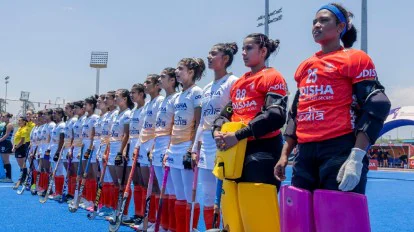
India U19 women’s hockey ends FIH Junior World Cup 2025 in 10th place; Kanika Siwach shines, but set-piece and mental lapses cost crucial wins.
India’s junior women’s hockey team concluded their campaign at the FIH Junior Women’s World Cup 2025 in Santiago, Chile, with a disappointing 10th-place finish, representing one of the lowest results in the annals of the program.
A narrow 1–2 loss to Spain in the 9th/10th playoff finalized the final classification, concluding a tournament characterized by moments of brilliance, instances of inexperience, and a persistent challenge in translating dominance into results.
India’s sole goal against Spain was scored by Kanika Siwach, who converted a penalty corner in the 41st minute. Spain, however, exploited their opportunities more efficiently, netting goals from Natalia Vilanova (16′) and Esther Canales (36′). The defeat confirmed India’s second-worst performance in the history of the Junior Women’s World Cup and underscored a decline from the team’s remarkable fourth-place finish in 2022.
India’s journey in the World Cup was marked by significant fluctuations in performance. They defeated lower-ranked Namibia decisively with a 13–0 victory, showcasing commanding offensive strength. Goals were scored from various areas of the field, including hat-tricks by Kanika Siwach and Hina Bano, a brace from Sakshi Rana, as well as strikes from Sonam, Ishika, Manisha, and others.
However, this remarkable performance concealed underlying shortcomings. Against well-organized, mid-level teams capable of withstanding duress, India’s tactical maturity wavered. They necessitated a penalty shootout to overcome Uruguay following a 1–1 draw, were defeated 1–3 by Germany in the group stage, and encountered difficulty in securing victory over Wales despite dominating the match. These matches revealed a distinct pattern: India was capable of overpowering less formidable opponents but consistently faltered in executing critical plays under duress.
Also read : Vaibhav Sooryavanshi Scores 171 Runs in U-19 Asia Cup
The qualification criteria exclusively permit group winners and the two highest-ranked second-placed teams to progress to the quarter-finals—leaving minimal room for error. India’s loss to Germany, despite a substantial goal difference, concluded their prospects of reaching the quarter-finals. A more limited failure, as analysts observe, might have propelled India into the quarterfinals.
Spain Playoff: A Reflection of India’s Challenges
The defeat to Spain in the playoffs encapsulated India’s persistent vulnerabilities within a single match.
Goalkeeper Nidhi made “heroic” saves early in the match to sustain India’s chances, yet the dependence on goalkeeping excellence highlighted the vulnerability of India’s defensive organization. Spain’s opening goal originated from a swift counterattack, a situation in which India’s high press consistently left them vulnerable.
The psychological turning point occurred in the 36th minute. India appeared to level the score through Sonam, only for Spain to invalidate the decision via video referral on account of a technical violation related to a “back stick.” Within moments, Spain secured a victory and converted a penalty corner, transforming a potential 1–1 into a 0–2 result. This incapacity to maintain emotional stability and to reorganize defensively following setbacks indicates a more profound problem related to mental conditioning and game management.
Kanika Siwach subsequently equalized with a precisely executed penalty corner, reaffirming her status as India’s most dependable set-piece specialist. However, Spain concluded the match effectively by adopting a compact formation that India was unable to breach.
Set-Piece Crisis: A Tactical Indicator of Concern
Throughout the tournament, India’s penalty corner conversion rate was notably low. The most conspicuous example occurred against Wales, where India secured eight penalty corners but failed to convert any, despite maintaining dominance within the circle. Even in the match against Uruguay, India found it challenging to penetrate a well-organized defensive barrier, depending instead on a low-percentage long-range shot from Manisha to secure the lead.
Although Kanika Siwach demonstrated individual effectiveness, India exhibited a deficiency in diversity and execution quality within their secondary routines. When opponents neutralized the primary glimmer, India’s alternative options faltered, disrupting their momentum and diminishing scoring prospects. This systemic deficiency, as highlighted in the report, necessitates urgent strategic action.
Notable Players
Despite the overall team performance, multiple individuals distinguished themselves as promising candidates for the senior pathway:
- Kanika Siwach: Achieved a hat-trick against Namibia, scored a pivotal goal in the quarterfinal against Spain, and distinguished herself as an exceptional drag-flicker. Recently chosen to participate in the inaugural Women’s HIL with Odisha Warriors.
- Hina Bano: Demonstrates consistent goal-scoring performance, with goals registered against Namibia, Germany, and Wales.
- Nidhi: India’s most dependable performer, delivering crucial saves during regulation time and an exceptional display in the shootout against Uruguay.
- Sonam and Manisha demonstrated an aggressive approach but need additional technical refinement under duress.
These players, the evaluation emphasizes, should be expedited into senior national team preparation, particularly in advance of the 2026 Women’s World Cup Qualifiers in Hyderabad—a critical and high-stakes undertaking, especially following India’s failure to qualify for the Paris Olympics.
A Strategic Plan for Restoration
The report concludes with three strategic directives:
- Rebuild Set-Piece Execution: A targeted drag-flick training regimen, comprehensive flicker development, and high-pressure simulation exercises are vital to enhance conversion efficiency.
- Enhance Mental Resilience: India must address and prevent psychological collapses after setbacks—an issue consistently observed in the matches against Spain and Germany.
- Tactical Advancement Against Robust Defenses: The team requires systematic training to break down compact formations utilizing spatial width, three-dimensional skills, and innovative patterns, rather than relying solely on direct pressure and circle entries.
A tenth-place finish serves as a stark reminder that talent alone is insufficient to maintain India’s advancement in juvenile women’s hockey. Strategic clarity, psychological resilience, and exemplary set-piece execution are now indispensable.
Santiago 2025 offered difficult lessons but also highlighted the young athletes who possess the potential to advance Indian hockey, provided the system is prepared to evolve with immediacy and intent.