
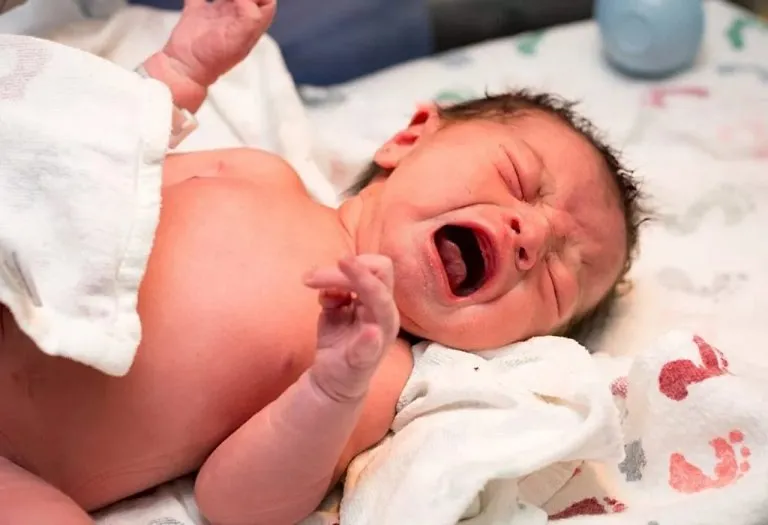
Discover why newborn babies cry at birth, what it signals about health, and the science behind their first wail.
Why Do Newborn Babies lament: It is observed both in films and in real life that the initial response of a newborn upon entering the world is often a lament. It is a widespread phenomenon that individuals seldom question why newborns initially begin to cry upon entering the world. There is a compelling fact that is fundamentally embedded in science, nature, and human existence. In addition to its insensitivity, crying serves as a vital means for infants to express their requirements or discomfort prior to developing advanced verbal communication skills. This innate response guarantees survival immediately following birth.
What Is the Significance of a Baby’s Initial Cry?
Although most infants wail following their birth, it is not an obligatory response but a significant indicator. The initial wail of a newborn signifies the activation of the body’s systems. It should be noted that infants do not cry due to discomfort immediately after birth.
Also read ; Wedding Day Glow: The Essential Skin Care Routine for Brides
According to medical professionals, the initial cry of the newborn indicates excellent health. Medical professionals employ a metric known as the Apgar score to evaluate the newborn promptly after birth. Crying indicates that the respiratory system and lungs are functioning properly. Furthermore, if the infant does not cry, medical professionals softly massage their back or delicately tap their feet to stimulate respiration.
The Underlying Causes of Neonatal Crying Immediately Following Birth
Within the womb, the fetus resides in a warm, fluid-filled environment for nine months. Their lungs are engorged with fluid, which explains why they have never taken a genuine inhalation. Following birth, air initially enters their airways. The abrupt increase in pressure within them causes the small air sacs to expand and triggers weeping, facilitating the circulation of oxygen throughout the body. Frequently, medical professionals refer to this as the baby’s initial ‘system on’ instant.
Furthermore, a rapid fluctuation in temperature and the encircling environment triggers the newborn’s innate cry. The uterus maintains a consistent temperature of 37°C. Thus, upon their initial exposure to the outside world, they encounter cold air, intense illumination, deafening noises, and the influence of gravity. This significant change unsettles the nervous system, and weeping emerges as the innate reaction.
Also read ; Chia Seeds Health Risks: Are They Safe for Everyone?
The initial emotional response of a newborn is predominantly weeping rather than laughter, as it aligns with the natural and essential progression of human development. Understanding the underlying science enables parents and the elderly to better appreciate how neonates interact with their external environment.