
ULFA-I Leaders Killed in Myanmar Drone Strike
Drone Strike Allegedly Hits ULFA-I Camps in Myanmar, Kills 3 Top Leaders
Guwahati, July 17: The banned insurgent outfit United Liberation Front of Asom–Independent (ULFA-I) has claimed that three of its senior leaders were killed and 19 others injured in a drone and missile strike on its camps in Myanmar’s Sagaing region, near the India-Myanmar border. The attack reportedly took place in the early hours of July 13.
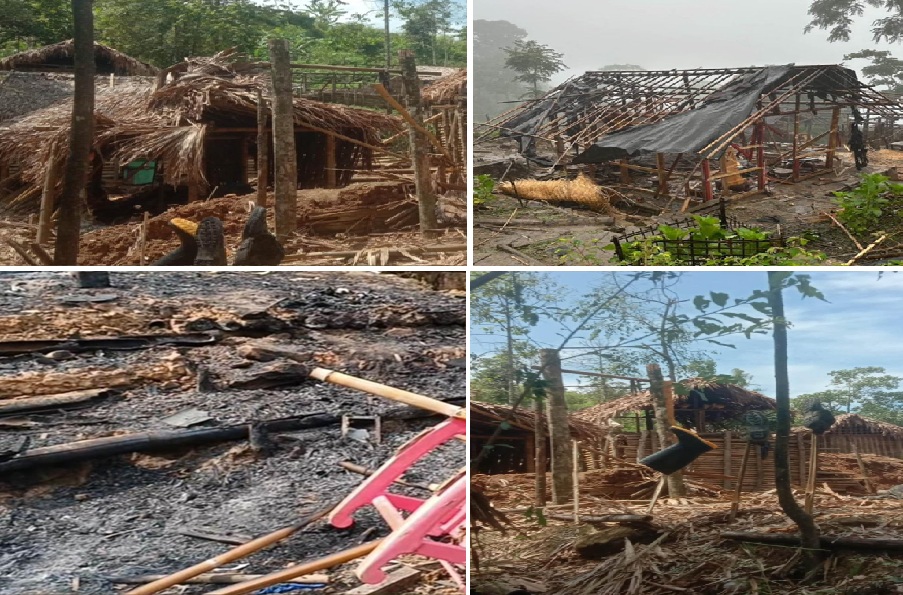
Visuals circulating online show the aftermath—destroyed bamboo huts and scattered debris—suggesting a high-intensity strike. However, the Indian Army and Assam government have firmly denied any involvement.
ULFA-I Claims Indian-Origin Drone Strike
In a strongly worded statement, ULFA(I) accused the Indian armed forces of launching the strikes using high-precision Israeli and French-made drones. The outfit stated that the operation targeted their mobile bases and led to the death of:
- Lt. General Nayan Medhi alias Nayan Asom
- Brigadier Ganesh Asom
- Colonel Pradip Asom
The group said the first strike occurred while two ill cadres were being rescued. A second wave of drones, they allege, struck again during Nayan Asom’s funeral, causing additional deaths.
ULFA(I)’s commander-in-chief, Paresh Baruah, released an audio message asserting, “The strike was launched from Indian territory. It happened four times. We will release proof soon.” He denied any ongoing dialogue with the Indian government and labeled claims of peace talks as false.
Indian Army and Assam Government Deny Allegations
In response, Defence PRO Colonel MS Rawat, speaking from Guwahati, stated, “There are no inputs with the Indian Army regarding any such operation.”
Assam Chief Minister Himanta Biswa Sarma, who also holds the Home portfolio, echoed the same view. “We have not received any information from the Centre. Assam Police is not involved. All current details are based solely on statements made by Paresh Baruah,” said Sarma.
He further added that no operation was launched from Indian soil, emphasizing that no official order was issued for such a cross-border action.
Opposition Demands Answers
The alleged attack has stirred political debate in Assam and beyond.
Gaurav Gogoi, MP and President of the Assam Pradesh Congress Committee (APCC), questioned the Centre’s silence:
“Can a drone strike happen without the knowledge of the Home Minister? Is this a shadow operation like the secret killings of the past?”
Debabrata Saikia, Leader of the Opposition in the Assam Assembly, expressed similar concerns.
“This could derail the fragile peace process started in 2023. The public needs transparency. Who authorized this strike, and why?”
Opposition parties have demanded that both the Union Home Ministry and the Ministry of Defence issue clarifications immediately.
Strategic, Political and Legal Implications
If ULFA-I’s claims are proven true, this incident could mark a significant escalation in India’s counter-insurgency tactics. The use of drones across international borders, without diplomatic coordination, could have serious geopolitical consequences.
However, the Indian Army’s flat denial suggests that either the source of the attack remains unverified, or it was conducted without official sanction.
According to defense analysts, any unauthorized military action beyond India’s borders risks violating international norms and damaging diplomatic relations with Myanmar.
What Happens Next?
As of now, no independent agency has confirmed the origin of the drone strike. ULFA(I)’s claim is yet to be supported by verifiable evidence, though the group has pledged to release proof within a week.
This event has reignited debate over India’s approach to dealing with insurgent groups operating in neighboring countries. It has also brought attention to the fragile peace talks and raised questions over the future of negotiations with ULFA(I).