
Owaisi Questions Cricket Match Amid Tensions
All India Majlis-e-Ittehad-ul-Muslimeen (AIMIM) chief Asaduddin Owaisi has criticized the Indian government and the Board of Control for Cricket in India (BCCI) for going ahead with the India-Pakistan cricket match in Dubai.
While contests between the two nations usually attract huge excitement, this clash is overshadowed by calls for a boycott. The anger stems from the Pahalgam terror attack earlier this year, which killed 26 civilians. Following the incident, the Indian Army launched Operation Sindoor against terrorist camps in Pakistan and Pakistan-occupied Kashmir. The operation intensified hostilities, with both nations nearly approaching a war-like situation before a ceasefire was announced.
Against this backdrop, Owaisi accused the government of being inconsistent in its stance. He argued that if dialogue and terrorism cannot happen together, then neither should cricket and terrorism.
“Is Money More Important Than Lives?”
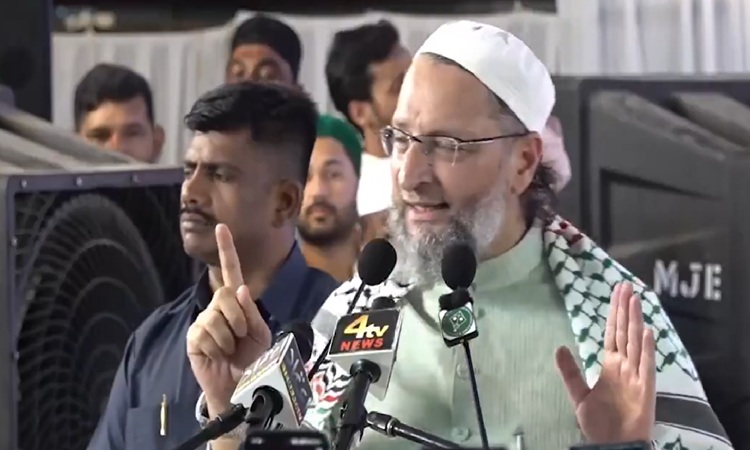
Speaking at a gathering in Hyderabad, Owaisi launched a sharp attack on the ruling party. Quoting him, news agency ANI reported his words:
“My question to the Chief Minister of Assam, the Chief Minister of Uttar Pradesh, and all of them is that you don’t have the power to refuse to play a cricket match against Pakistan which asked for the religion of our 26 citizens in Pahalgam and shot them. We ask the Prime Minister, when you said that blood and water cannot flow together, dialogue and terrorism cannot happen together, then how much money will the BCCI get from one cricket match, Rs 2000 crore, Rs 3000 crore? Is the value of the lives of our 26 citizens more than the money? This is what the BJP should tell.”
Owaisi emphasized that his party stood with the families of the victims. He declared that AIMIM had supported the victims in the past, continues to stand with them, and will do so in the future.
His remarks fueled the ongoing debate over whether India should play bilateral or ICC events with Pakistan when terror-related tensions remain high.
Dressing Room Response to Boycott Calls
Meanwhile, the Indian cricket team’s support staff maintained that the players are focused only on their game. Ryan ten Doeschate, India’s Dutch fielding coach, addressed media questions on Saturday and acknowledged the sensitivity of the matter.
“It is a very sensitive issue. Players feel the emotion and sentiments of the public. This is what we have discussed in the team meetings. Players are here to play cricket. We are following government instructions,” said Ten Doeschate, a former Netherlands cricketer.
He stressed that the players were not in a position to decide on political matters. Instead, they were respecting the directives of both the BCCI and the Indian government.
Cricket, Politics, and National Sentiment
The India-Pakistan cricket rivalry has historically been a mix of sport and politics. Matches are rare, limited mostly to ICC or Asia Cup tournaments, with bilateral series suspended for years due to political tensions.
This time, however, public sentiment appears more divided. While fans are passionate about the contest, the memory of the Pahalgam killings has fueled anger and calls for cancellation. Social media has also been buzzing with hashtags urging India to pull out of the match.
Political leaders, including Owaisi, have amplified these demands, putting additional pressure on the BCCI and the government. Analysts note that the government’s decision to proceed with the game signals a willingness to separate cricketing obligations from diplomatic standoffs, but the emotional impact of the terror attack cannot be ignored.
Conclusion
The India-Pakistan cricket match in Dubai has sparked fierce debate across the nation. While fans await the clash, questions about morality, money, and national sentiment continue to dominate public discourse.
Owaisi’s sharp remarks, linking the match with the Pahalgam killings, have kept the controversy alive. On the other hand, the Indian cricket team and its staff remain focused on the game, abiding by the government’s directives.
As the match unfolds, it is not just cricket on the line, but also a test of how India balances diplomacy, sport, and public sentiment.