
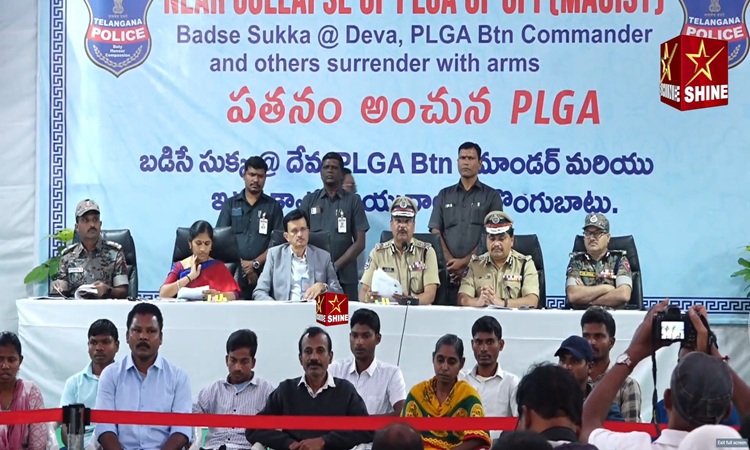
Maoist PLGA Battalion 1 Wiped Out as Hidma Aide Barse Deva Surrenders
Raipur: The surrender of senior Maoist commander Barse Deva along with over 40 cadres in Telangana has marked a major breakthrough for Indian security forces. Officials have described the development as the effective wipeout of PLGA battalion number 1, the most feared Maoist strike unit operating in the Bastar region. The surrender comes barely six weeks after the killing of top Maoist leader Madvi Hidma in an encounter in Andhra Pradesh.
Security agencies believe the twin developments have significantly weakened the Maoist command structure in south Chhattisgarh. The focus has now shifted to clearing remaining pockets of resistance before the Centre’s March 31, 2026 deadline to end Left-Wing extremism nationwide.
Who Is Barse Deva and Why His Surrender Matters
Barse Deva, a close confidant of Madvi Hidma, joined the Maoist movement in 2003 after being influenced by Hidma. Both leaders belonged to the Koya tribal community and rose together within the Maoist hierarchy. Over two decades, they became inseparable comrades and key planners of major insurgent attacks.
At the time of his surrender, Deva carried a cumulative bounty of Rs 75 lakh, announced by Telangana, Chhattisgarh, Maharashtra, and the National Investigation Agency (NIA). His history sheet links him to several deadly ambushes targeting security forces.
Officials say Deva played a central role in planning attacks that shaped Maoist dominance in Bastar. These included the Darbha Ghati attack of May 25, 2013, which killed 27 people, including senior Congress leader Mahendra Karma and veteran politician Vidya Charan Shukla. He was also involved in the April 2021 Sukma–Bijapur ambush, where 22 security personnel lost their lives.
According to officials, the loss of Hidma followed by Deva’s surrender has shattered the operational spine of PLGA battalion number 1.
Also Read : Odisha Illegal Stone Quarry Blast Kills Two in Dhenkanal
PLGA Battalion 1: Bastar’s Most Feared Maoist Unit
The People’s Liberation Guerrilla Army (PLGA) battalion number 1 was long considered the deadliest Maoist formation in central India. It operated across dense forest corridors spanning Chhattisgarh, Telangana, Maharashtra, and Andhra Pradesh.
Security officials say the battalion specialised in high-impact ambushes, coordinated IED attacks, and strategic withdrawals. Hidma and Deva jointly trained cadres and supervised operations across south Bastar.
With Deva’s surrender and the defection of more than 40 rebels, agencies believe the battalion has effectively ceased to exist. Many of those who surrendered are said to be mid-level operatives and logistics handlers.
Officials added that sustained pressure, intelligence-based operations, and improved coordination between states forced the Maoists into a defensive corner.
Fresh Encounters Signal Year’s First Major Offensive
The surrender coincided with fresh encounters in Chhattisgarh’s Bastar region, where security forces killed at least 14 Maoists in two separate clashes in Sukma and Bijapur. These encounters marked the first major anti-Maoist offensive of the year.
Senior officials said the operations were intelligence-driven and focused on dismantling remaining armed squads. The timing is critical, as the Centre has set a firm deadline to eliminate Left-Wing extremism.
Security planners say the biggest challenge over the next three months is to clear South Bastar, which remains the last significant Maoist stronghold. The terrain, dense forests, and local networks still offer insurgents limited shelter.
However, officials believe morale within Maoist ranks has suffered badly after the recent setbacks.
Centre’s 2026 Deadline and the Road Ahead
The Centre’s March 2026 deadline has pushed security forces into high-intensity operations across affected states. Improved road connectivity, forward operating bases, and better surveillance have shifted the balance.
Authorities say surrenders like Deva’s show that the strategy of combining force with rehabilitation policies is working. Several surrendered cadres are expected to be rehabilitated under state surrender policies.
Officials also credit local intelligence and tribal outreach programs for weakening Maoist influence. Many villagers now cooperate with security forces, reducing the rebels’ support base.
While challenges remain, security agencies believe the endgame against Maoism has entered its final phase.
A Turning Point in the Maoist Conflict
The fall of Hidma and surrender of Barse Deva represent a symbolic and operational turning point. For over a decade, the duo personified Maoist resistance in Bastar.
With PLGA battalion number 1 neutralised, officials say remaining Maoist units lack both leadership and coordination. The coming months will test whether security forces can convert these gains into lasting peace.
For now, the surrender has sent a strong signal that the Maoist movement in Bastar is on the back foot.