
India Asserts Dalai Lama Alone Can Choose Successor, Rejects China’s Claim of Authority
India Rejects China’s Interference in Dalai Lama’s Successor Decision, Reaffirms Spiritual Autonomy
New Delhi/Dharamshala – : India has strongly pushed back against China’s assertion that the selection of the next Dalai Lama must receive Beijing’s approval, reaffirming that only the Tibetan spiritual leader himself holds the right to determine his successor. The response came amid escalating geopolitical and cultural tensions over the religious succession of Tibetan Buddhism’s most revered figure.
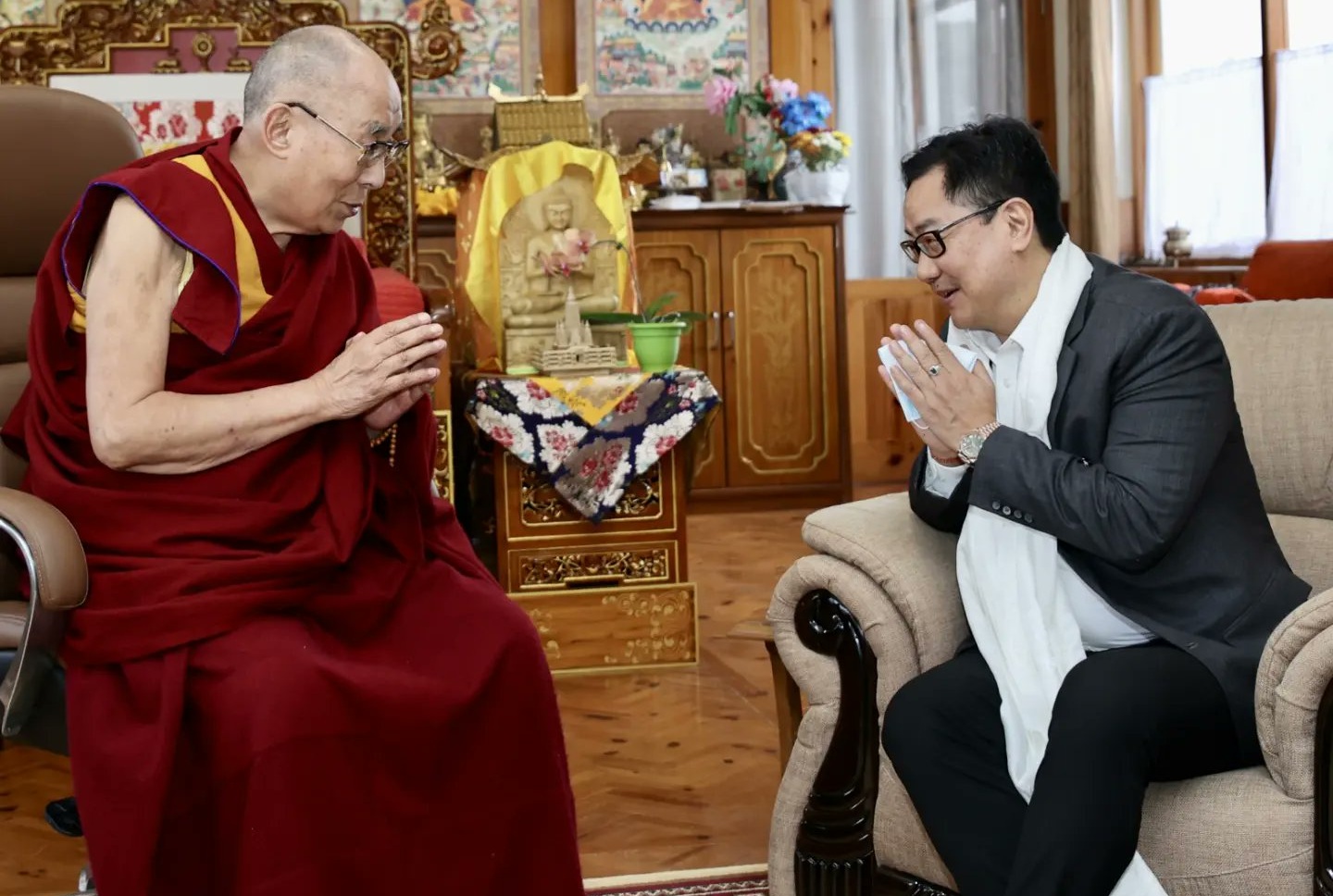
Speaking at an event in Dharamshala, Union Minister for Minority Affairs Kiren Rijiju stated unequivocally, “The right to decide on the successor to the Dalai Lama rests solely with His Holiness. Neither China nor any government has any say in this purely spiritual matter.”
Rijiju Leads Indian Delegation at Dalai Lama’s 90th Birthday Celebrations
Rijiju, along with Janata Dal (United) leader Lallan Singh, is in Dharamshala to participate in celebrations marking the 90th birthday of the Dalai Lama. The event has drawn dignitaries, monks, and followers from across India and abroad.
“This is a religious occasion of global significance. The Dalai Lama’s spiritual legacy belongs to his followers, not to any political entity,” Rijiju emphasized.
The Minister’s remarks come at a time when China has reiterated its claim that the reincarnation of the 14th Dalai Lama must occur within its borders, and that the selection must comply with Chinese legal and religious frameworks.
Dalai Lama’s Office Reaffirms Gaden Phodrang Trust’s Role
On Wednesday, the Dalai Lama’s office issued a detailed statement restating that only the Gaden Phodrang Trust—his official institution—is authorized to oversee the reincarnation process.
“The process by which a future Dalai Lama is to be recognized has been clearly established in the September 24, 2011 statement,” the office said, adding that “this responsibility rests exclusively with members of the Gaden Phodrang Trust.”
The statement strongly implies that external governments, including China, have no role in the centuries-old Tibetan Buddhist reincarnation process.
China Insists on Control Over Reincarnation
Meanwhile, Chinese Foreign Ministry spokesperson Mao Ning repeated Beijing’s hardline position, stating, “The Dalai Lama’s succession must comply with Chinese laws, regulations, religious rituals, and historical conventions.”
China has long maintained that Tibet is an internal matter, and it has attempted to assert control over Tibetan religious traditions, especially the reincarnation of spiritual figures like the Dalai Lama and Panchen Lama. Beijing fears that losing control of the Dalai Lama’s succession could weaken its influence in Tibet and among global Tibetan communities.
India’s Strategic and Cultural Positioning
India’s support for Tibetan religious autonomy comes amid increasing border tensions and strategic rivalry with China. Experts believe New Delhi’s stance is both a diplomatic and cultural affirmation of its support for Tibetan rights, as well as a geopolitical signal to Beijing.
Tibetans in exile, particularly those settled in Dharamshala, which hosts the Dalai Lama’s residence and the Tibetan government-in-exile, welcomed the Indian government’s firm backing.
“India’s clear message strengthens the global Tibetan cause and sends a powerful message to Beijing,” said Tenzin Norbu, a spokesperson for the Central Tibetan Administration.
A Battle Over Legacy and Legitimacy
The institution of the Dalai Lama has existed for nearly 600 years, with each reincarnation believed to be the rebirth of a predecessor who continues the Bodhisattva of Compassion’s mission. The current 14th Dalai Lama has suggested that his reincarnation could be born outside of Tibet or may even not continue, depending on the spiritual need.
This uncertainty, combined with China’s attempts to pre-select a successor, has triggered global concern about the authenticity and legitimacy of any China-backed successor.