
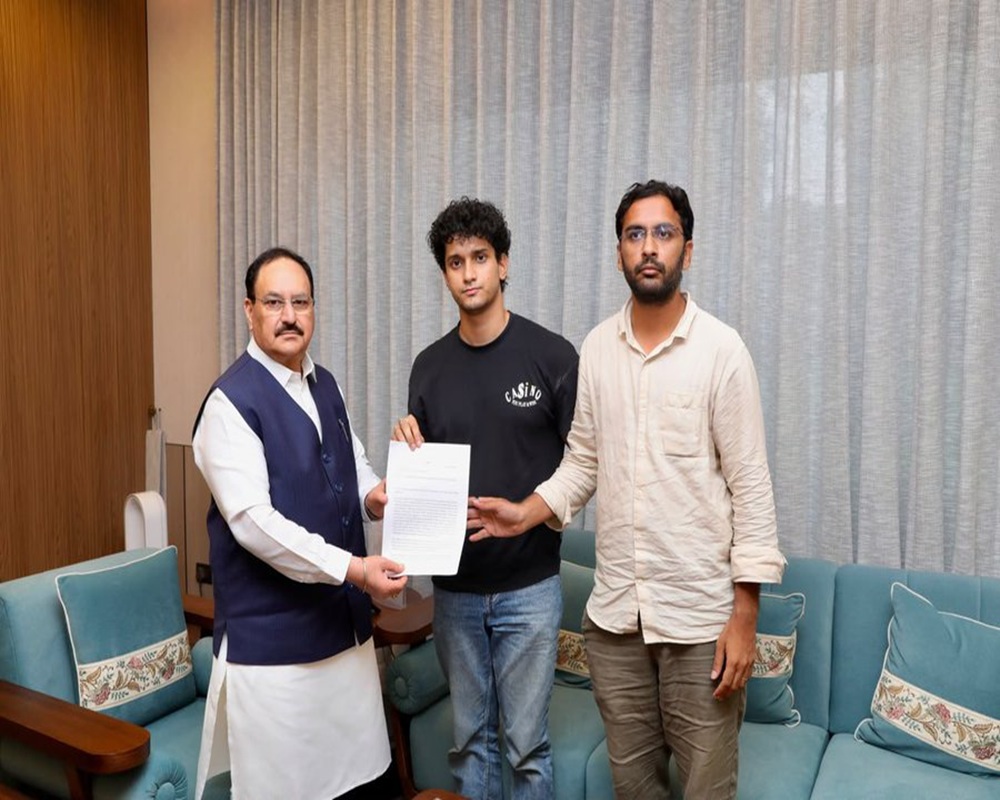
NEW DELHI : A high-stakes political crisis gripped New Delhi on Monday, July 20, 2026, as the ongoing national student agitation reached a dramatic tipping point. The youth-led Cockroach Janta Party (CJP) officially stepped up its pressure on the political establishment. During a high-profile backchannel meeting, the CJP makes 3 demands from Centre to immediately resolve the expanding deadlock. CJP spokespersons Saurav Das and Ashutosh Ranka entered the official residence of BJP leader and Union Minister JP Nadda to present their specific written ultimatum. Meanwhile, thousands of students outside initiated a chaotic, highly contested march toward the high-security Parliament House complex.
Update:
Me and @SauravDassss are still at Nadda ji’s residence. Nadda ji has requested some time to align with their leadership with regards to our following demands:
– Immediate release of @Wangchuk66
– Dharmendra Pradhan’s resignation
– 1Cr compensation for all NEET aspirants…— Ashutosh Ranka (@AshutoshRanka) July 20, 2026
Additionally, this critical meeting marks the first formal direct negotiation between the agitating youth and senior government decision-makers. The administration initiated contact earlier this morning as the “Chalo Sansad” march directly threatened to disrupt the opening day of the crucial Parliament Monsoon Session. CJP representatives actively refused to speak with lower-level administrative bureaucrats, forcing direct engagement with the senior political leadership. Consequently, Ranka confirmed via a detailed social media post that Nadda requested extra time to align with top government officials before responding.
Read More : CJP Alleges Severe Crackdown: Founder Abhijeet Dipke Detained in Delhi Protests
Furthermore, the strategic conversation occurs at a highly volatile moment for local internal security personnel. While leaders discussed policy inside, the surrounding streets witnessed running battles between police forces and determined student groups. The intense pressure from the student community has effectively forced the ruling coalition to re-examine its stiff public posture. The absolute core of the dispute rests entirely on three non-negotiable points that the youth party refuses to alter. As the political temperature rises, the news that the CJP makes 3 demands from Centre remains the dominant national headline.
🚨#ImportantAnnouncement: @AshutoshRanka and I have been at J.P. Nadda’s residence since 12 noon. The demands have been conveyed, including immediate resignation/sacking of Dharmendra Pradhan.
The Minister assured us he will discuss this at the appropriate level. However, no… pic.twitter.com/vzLluczbkV
— Saurav Das (@SauravDassss) July 20, 2026
The Three Uncompromising Conditions for Peace
The official charter presented to Minister JP Nadda targets systemic failures within the national education and health governance structures. First, the party demands the immediate, unconditional release of renowned climate and educational activist Sonam Wangchuk from Safdarjung Hospital. Police units had forcibly shifted the fasting reformer to the medical facility on Saturday against his explicit will. Second, the CJP is aggressively seeking the immediate resignation or sacking of Union Education Minister Dharmendra Pradhan. The group holds the minister directly responsible for the massive, recurring structural irregularities in recent competitive testing systems.
THE CJP’S THREE CORE DEMANDS
1. Immediate release of activist Sonam Wangchuk
2. Resignation/Sacking of Education Minister D. Pradhan
3. ₹1 Crore compensation for families of NEET leak victims
Moreover, the third financial condition addresses the severe human cost of the nationwide competitive testing crisis. The youth group demands ₹1 crore in direct state compensation for the grieving families of all NEET aspirants. Specifically, this targets families whose children tragically committed suicide following the widespread institutional paper leak scandals. CJP leaders emphasize that the state must take direct, financial accountability for these preventable psychological tragedies.
Additionally, the dual strategy of executive negotiation and active street mobilization has effectively forced a top-level administrative huddle. Concurrently, Union Home Minister Amit Shah held an emergency review meeting with Education Minister Dharmendra Pradhan inside Parliament. Officials tightly guarded the exact results of that meeting as internal security units struggled to contain the outdoor crowds. Therefore, the administrative leadership is facing severe parallel pressures from both political negotiators and aggressive grassroots student rallies.
Street Chaos and Mass Detentions in Central Delhi
The security environment across central Delhi rapidly disintegrated into absolute chaos as the “Sansad Chalo” march commenced. Thousands of passionate demonstrators actively defied strict prohibitory regulations to advance toward the secure legislative zone. Security personnel quickly deployed Rapid Action Force (RAF) units and fired multiple rounds of tear gas to disperse crowds. Consequently, fierce scuffles erupted near the Reserve Bank of India building as students attempted to breach steel barricades.
Furthermore, the local police department conducted an extensive series of preventive detentions to neutralize the crowd’s operational momentum. Prominent news agencies reported that at least seven core CJP members were taken into custody during the initial march. Among those initially intercepted near Parliament Street was the young organization’s visible public founder, Abhijeet Dipke. However, CJP spokespersons later issued distinct, real-time digital clarifications stating that Dipke was not formally placed under legal arrest.
Meanwhile, the extensive security containment strategies severely impacted ordinary daily commuters traveling through the bustling capital region. Local transit authorities completely closed multiple entry and exit gates at key metro stations near the protest perimeter. Heavy police cordons effectively placed Rail Bhawan outside public bounds, forcing trapped corporate employees to remain entirely indoors. Nevertheless, fragmented groups of determined student protesters managed to slip past barriers, spreading their slogans into India Gate.
The Rising Political Stake and E-E-A-T Framework
Ultimately, this sudden confrontation reveals a profound institutional crisis regarding the overall credibility of the national testing framework. The ongoing fact that the CJP makes 3 demands from Centre shows the deep systemic nature of youth unrest. Opposition leaders, including Congress General Secretary Priyanka Gandhi Vadra, heavily slammed the administration’s aggressive use of physical force. She noted that treating young, concerned students like hostile actors highlights a complete refusal to discuss critical educational reforms.
Moreover, the moral authority of the protest remains anchored to Sonam Wangchuk’s ongoing physical fast inside Safdarjung Hospital. Hospital officials released a formal clinical bulletin confirming that his vitals are stable but require close observation. From his ward, Wangchuk explicitly stated he will only break his strike if the state takes formal accountability. This unyielding persistence ensures that the student movement maintains a high level of public trust and domestic validation.
In conclusion, the outcome of the backchannel talks at Nadda’s residence will determine the immediate future of this movement. The combination of moral fasting and aggressive street pressure has successfully brought the state to the negotiation table. If the Centre fails to meet these demands, the youth leaders promise an even larger nationwide student mobilization. For now, the capital remains on high alert as both sides refuse to compromise their fundamental core principles.