
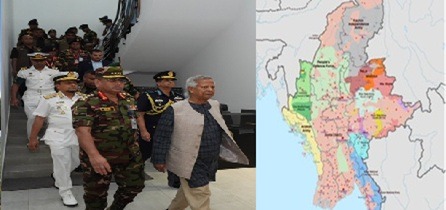
Bangladesh Army’s Reluctance to Intervene Amid Myanmar’s Rakhine State Conflict
Bangladesh Army Faces Growing Dilemma as Conflict in Myanmar’s Rakhine State Intensifies
The ongoing conflict in Myanmar’s Rakhine State is becoming increasingly complex, with the Arakan Army gaining ground against the military junta. As intense fighting continues, the Bangladesh Army is caught in a delicate position, facing mounting pressure to provide assistance, particularly in keeping supply routes open along the Bangladesh-Myanmar border.
The Arakan Army, which controls large swaths of Rakhine, has focused its efforts on seizing key cities still under the control of Myanmar’s military, including Sittwe, Kyaukphyu, and Manaung. However, the group has not yet been able to achieve a complete victory, leaving the region in a precarious balance. As the situation intensifies, the Bangladesh Army faces the possibility of being drawn into a conflict it is hesitant to join.
The Strategic Dilemma for Bangladesh
The strategic importance of Rakhine State and its proximity to Bangladesh creates a complex scenario for Dhaka. The conflict in Myanmar is not only a humanitarian crisis but also has significant security implications for Bangladesh. The Bangladesh Army is under growing international pressure to ensure that critical supply routes near the border remain open, especially as Arakan Army attacks continue.
In late March 2025, Lieutenant General Joel JB Vowell, Deputy Commanding General of U.S. Army Pacific, visited Bangladesh to meet with Bangladesh Army Chief General Waker-Uz-Zaman. According to reports, the two discussed the situation in Myanmar, with a particular focus on the need to maintain supply routes near the Bangladesh-Myanmar border. However, General Zaman stopped short of committing to any military intervention or assistance to keep these routes open.
The reluctance of the Bangladesh Army’s leadership to take a more active role in the Myanmar conflict is understandable. Despite the increasing pressure from international partners, including the United States, the Bangladesh Army remains cautious about becoming entangled in a neighbor’s civil war. The concern is not only about security risks but also the long-term impact on Bangladesh’s military resources.
The U.S. Push for Bangladesh Support
The stakes are high as the Arakan Army is reportedly planning a large-scale military offensive to capture the cities of Sittwe, Kyaukphyu, and Manaung. If successful, this would leave the Myanmar military regime with significantly reduced control in the region. For Bangladesh, this situation is particularly concerning, as it could trigger new waves of refugees and further destabilize an already vulnerable area.
In a related development, U.S. Deputy National Security Advisor (NSA) Alex Nelson Wong spoke with Khalilur Rahman, a senior representative of Bangladesh’s interim government, on April 2. The call marked the highest-level communication between the Trump administration and Bangladesh’s interim government since the 2022 political upheaval in Bangladesh.
While the exact contents of the conversation have not been made public, sources suggest that the U.S. is pressing Bangladesh to ensure that critical supply routes along the border remain open to assist the Arakan Army. There is growing concern in Washington that the situation in Myanmar could spill over into Bangladesh, further complicating the region’s security environment.
Bangladesh’s Strategic Caution
Despite the external pressures, General Zaman has remained cautious. In interviews and public statements, the Bangladesh Army Chief has repeatedly emphasized the importance of neutrality in the conflict and the need for Bangladesh to avoid getting involved in Myanmar’s internal struggles. While Bangladesh has historically provided humanitarian aid to Myanmar’s displaced Rohingya Muslims, direct military involvement in the conflict remains off the table for now.
The Rakhine State conflict also has serious implications for Bangladesh’s national security. Should the Arakan Army successfully expand its control, the likelihood of spillover violence or increased refugee flows into Bangladesh will likely escalate, further straining Bangladesh’s resources. The Bangladesh Army, already tasked with securing its borders, is facing difficult decisions about how best to balance its humanitarian and security obligations.
A Complex Regional Landscape
The situation is further complicated by the ongoing Rohingya crisis, where hundreds of thousands of displaced people from Myanmar’s Rohingya minority continue to live in camps in Bangladesh. The international community remains focused on finding a lasting solution to the crisis, but the prospect of greater instability in Rakhine State threatens to derail efforts.
The possibility of a safe zone for Rohingyas along the Bangladesh-Myanmar border has been discussed at various international forums, but it remains uncertain whether Bangladesh will take steps to create such a zone, especially if it risks escalating tensions with Myanmar or drawing the country into further conflict.
Looking Ahead: A Delicate Balancing Act
As the situation in Myanmar continues to evolve, Bangladesh’s military and political leaders face a delicate balancing act. On one hand, they must safeguard their borders and ensure the security of their citizens; on the other, they are being pressured to support the Arakan Army in its fight against the Myanmar military. With international actors, including the United States, intensifying their demands for assistance, the Bangladesh Army will have to carefully navigate this complex geopolitical landscape.
In the coming weeks, as the Arakan Army’s military offensive potentially escalates, Bangladesh may find itself forced to make tough decisions regarding its role in the Myanmar conflict. The international community will undoubtedly continue to monitor the situation closely, as the consequences of this conflict ripple across South Asia.