
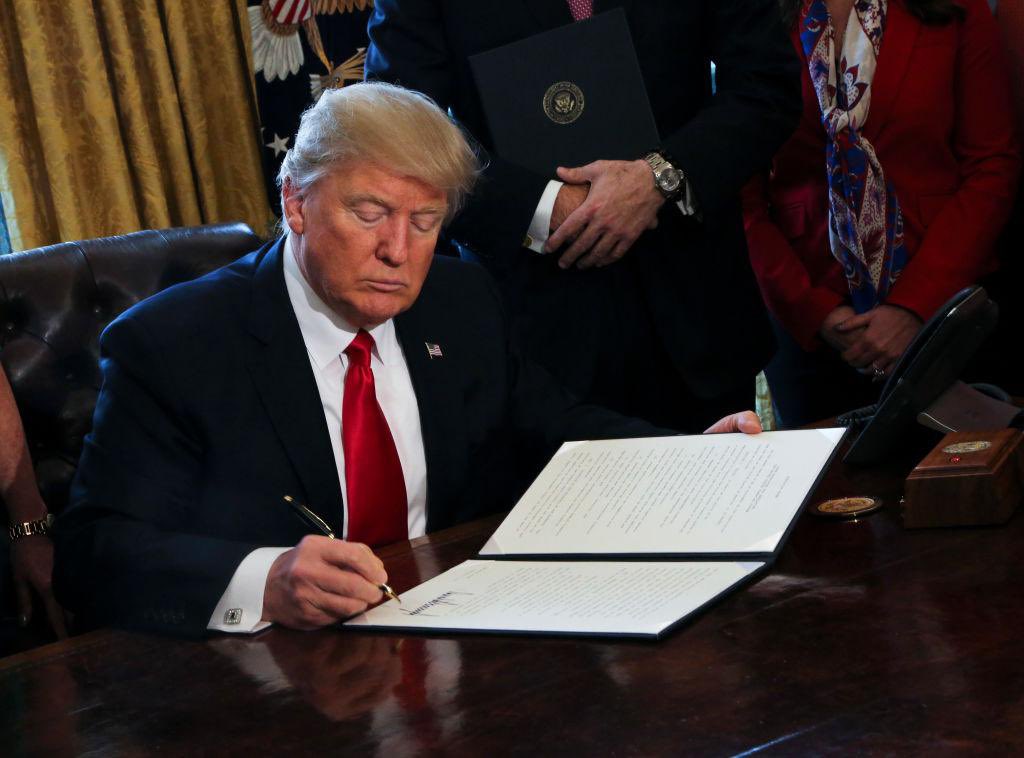
Donald Trump Signs the Trump Russia Sanctions Law
US President Donald Trump has officially signed a sweeping energy and financial package into federal law. Named the Lindsey O. Graham Sanctioning Russia and Iran Act of 2026, the legislation increases economic pressure on Moscow. It restricts funds used to finance ongoing military operations. The bill passed the Senate 86–11 before clearing the House 262–159 earlier this week.
The legislation targets Russia’s energy sectors, financial institutions, and specialized maritime transportation networks. The White House confirmed that the law gives executive agencies statutory powers to enforce trade restrictions. These measures aim to restrict Russian state revenues derived from international crude oil sales.
At its core, the Trump Russia sanctions law introduces discretionary presidential authority. The White House can levy tariffs of up to 100% on foreign nations. These duties target countries that continue purchasing significant volumes of Russian crude oil or natural gas.
US Sanctions Enactment ──> Target Russian Energy Revenues ──> Statutory Discretionary Tariffs
└──> Block Shadow Fleet Maritime Access
Summary of Major Provisions in the New Sanctions Legislation
| Legislative Provision | Targeted Entity / Sector | Enforced Mechanism | Legal Enforcement Timeline |
| Tariff Enforcement | Top 5 buyers of Russian crude and gas | Up to 100% duties on goods exported to the US | Takes effect within 30 days |
| Maritime Restrictions | Russia’s oil-transporting “shadow fleet” | Port bans, vessel seizures, and asset freezes | Immediate statutory mandate |
| Financial System Blocks | Major Russian banks and energy executives | Exclusion from global dollar transactions | Immediate statutory mandate |
| Middle East Framework | Iranian energy and military networks | 5-year extension of Iran Sanctions Act | Immediate statutory mandate |
Tariff Mechanism Targets Major Russian Energy Buyers
The new statutory framework focuses heavily on third-party trade dynamics. Under the text, the White House can penalize the five largest global purchasers of Russian energy. The calculation relies on total volume purchased during the 12 months prior to enactment.
The law does not explicitly name target countries. However, market analysts identify China and India as primary targets due to their purchasing volumes. China remains the largest buyer of Russian crude, while India relies on Russian imports for energy needs.
Supporters argue these provisions cut off financial lifelines supporting Russian military activities. Conversely, legal analysts note that broad discretionary powers give Washington substantial leverage during international trade negotiations.
| Foreign Energy Market | Russian Crude Volume Share | Estimated Annual Trade Value | Potential US Tariff Exposure |
| China | ~50% of crude import portfolio | Exceeds $60 Billion annually | Discretionary duties up to 100% |
| India | ~45% of total crude imports | $40.8 Billion (FY2026) | Discretionary duties up to 100% |
| European Union (Select) | Under 15% (Gas imports) | Varying regional totals | Exempt if imports decline significantly |
Economic Impact on India and Energy Security
The Trump Russia sanctions law creates significant strategic challenges for India’s energy planners. Before 2022, Russian crude accounted for just 0.2% of India’s total oil imports. By mid-2026, that share rose to nearly 50%, reaching approximately 2.96 million barrels per day.
India’s Ministry of External Affairs responded directly to the legislative developments. Official statements emphasize that India remains committed to securing affordable energy for its 1.4 billion citizens. Government officials stated that New Delhi will take necessary steps to protect its trade interests.
India Energy Strategy ──> Maintain Russian Sourcing ──> Protect Domestic Margins
└──> Risk Penal Tariffs on US Exports
Trade experts note that Indian refiners face complex procurement decisions. The law takes effect 30 days after signature, giving buyers time to adjust supply chains or negotiate exemptions.
Also Read : https://indiathisweek.in/world/trump-greenland-infinite-life-deal-us-denmark-security-pact/
| Indian Energy Sector Metric | Historical Baseline (Pre-2022) | Peak Import Level (2026) | Strategic Target Under New US Law |
| Russian Import Share | 0.2% of total crude imports | ~45% – 50% of total crude imports | Subject to potential presidential waivers |
| Daily Import Volume | ~50,000 barrels per day | ~2.96 million barrels per day | Diversification toward alternative sources |
| Bilateral Trade Impact | Standard tariff schedules | Up to 100% penalty tariff risk | Protection of core national economic interests |
Market Reactions and Global Oil Dynamics
The signing comes during a volatile period for international energy markets. Brent crude prices recently rose past $100 per barrel due to supply constraints in West Asia. Restricting Russian crude supplies could further tighten global availability.
Analysts from energy research firms indicate that replacing Russian crude entirely remains difficult for major Asian refiners. Rather than halting purchases, energy companies may request statutory waivers or negotiate deeper purchase discounts from Russian suppliers.
| Global Market Variable | Current Condition / Baseline | Predicted Market Adjustment |
| Brent Crude Benchmark | Sustained above $100 per barrel | Potential price spikes on supply disruptions |
| Shadow Fleet Activity | ~600 operational transport vessels | Increased maritime seizures and port restrictions |
| Alternative Crude Supply | Tight Middle Eastern production | Higher spot market premiums for non-Russian crude |
The White House retains authority to waive tariffs if the administration certifies that doing so serves national interest goals. Diplomatic observers expect intense negotiations between Washington, New Delhi, and Beijing in the coming weeks.