
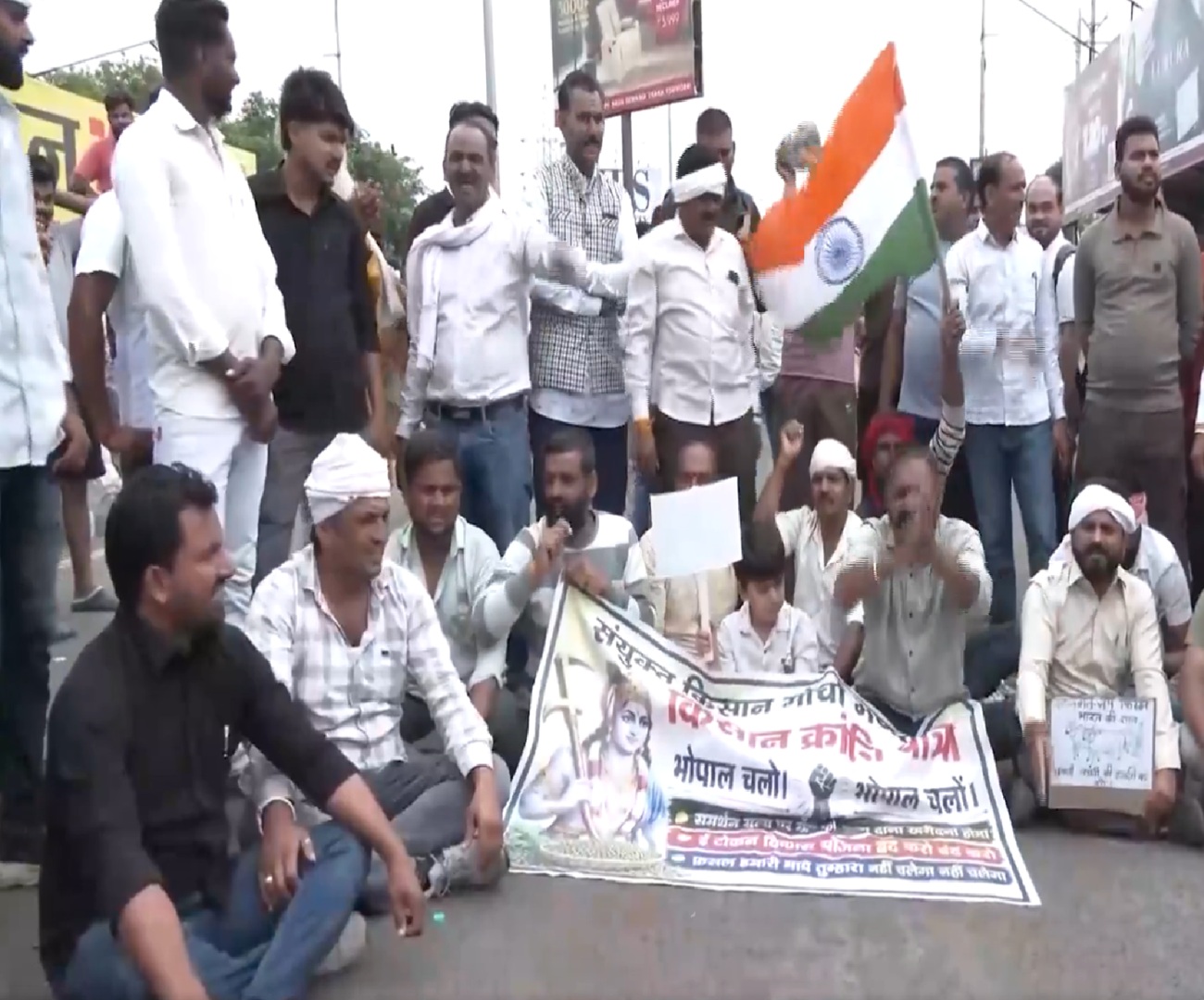
BHOPAL : The state capital witnessed massive unrest as the Bhopal farmers protest Moong MSP demands reached a boiling point. Over 2,000 determined protesters broke through heavy police blockades along the city borders on Tuesday afternoon. Organized under the Samyukta Kisan Morcha, the “Kisan Kranti Padyatra” marched directly toward Chief Minister Mohan Yadav’s residence.
Navigating past multiple police barriers near the Kaliyasot River bridge at Mandideep, farmers chanted slogans while waving the national flag. Following the foot marchers, a vast convoy of tractor-trolleys pressed into Bhopal, forcing administrative intervention. Consequently, senior police officials stopped the march near the RRL intersection in Baghsewania to initiate high-level talks.
Key Timeline of Bhopal Farmers Protest
├──► Sethanighat Sit-In : March commences from Narmadapuram after prayers
├──► Border Breach : 2,000+ farmers break police barriers at Mandideep
├──► Capital Entry : Tractor convoys proceed along Hoshangabad Road
└──► RRL Intersection : Administration halts march near Savarkar Bridge
Farmer delegates confirmed that 19 distinct agrarian organizations have joined forces for this unified agitation. Coming primarily from Narmadapuram, Harda, Seoni, and Raisen districts, the marchers remain adamant about resolving key grievances. As discussions continue, protesters have camped out with multi-day supplies, signaling a prolonged standoff.
Also Read : Centre Faces Growing Backlash Over E20 Petrol Policy as Opposition and Transporters Demand Answers
What Are the Key Demands Behind the Bhopal Farmers Protest Moong MSP Agitation?
At the core of the Bhopal farmers protest Moong MSP movement is the urgent call for 100 percent state procurement of summer moong (green gram). While Madhya Pradesh stands as India’s top green gram producer, farmers allege that official procurement remains drastically low. Consequently, growers are forced to sell their produce to private traders well below government-fixed support prices.
Besides crop procurement, protesters are demanding immediate structural overhauls in the agricultural distribution network. Specifically, farmer unions want the complete abolition of the complex e-token registration mechanism. Furthermore, they demand that essential fertilizers be distributed strictly based on verified land ownership records.
Core Grievances & Policy Demands
- Moong Procurement : 100% state purchase at Minimum Support Price
- Portal Digitalization: Scrapping the mandatory e-token registration system
- Fertilizer Access : Streamlined distribution based on physical land records
- Legal Safeguards : Timely market intervention to prevent distress sales
Union leader Arun Patel stressed that previous government assurances failed to translate into ground-level relief. Additionally, farmers allege administrative negligence regarding timely chemical fertilizer allocations ahead of sowing seasons. Therefore, union representatives refuse to vacate their positions until official written guarantees are delivered.
Prepared for a Long Battle: Protesters Arrive with Supplies and Rations
Demonstrators participating in the Bhopal farmers protest Moong MSP rally came thoroughly equipped for an extended siege. Tractor-trolleys following the marchers are packed with essential provisions, including clean drinking water, cooking fuel, and dry rations. Many farmers even carried pre-cooked meals like dal-bati to avoid relying on external aid.
Earlier in the day, security forces attempted to stop the procession near the Aubedullaganj toll plaza. Although local administrative officers urged the crowd to halt, the farmers peacefully bypassed the checkpoints. This unwavering resolve underscores deep-seated agrarian distress across the Narmada belt.
Protesters’ Operational Readiness
├──► Provisions Carried : 5+ days of rations, water tanks, and cooked meals
├──► Organizational Base: Coalition of 19 regional agricultural unions
├──► Geographic Reach : Protesters arriving from 4 major agrarian districts
└──► Strategy : Continuous sit-in until formal cabinet intervention
Moreover, former Chief Minister Kamal Nath urged the government to expedite crop purchasing immediately. In an official letter to Chief Minister Mohan Yadav, he highlighted that slow procurement is causing severe distress to growers. Thus, political pressure continues to mount alongside the physical protest in the capital.
Massive Traffic Chaos Disrupts Normal Life Across Bhopal
The sudden influx of thousands of protesters severely impacted Bhopal’s urban transportation network throughout Tuesday. A massive traffic gridlock stretched across Narmadapuram Road as tractor convoys occupied key lanes. In response, traffic authorities initially closed one side of the artery before shutting down both lanes entirely near Savarkar Bridge.
Consequently, thousands of commuters residing in over 150 neighboring residential colonies faced severe travel delays. Key commercial hubs including MP Nagar, Bawadia Kalan, Kolar, and Market Number 10 experienced bumper-to-bumper traffic jams for hours.
Impact on Capital Infrastructure
- Primary Corridors Hit : Narmadapuram Road, Hoshangabad Road, Savarkar Bridge
- Affected Localities : MP Nagar, Kolar Road, Bawadia Kalan, Market No. 10
- Commuter Disruption : Government Secretariat staff and office workers stranded
- Police Deployment : Additional forces mobilized from adjacent districts
Government employees commuting to the state Secretariat and administrative offices were stranded during peak morning hours. Meanwhile, police personnel deployed heavy barricading and diverted light vehicles onto secondary residential routes. Nevertheless, main transit corridors remained severely congested as negotiation rounds continued late into the evening.
Administrative Negotiations and Political Outlook
As the Bhopal farmers protest Moong MSP movement holds its ground, district magistrates and senior police officers remain engaged in talks. Officials are attempting to broker a compromise that restores traffic flow without escalating tensions. However, farmer committees maintain that ending the protest depends entirely on concrete policy decisions regarding crop buying.
In summary, the high-stakes demonstration highlights growing friction over state agricultural procurement practices. How the government resolves these administrative bottlenecks will determine whether peace returns to the capital roads soon.