
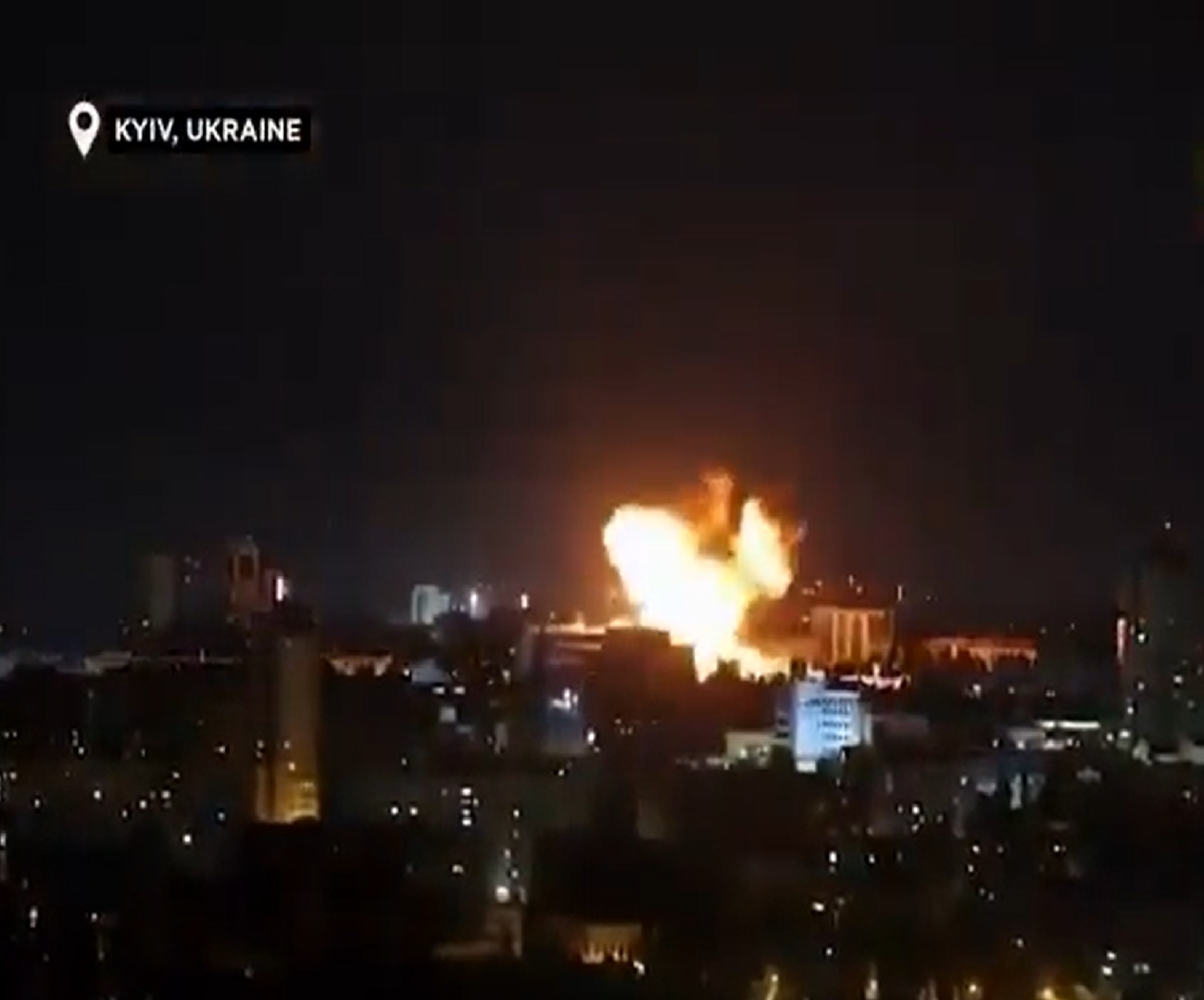
A massive security crisis unfolded across Eastern Europe over the weekend. Moscow deployed an unprecedented volume of advanced aerial weaponry against Ukrainian territory. Specifically, the scale of the offensive has forced global military analysts to analyze the underlying geopolitical timing. Understanding the core motives explains exactly why Russia launched its biggest attack against Ukraine now during this phase of the war.
The intense five-hour bombardment hit major metropolitan centers across the country. Consequently, municipal rescue teams confirmed multiple civilian casualties and severe structural damage to residential neighborhoods. The strategic strike force utilized 41 high-velocity ballistic missiles alongside 125 long-range attack drones. Because of this massive scale, tracking radars in the capital district experienced severe saturation.
Also Read : US Says Aqaba Airport, Seaport Evacuated After Credible Threat; Jordan Denies
Exploiting Critical Air Defense Shortages Across the Nation
The primary tactical calculation involves the visible depletion of advanced Western defense stockpiles. Currently, Ukrainian frontline units face a severe shortage of Patriot interceptor missiles. These specialized American systems represent the only domestic defense asset capable of neutralizing hypersonic Zircon variants. Consequently, Moscow timed the multi-layered assault to exhaust the remaining defensive ammunition reserves.
Furthermore, mixing dynamic drone swarms with heavy ballistic components creates immense tracking difficulties. By forcing defenders to target slow drones, the military planners ensured that fast ballistic missiles reached their targets. Security intelligence reports confirm that more than half of the incoming ballistic threats successfully penetrated the grid. Therefore, this inventory shortage directly explains why Russia launched its biggest attack against Ukraine now.
Additionally, logistics experts highlight that Western replenishment timelines have slowed down significantly this season. The delay in delivering fresh interceptor batteries has left major cities vulnerable to high-altitude strikes. As a result, strategic planners in Moscow recognized a temporary window of operational vulnerability. They exploited this tactical gap to inflict maximum damage on infrastructure networks before additional aid arrives.
Direct Retaliation for Deep Ukrainian Drone Strikes
The recent escalation serves as an immediate kinetic response to successful operations deep inside Russian territory. Just a day prior, Ukrainian long-range strike drones successfully penetrated deep airspace. The sophisticated operation targeted a massive Wildberries distribution complex situated in Elektrostal. This major economic hub near Moscow suffered extensive fire damage, creating significant visual panic.
Moreover, coordinated naval drone operations simultaneously disabled several critical oil tankers within the Black Sea economic zone. These precise operations effectively restricted the fuel supply corridors utilized by regional military divisions. Therefore, the subsequent aerial barrage represents a heavy-handed act of retribution by the Kremlin. The military administration used this massive strike to reassure domestic audiences after visible security failures.
By launching an unprecedented wave of missiles, the state demonstrated its ability to project overwhelming retaliatory power. This rapid cycle of action and reaction illustrates the increasingly volatile nature of the border conflict. Every successful long-range strike by Kyiv triggers an immediate, large-scale counter-offensive against major urban centers. Consequently, this retaliatory imperative explains why Russia launched its biggest attack against Ukraine now.
Capitalizing on Kyiv’s Sudden Internal Political Instability
The strategic timing deliberately leveraged a rare moment of internal political friction inside the administration. Public demonstrations recently disrupted the capital following a major leadership shift. Specifically, the sudden removal of Defense Minister Mykhailo Fedorov created intense debates across regional political factions. This unexpected administrative shakeup temporarily complicated the military command structure during a critical period.
Furthermore, foreign intelligence services note that internal political friction often degrades real-time military reaction speeds. Protesters filling central streets added severe logistical pressure on local emergency response teams. By hitting the capital city during these civil disruptions, Moscow aimed to maximize public anxiety. The overarching objective remains focused on breaking public morale and forcing administrative policy shifts.
| Weapon Category | Total Deployed | Intercepted by Ukraine |
| Ballistic Missiles | 41 Units | 18 Intercepted |
| Attack Drones | 125 Units | 108 Intercepted |
| Hypersonic Variants | Undisclosed | Minimal Interception |
This calculated psychological warfare aims to exploit fractures within the domestic governance framework. When political transitions occur, military systems are uniquely vulnerable to external shocks. Accordingly, the timing of the bombardment was carefully chosen to capitalize on these internal systemic pressures. This political calculation clarifies why Russia launched its biggest attack against Ukraine now.
Neutralizing High-Tech Drone Production Infrastructure
The final motivating factor centers on destroying advanced industrial manufacturing capabilities. The Russian Ministry of Defense confirmed that the missiles target high-tech military production complexes. Specifically, the primary targets included specialized facilities manufacturing the long-range Flamingo strike drone. These domestic aerial platforms have been instrumental in executing deep strikes against distant energy targets.
Additionally, the heavy bombardment focused on destroying key storage depots housing advanced Neptune guided missiles. Eliminating these manufacturing facilities reduces the long-term strike capacity of the frontline forces. The destruction of logistics centers also impairs the distribution of vital electronic components to frontline assembly lines. Consequently, this industrial focus explains why Russia launched its biggest attack against Ukraine now.
Ultimately, this massive aerial operation marks a critical turning point in the seasonal campaign strategy. By combining tactical air defense exploitation, immediate retaliation, political timing, and industrial targeting, the assault achieved major strategic goals. The global community must now assess how these developments will influence the broader regional stability. The ongoing conflict continues to reshape modern geopolitical realities with every passing week.