
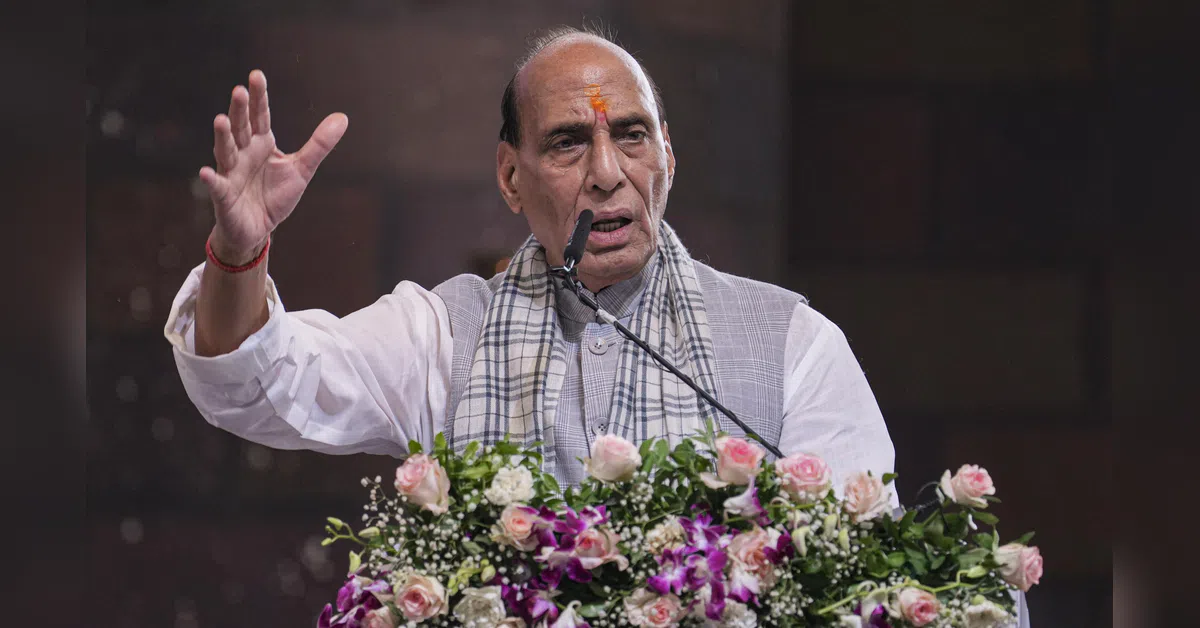
Defence Minister Rajnath Singh on Saturday said that while future wars may increasingly involve Artificial Intelligence (AI) and advanced technologies, victory will continue to depend on national resolve, well-trained soldiers and robust military capabilities. He made the remarks while addressing the INS Mahendragiri Commissioning ceremony in Visakhapatnam.
Speaking at the event, Singh said India is adopting a balanced approach to defence modernisation by investing in next-generation technologies while simultaneously strengthening its conventional military capabilities. He noted that modern warfare requires the integration of advanced technologies with traditional combat platforms rather than treating them as alternatives.
INS Mahendragiri Commissioning Strengthens Indian Navy
The INS Mahendragiri Commissioning marks another milestone in India’s defence self-reliance and indigenous shipbuilding programme. The newly inducted warship has been designed and built in India and is equipped with advanced combat systems, including indigenous rocket launchers, torpedo launchers, an Integrated Anti-Submarine Defence System, an Electronic Warfare Suite and a Close-In Weapon System.
Describing the vessel as a “blue-water warship,” Rajnath Singh said it is capable of tackling threats from the air, sea and underwater while protecting India’s maritime interests across the Indian Ocean Region and beyond.
Also read : India-New Zealand Ties Strengthen as PM Modi New Zealand Visit Highlights Growth and Trade
AI and Conventional Warfare Must Work Together
During the INS Mahendragiri Commissioning, the Defence Minister said emerging technologies such as Artificial Intelligence, drones, cyber warfare, hypersonic weapons and space-based capabilities are changing the nature of warfare. However, he stressed that conventional military strength remains the foundation of national defence.
He cited Operation Sindoor as an example of how conventional forces and modern technologies can effectively work together to safeguard India’s security.
According to Singh, future conflicts will require both technological superiority and capable armed forces, making investment in both areas equally important.
Maritime Security Key to Economic Growth
Highlighting the importance of maritime security, Singh said secure sea routes are essential for global trade, supply chains, energy security and economic growth. He reaffirmed the government’s commitment to the Security and Growth for All in the Region (SAGAR) vision for the Indo-Pacific.
Attended the Commissioning Ceremony of #INSMahendragiri in Visakhapatnam today.
The indigenously-built advanced stealth frigate ‘INS Mahendragiri’ is a reflection of India’s growing self-reliance in shipbuilding sector and its ability to deliver state-of-the-art platforms in a… pic.twitter.com/DUcmIKadNG
— Rajnath Singh (@rajnathsingh) July 11, 2026
The Defence Minister also praised the Indian Navy’s role in humanitarian assistance, anti-piracy operations and evacuation missions. Referring to Operation Urja Suraksha, he said the Navy safely escorted 18 merchant vessels carrying cargo worth over ₹9,000 crore during the recent West Asia conflict, protecting both national and economic interests.
Push for Defence Self-Reliance
The INS Mahendragiri Commissioning also reflects India’s growing focus on indigenous defence manufacturing. Singh said warship construction strengthens technological expertise, skilled manpower and the broader maritime industrial ecosystem while generating employment and encouraging innovation.
He highlighted initiatives such as Maritime India Vision 2030, the Maritime Development Fund, the Shipbuilding Financial Assistance Scheme and the Shipbuilding Development Scheme as key steps towards making India a global hub for shipbuilding and maritime defence innovation.
Calling upon young entrepreneurs, engineers, researchers and innovators to contribute to the defence sector, Singh said the INS Mahendragiri Commissioning represents another important step towards achieving self-reliance in defence and enhancing India’s naval capabilities for future security challenges.