
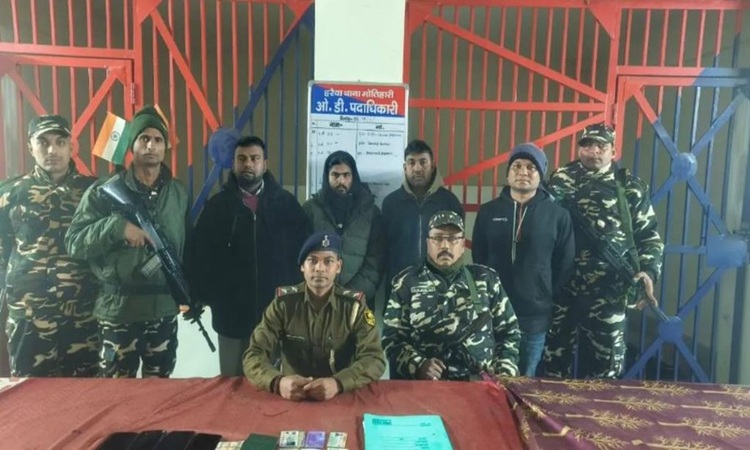
New Delhi : Indian security agencies have flagged a serious national security concern after arresting three Bangladeshi nationals attempting illegal entry into India via Nepal. The arrests took place along the India–Nepal border during a special New Year alert by the Sashastra Seema Bal (SSB). Officials also detained an Indian citizen, identified as Sarfaraz Ansari, who allegedly acted as a local guide for the group.
Experts now warn that the Nepal route has emerged as the easiest and most exploited entry point for Bangladeshi infiltrators. The development has triggered fresh concerns over border management, forged documents, and organised human trafficking networks operating across eastern India.
According to officials, the arrested Bangladeshi citizens were intercepted before they could blend into Indian territory. Authorities believe the group would have crossed undetected if the special alert had not been issued. The suspects are now under sustained questioning to uncover the full extent of the network involved.
Nepal Route Emerges as Preferred Entry Point for Infiltration
Security analysts say Nepal’s relatively simple visa regime has made it a convenient transit country for Bangladeshi nationals seeking illegal entry into India. Once inside Nepal, agents allegedly coordinate border crossings using local guides familiar with forest tracks and unmanned routes.
Investigators revealed that Sarfaraz Ansari played a critical role in guiding the group across the porous border. Police suspect he worked with multiple agents operating in nearby Indian districts. These operatives reportedly charge large sums for providing end-to-end support.
This support allegedly includes border crossing, transport, safe accommodation, and job placement. Cities such as Patna, Delhi, Mumbai, and Bengaluru often serve as final destinations. Officials said employment and housing arrangements are usually finalised even before the migrants enter India.
Experts also warned that such organised movement poses risks beyond illegal migration. It can facilitate forged identity creation, financial fraud, and even extremist infiltration. Therefore, authorities consider the Nepal corridor a growing internal security challenge.
Investigation Expands After Arrests Near India–Nepal Border
The arrested Bangladeshi nationals have been identified as Mohammad Olure Rahman, Mohammad Sofaz, and Mohammad Firoz. Officials confirmed that all three entered Nepal legally before attempting to cross into India illegally.
A joint team of the SSB and state police has launched a detailed investigation. The probe includes analysis of call detail records, Nepal stay histories, and Indian contacts. Agencies are also mapping routes frequently used by traffickers.
Officials stated that several infiltration and forged document cases have surfaced along the India–Nepal border in recent months. Human trafficking networks have also exploited the same corridors. Consequently, security forces are intensifying surveillance and coordination.
Authorities aim to identify active agents, financial handlers, and local facilitators. They are also reviewing border vulnerability points to prevent repeat incidents. Moreover, officials stressed that community intelligence will play a key role going forward.
Rising Security Concerns and Policy Challenges
Experts believe the latest arrests highlight structural gaps in border monitoring. While the India–Nepal border allows free movement, misuse by criminal networks remains a pressing issue. Security specialists have urged better data sharing and stronger ground-level vigilance.
Former officials also called for coordinated diplomatic engagement with Nepal and Bangladesh. They stressed that illegal migration networks thrive where enforcement gaps exist. Therefore, a multi-agency and cross-border approach is essential.
For now, authorities say heightened alerts will continue across sensitive border stretches. The investigation remains ongoing, and more arrests are possible as links emerge. The case has once again underlined how organised infiltration threatens internal security and social stability.