
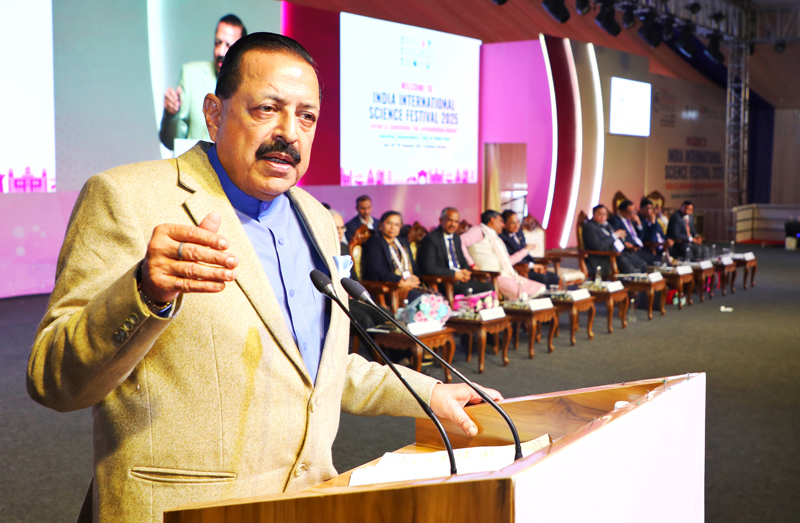
Dr. Jitendra Singh at IISF says India is now a global leader in innovation, space, nuclear, AI, and agri-tech, inspiring young entrepreneurs nationwide.
Dr. Jitendra Singh, Union Minister of State (Independent Charge) for Science & Technology, Minister of State in the Prime Minister’s Office, and Minister of State for the Departments of Atomic Energy and Space, stated at the 4-day India International Science Festival (IISF) currently taking place here that India has entered a pivotal phase in its evolution from a traditional economy to an innovation-driven nation and is now shaping global trends in technology-driven growth rather than following them.
During a special Fireside Chat at IISF, the Minister stated that India’s scientific temperament, policy direction, and governance style have fundamentally changed during the past ten years. He claimed that science, technology, research, and innovation are now clearly driving India’s economic growth and that the world community is beginning to view India as a source of new models for technology-led development, public service delivery, and governance.
India has always had talent, potential, and dedication, according to Dr. Jitendra Singh; the only things that have changed are the caliber of governmental backing and the clarity of the country’s mission. According to him, India is no longer lagging behind in technical advancements throughout the world and is currently taking the lead in a number of cutting-edge fields, such as biotechnology, nuclear innovation, regenerative sciences, and next-generation space technologies.
Also read : Swadeshi Rath Yatra Launched in Haryana; CM Saini Highlights Aatmanirbhar Bharat Initiatives
The Minister gave a lengthy speech at the festival regarding the establishment of the new national R&D fund, describing it as a revolutionary step to enable high-risk, high-impact innovation. According to him, this fund will assist business and research in fields like space and nuclear energy that were previously off-limits to private enterprises. He referred to the program as a “catalytic push” that aims to provide low-interest, long-term financial support to Indian business in order to help it develop long-term skills. This will allow enterprises to grow with confidence before they become powerful, independent contributors to India’s technological advancement.
The minister stated that even journalists were once prohibited from entering Sriharikota’s gates during rocket launches, reflecting on the beginning of the space industry. He claimed that since Prime Minister Narendra Modi took office, the number of space start-ups has dramatically increased from a few to about 400, many of which are now well-known worldwide. According to him, India is now achieving more than just rocket launches in space; it has set the standard for the use of space technologies in disaster relief, drinking water solutions, healthcare, and agriculture.
The same shift, he said, is evident in the nuclear industry, where advancements are now directly helping people through community water purification systems, cancer treatment networks, and other uses. He claimed that India’s achievements in space and nuclear power show how strategic technologies may significantly increase living standards.
According to Dr. Jitendra Singh, who spoke about India’s rising international prominence, young Indians now are treated with significantly more respect overseas than previous generations. He claimed that an Indian professional’s credibility in the job market instantly increases when he introduces himself abroad, a change he called a “complete reversal” of the circumstances two decades prior. He claimed that in recent months, delegations from various nations have traveled to India to learn about its grievance redressal systems, digital certification processes for senior citizens, and other innovations in public service, demonstrating how India has emerged as a leader in the development of globally applicable best practices.
The Minister said that the shift in work culture over the past ten years was largely responsible for the country’s newfound confidence. He claimed that programs like the Pradhan Mantri Awas Yojana and Ujjwala Yojana reflect a new spirit of inclusive democracy where benefits reach citizens without discrimination based on caste, religion, or political preference, and that the government now operates with greater purpose, accountability, and responsiveness. He claims that this change has restored public confidence in the government.
The minister added that the democratization of opportunity occurring throughout the nation is inextricably linked to India’s technical advancement. Young people from small towns and rural areas are now on an equal footing with those from large cities thanks to digital connectivity and reasonably priced information access. According to him, this shift is demonstrated by the shifting makeup of UPSC winners, who come from non-metropolitan places like Poonch and areas close to the Punjab-Haryana belt. One of India’s greatest strengths, he said, is the surge of aspiration from “Bharat.”
Dr. Jitendra Singh stated that sustainability is the true indicator of India’s innovative growth. Concepts must become successful businesses with solid ties to the market and industry. According to him, innovation cannot stay limited to idealism; it must also provide equity in society, financial stability, and dignity. He mentioned the emergence of lucrative agri-start-ups, such as businesses based on lavender, that were established by professionals who quit demanding corporate positions to create businesses that are both financially successful and meaningful.
ALso read ; Haryana CM Nayab Singh Saini Pushes for Vertical Farming, AI & Digital Governance in Agriculture
Dr. Jitendra Singh stated that India’s greatest asset, spanning generations, is its talent. He added that India will surprise the world in a number of fields, including space, and that within the next 15 to 20 years, an Indian would set foot on the moon. According to him, if artificial intelligence is managed sensibly and maturely, it will drastically change Indian daily life. His advice to young entrepreneurs was simple: take chances, look for solid business alliances, and fully utilize the connections and resources provided by the government.
Dr. Jitendra Singh stated that the goal of these platforms, as IISF continues in Panchkula, is to arouse curiosity, inspire confidence, and show that India is prepared to take the lead in the international scientific community. He claimed that India is in a far stronger and more prestigious position now than it has ever been in its recent history and that those who can successfully blend scientific creativity with national purpose will win the next ten years.