
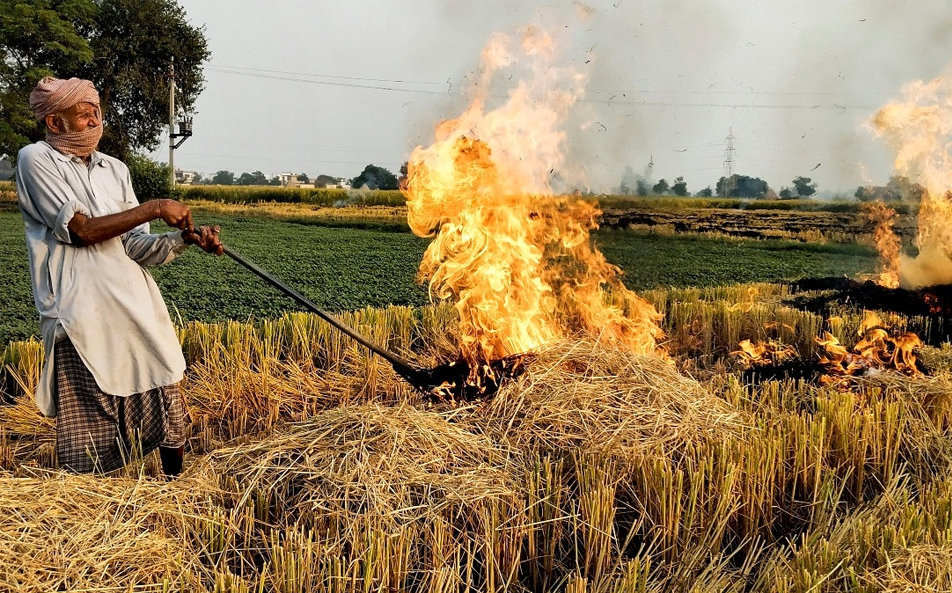
Haryana reports 77% drop in stubble burning, using sustainable farming, technology, and industrial straw use, aiming to be fire-free by 2027.
With impressive success in reducing crop residue burning, Haryana is on course to become a stubble burning-free state in the next two years. Only 171 fire occurrences were reported as of November 6, 2025, compared to 888 at the same period previous year, marking a 77 percent decrease in fire accidents this season, according to the state. Anurag Rastogi, the chief secretary of Haryana, gave this information following a high-level review meeting run by the chairperson of the Commission for Air Quality Management (CAQM), Sh. Rajesh Verma.
CAQM Chairperson Rajesh Verma praised the farmers’ and Haryana Government officials’ combined efforts to lower the number of stubble burning occurrences. He praised Kurukshetra and Karnal districts in particular for making great strides in reducing the burning of crop residue. He told the district administrations that the next 10 days are very important and that they must exercise severe caution to prevent any such stubble burning incidents in the state.
According to Chief Secretary Anurag Rastogi, Haryana’s three-pronged approach, which includes fodder use, ex-situ exploitation, and in-situ management, is producing excellent results throughout the state’s 39.31 lakh acres of paddy land. The residue is being managed in-situ for 44.40 lakh tonnes, ex-situ for 19.10 lakh tonnes, and for feed for 22 lakh tonnes. Direct Seeding of Rice (DSR) has been used by over 1.74 lakh farmers, greatly lowering water consumption and stubble production, while 19,670 acres have been diverted from paddy agriculture.
Also read : Bhagwant Mann Hands Over Appointment Letters to Young Punjab Job Seekers
The government has increased financial incentives to encourage sustainable farming techniques. These incentives include ₹4,500 per acre for DSR, ₹8,000 per acre for crop diversification, and ₹1,200 per acre for in-situ and ex-situ management. The entire amount allotted for these projects is ₹471 crore. With the technique being implemented on 2 lakh acres at CCS HAU, Hisar, free bio-decomposer powder is being provided. The Central Government and State Governments have jointly approved 7,781 machines valued at 94 crore under the Crop Residue Management (CRM) program for 2025–2026.
Mr. Rastogi highlighted Haryana’s advancements in the industrial use of paddy straw, stating that the state currently has two CBG plants, one 2G ethanol plant, five thermal power plants that use 16.64 lakh tonnes of paddy straw annually, 31 pelletization and briquetting plants with a combined capacity of 8.17 lakh tonnes annually, and 11 biomass power plants that generate 111.9 MW. Additionally, non-NCR districts’ brick kilns have been instructed to gradually employ pellets made from paddy straw, with a goal of 20% by 2025 and 50% by 2028.
Also read : Punjab Prepares for Tarn Taran Bye-Poll with 100% CCTV Coverage and CAPF Deployment
Haryana has deployed 10,028 nodal officers, he continued, and employs HARSAC’s satellite monitoring technology to detect fire occurrences in real time. All confirmed incidents are subject to environmental compensation and FIRs. Compensation of ₹4.60 lakh had been assessed in 87 cases as of November 6, with ₹3.35 lakh already recovered. Eighty-seven farm records have red entries. Between January and October 2025, the state issued 3,25,989 PUC challans and fined 285 noticeably polluting vehicles in ncr districts in an effort to reduce vehicle emissions. 101 of the 188 identified bottleneck locations have been cleared to cut down on idle emissions. Regarding garbage management, 169 waste-burning events that were discovered this year have been fully stopped by awareness and enforcement campaigns. 86 CCTV cameras are currently in place at dumpsites in Gurugram and Faridabad to guarantee prompt action in the event of a fire.